Home
Class 9
MATHS
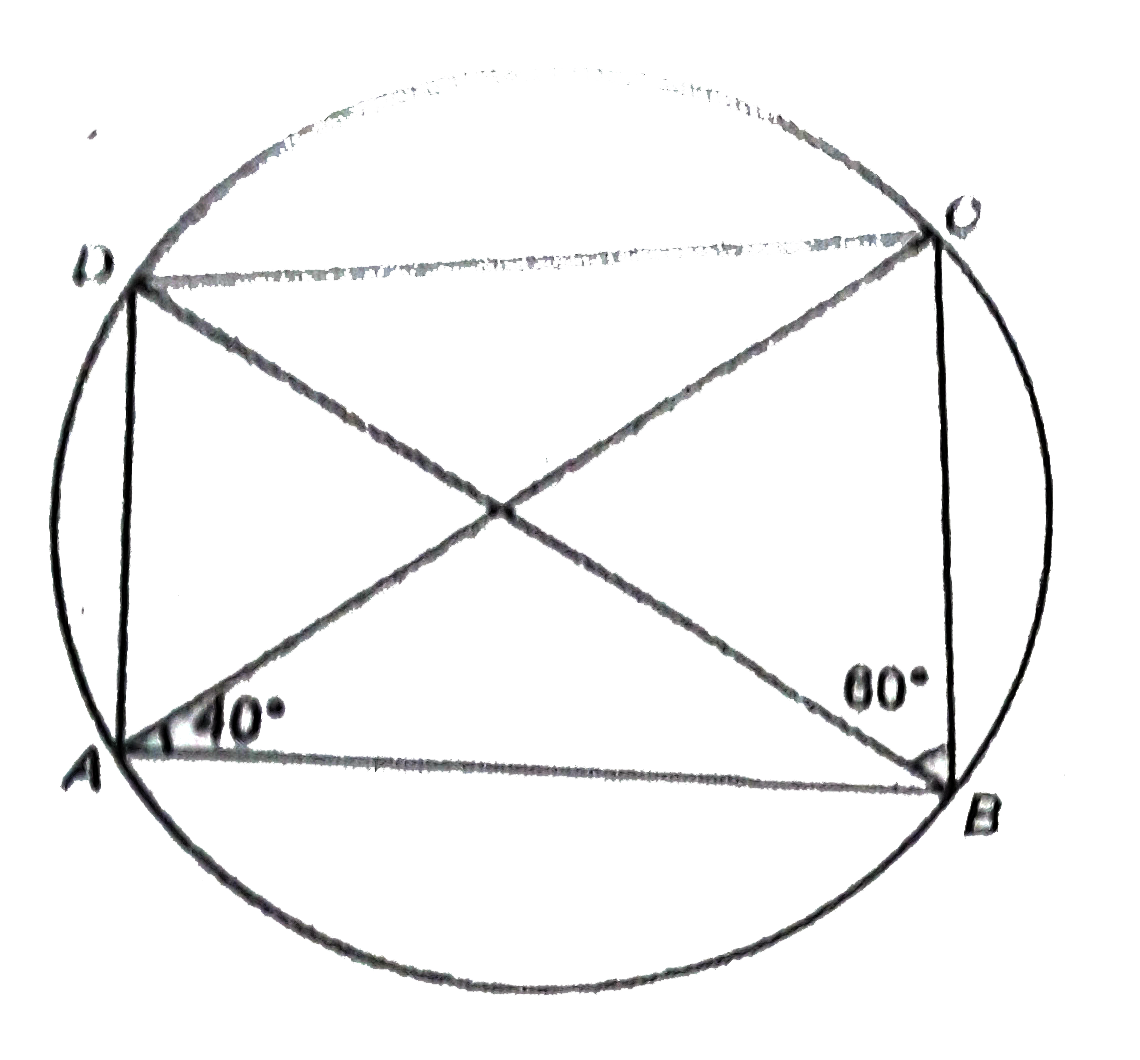
In the adjoining figure, ABCD is a cycli...

In the adjoining figure, `ABCD` is a cyclic quadrilateral. If `angleDBC=60^(@)` and `angleBAC=40^(@)` , then find the value of `angleBCD` .

Text Solution

Verified by Experts

Since, `ABCD` is a cyclic quadrilateral .
`thereforeangle DAC =angle DBC=60^@`
and ` angle DAB=angle DAC+angle CAB`
`=60^@+40^@`
`=100^@`
Now, `angle DAB+angle BCD=180^@`
`rArr100^@+angle BCD =180^@`
`angle BCD =180^@-100^@`
`=806@` .
Promotional Banner

Topper's Solved these Questions

  • CIRCLE

    NAGEEN PRAKASHAN|Exercise Exercise 10a|22 Videos
  • CIRCLE

    NAGEEN PRAKASHAN|Exercise Exercise 10b|19 Videos
  • AREA OF PARALLELOGRAMS AND TRIANGLES

    NAGEEN PRAKASHAN|Exercise Revision Exercise (long Answer Question)|5 Videos
  • CO-ORDINATE GEOMETRY

    NAGEEN PRAKASHAN|Exercise Exercise|8 Videos

Similar Questions

Explore conceptually related problems

In the adjoining figure, ABCD is a cyclic quadrilateral . If angleCBX=104^(@) and angleCAB=56^(@) , then find the value of angleADB .

In Fig , ABCD is a cyclic quadrilateral . If angleBAC = 50^@ and angleDBC = 60^@ then find angleBCD .

In the adjoining figure, if ABCD is a cyclic quadrilateral, find the value of x.

In the adjoining figure, ABCD is a cyclic quadrilateral.If side BC is produced upto point E and angleDAB=95^@ , then find the value of angleDCE .

In the given diagram ABCD is a cyclic quadrilateral angleOCB = 50 ^(@) and angleBOC = 110^(@) Find the value of angleDAO :

In the adjoining figure, ABCD is a cyclic quadrilateral and AB is the diameter of the circle. If angleAPC=120^@ , then find the value of angle CAB .

In the given figure, ABCD is a quadrilateral angleADB=60^(@), angleBAC=70^(@),angleDBC=30^(@) , and

In Figure,ABCD is a cyclic quadrilateral. Find the value of x

In the given figure, ABCD is a cyclic quadrilateral and AB is diameter. angleADC = 140^(@) , then find angleBAC :

In the adjoining figure, the area of quadrilateral ABCD is
