Home
Class 11
PHYSICS
A car weighs 1800 kg. The distance betwe...

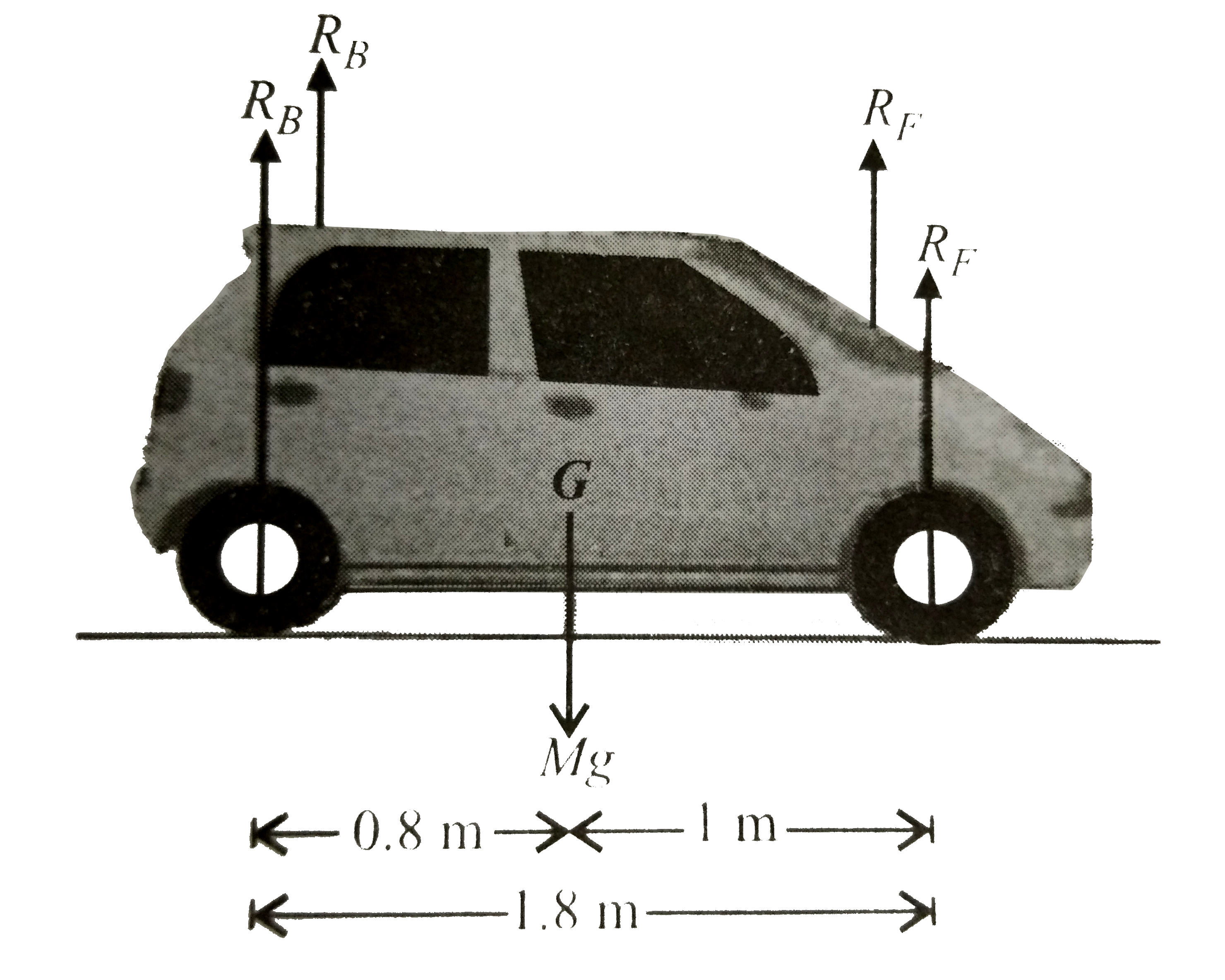
A car weighs `1800 kg`. The distance between its front and back axles is `1.8 m`. Its centre of gravity is `1.05 m` behind the front axle. Determine the force exerted by the level ground on each front wheel and each back wheel.

A

4000 N on each front wheel, 5000 N on each back wheel

B

5000 N on each front wheel, 4000 N an each back wheel

C

4500 N on each wheel, 4500 N on each back wheel

D

3000 N on each front wheel, 6000 N on each back wheel

Text Solution

Verified by Experts

The correct Answer is:
A

Here, mass of the car, M=1800 kg
Distance between front and back axles = 1.8 m
Distance of gravity G behind the front axle = 1m
Let `R_(F)` and `R_(B)` be the forces exerted by the level ground on each front wheel and each back wheel.

For translation equilibrium,
`2R_(F)+2R_(B)=M_(g)`
or `R_(F) + R_(B)= (Mg)/(2)= (1800 xx 10)/(2) = 9000N`............(i)
(As there are two front wheels and two back wheels)
For rotational equilibrium about G
`(2F_(F))(1) = (2R_(B))(0.8)=8/10=4/5 rArr R_(F)=4/5R_(B)`.............(ii)
Substituting this in Eq. (i), we get
`4/5R_(B)+R_(B)= 9000` or `9/5R_(B)=9000`
`R_(B)= (9000 xx 5)/(9) = 5000 N`
`therefore F_(F)= 4/5 F_(B) = 4/5 xx 5000 N=4000N`
Promotional Banner

Topper's Solved these Questions

  • SYSTEM OF PARTICLES AND ROTATIONAL MOTIONS

    NCERT FINGERTIPS|Exercise Moment Of Inertia|7 Videos
  • SYSTEM OF PARTICLES AND ROTATIONAL MOTIONS

    NCERT FINGERTIPS|Exercise Theorems Of Perpendicular And Parallel Axes|5 Videos
  • SYSTEM OF PARTICLES AND ROTATIONAL MOTIONS

    NCERT FINGERTIPS|Exercise Torque And Angular Momentum|11 Videos
  • PRACTICE PAPERS

    NCERT FINGERTIPS|Exercise Practice Paper 3|50 Videos
  • THERMAL PROPERTIES OF MATTER

    NCERT FINGERTIPS|Exercise Assertion And Reason|10 Videos

Similar Questions

Explore conceptually related problems

The radius of the front and rear wheels of a carriage are a and b, and c is the distance between the front an drear axles. A particle of dust driven from the highest point of the rear wheel is observed to alight on the highest point of the front wheel. Find the velocity of the carriage.

There is a man of mass 100 kg sitting on a motorbike of mass 150 kg. The distance of the axles of the wheels (wheelbase) is 1 . 5 m, the common mass center of the man and the motorbike is at a 1 m height above the ground level, and at a 0.6 m distance from the vertical line going through the rear axle. What acceleration is needed to lift the front wheel?

There is a man of mass 100 kg sitting on a motorbike of mass 150 kg. The distance of the axles of the wheels (wheelbase) is 1 . 5 m, the common mass center of the man and the motorbike is at a 1 m height above the ground level, and at a 0.6 m distance from the vertical line going through the rear axle. What normal force is exerted on the real wheel by the ground, when the motorbike starts off with an acceleration of a = 2 m//s^(2) ?

The centre of gravity of a car is at a height h and the distance between its wheel is 2a. The car moves on a level curve of radius r with speed v . Let N_(1) and N_(2) be the normal reactions on the inner and outer wheels of the car. Then

The tricycle weighing 20 kg has a small wheel symmmetrically placed 1m behind the two large wheels, which are also 1m apart. If the center of gravity of machine is at a horizontal distance of 25 cm behind the front wheels and the rider whose weight is 40 kg is 10 cm behind the front wheels. Then, the thrust on each front wheel is

What must be the minimum coefficient of friction mu between the tyres of the drive wheels of a car and the road, if the car and the road, if the car of mass m=2 tons and load M=4 tons, has an acceleration a=0.2 ms^(-2) ? Consider the problem for two cases : (a) all the wheels are driven , (b) only the rear wheels are driven. Assume that the centre of gravity of the car lies at the mid-point between the axes of the wheel and the centre of gravity of the load above the rear axle.

A motor car has a width 1.1m between wheels. Its centre of gravity is 0.62 m above the ground and the coefficient of friction between the wheels and the road is 0.8. What is the maximum possible speed, if the centre of gravity inscribes a circle of radius 15 m ? (Road surface is horizontal)

