

Home
Class 12
PHYSICS
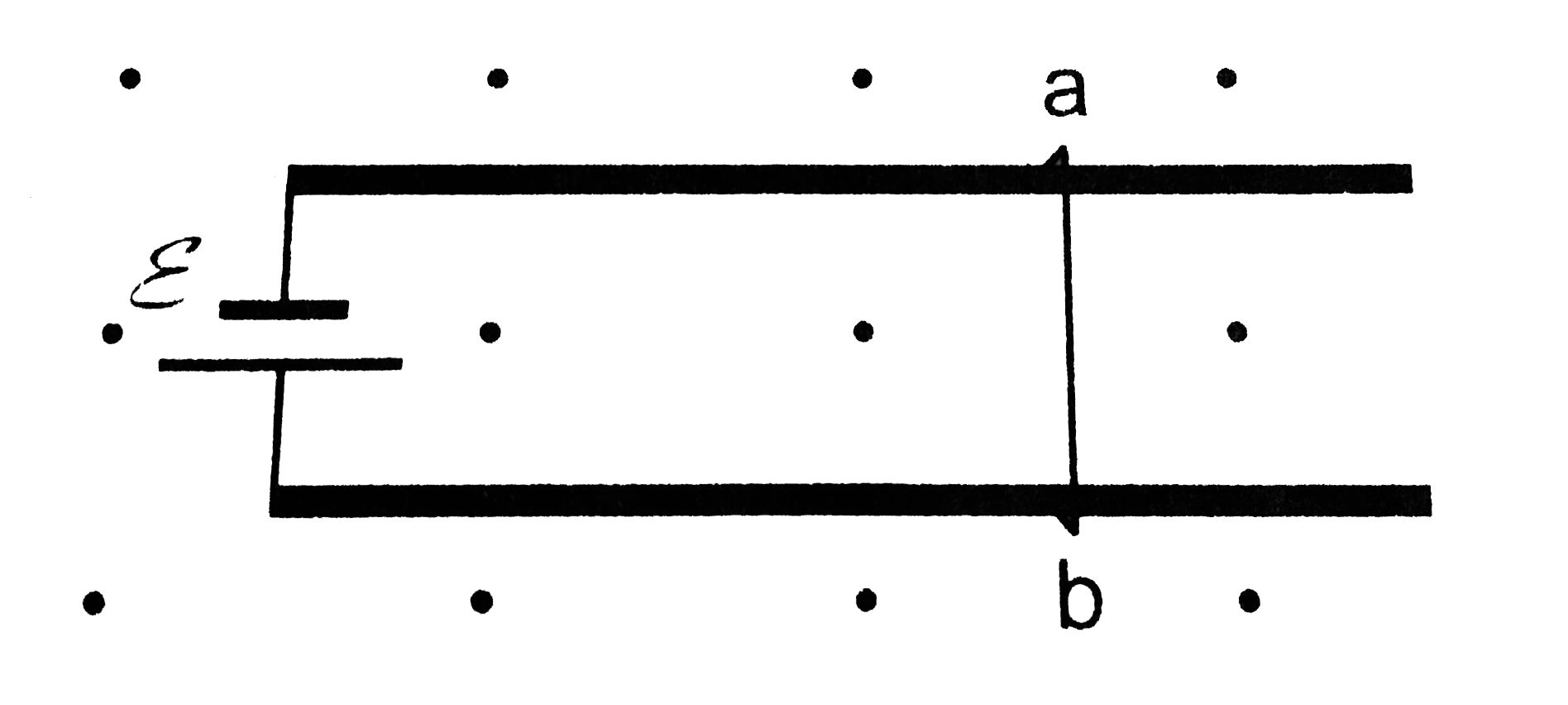
Shows a smooth pair of thick metallic ra...

Shows a smooth pair of thick metallic rails connected across a battery of emf `epsilon` having a negligible internal resistance. A wire ab of length l and resistance r can slide smoothly on the rails. The entire system lien in a horizontal plane and is immersed in a uniform vertical magnetic field B. At an instant t, the wire is given a small velocity v towards right. (a) find the current in it at this instant. What is the direction of the current? (b) What is the force acting on the wire at this instant? (c) Show that after some time the wire ab will slide with a constant velocity. Find this velocity.

Promotional Banner

Similar Questions

Explore conceptually related problems

Figure showns a smooth pair of thick metallic rails connected across a battery of emf epsilon having a negligible internal resistance.A wire ab of length l and resistance r can slide smoothly on the rails.The entire system lies in a horizontal plane and is immersed in a uniform vertical magnetic field B .At an instant t the wire at this instant. (b)What is the force acting on the wire at this instant. (c)Show that after some time the wire ab will slide with a constant velocity.Find this velocity.

Shows a wire ab of length l and resistance R which can slide on a smooth pair of rails. I_g is a current generator which supplies a constand current in in the circuit. If the wire ab slides at a speed v towards right, find the potential difference betwwen a and b .

Shows a wire ab of length l and resistance R which can slide on a smooth pair of rails. I_g is a current generator which supplies a constand current in in the circuit. If the wire ab slides at a speed v towards right, find the potential difference betwwen a and b .

The current generator i_g , shown in , sends a constant current I through the circuit. The wire ab has a length l and mass m and can slide on the smooth, horizontal rails connected to l_g . The entire system lies in a vertical magnetic field B. Find velocity of the wire as a function of time.

The current generator i_g , shown in , sends a constant current I through the circuit. The wire ab has a length l and mass m and can slide on the smooth, horizontal rails connected to l_g . The entire system lies in a vertical magnetic field B. Find velocity of the wire as a function of time.

A rod of mass m , length l and resistance R is sliding down on a smooth inclined parallel rails with a cinstant velocity v . If a uniform horizontal magnetic field B exists, then find thevalue of B .

A rod of mass m , length l and resistance R is sliding down on a smooth inclined parallel rails with a cinstant velocity v . If a uniform horizontal magnetic field B exists, then find thevalue of B .

A wire ab of length l, mass m and resistance R slides on a smooth thick pair of metallic rails joined at the bottom as shown in fig. The plane of the rails makes an angle theta with the horizontal. A vertical magnetic field B exist in the region. If the wire slides on the rails at a constant speed v, then the value of B is -

A wire ab of length l, mass m and resistance R slided on a smooth, thick pair of metallic rails joined at the bottom as shown in . The plane of the the rails makes an angle theta with the horizontal. A vertical magnetic field B exists in the ragion. if the wire slides on the rails at a constant speed v, show that B = sqrt(mg R sin theta)/(vl^2 cos^theta) .

A conducting wire ab of length l, resistance r and mass m starts sliding at t = 0 down a smooth, vertical, thick pair of connected rails as shown in . A uniform magnetic field B exists in the space in a diraction perpendicular to the plane of the rails. (a) Write the induced emf in the loop at an instant t when the speed of the wire is v. (b) what would be the magnitude and direction of the induced current in the wire? (c) Find the downward acceleration of the wire at this instant. (d) After sufficient time, the wire starts moving with a constant velocity. Find this velocity v_m. (e) Find the velocity of the wire as a function of time. (f) Find the displacement of the wire as a functong of time. (g) Show that the rate of heat developed inte wire is equal to the rate at which the gravitational potential energy is decreased after steady state is reached.