Home
Class 12
PHYSICS
A bead of mass m can slide without frict...

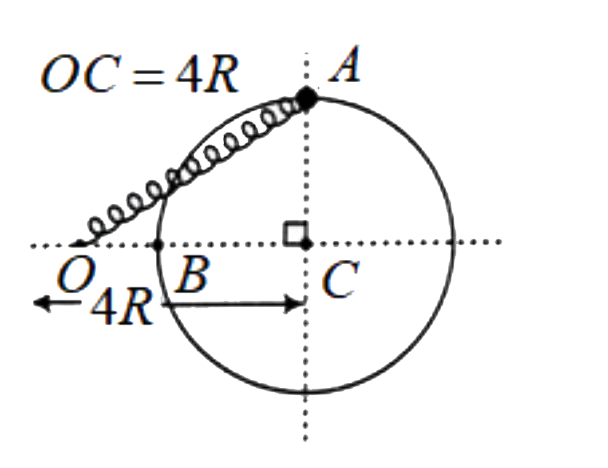
A bead of mass m can slide without friction on a fixed circular horizontal ring of radius 3R having a centre at the point C. The bead is attached to one of the ends of spring of spring constant k. Natural length of spring is R and the other end of the spring is R and the other end of the spring is fixed at point O as shown in the figure. If the bead is released from position A, then the kinetic energy of the bead when it reaches point B is

A

`25/2kR^2`

B

`9/2kR^2`

C

`8kR^2`

D

`12kR^2`

Text Solution

Verified by Experts

The correct Answer is:

C
Promotional Banner

Topper's Solved these Questions

  • NTA NEET SET 74

    NTA MOCK TESTS|Exercise PHYSICS|45 Videos
  • NTA NEET SET 76

    NTA MOCK TESTS|Exercise PHYSICS|45 Videos

Similar Questions

Explore conceptually related problems

A Bead of mass m is attached to one end of a spring of natural length 'R' and spring cosntant 'k=((sqrt3+1)mg)/R' . The other end of the spring is fixed at point 'A' on a smooth vertical ring of radius 'R' as shown

A spring has natural length 40 cm and spring constant 500 N//m . A block of mass 1 kg is attached at one end of the spring and other end of the spring is attached to a ceiling. The block is relesed from the position, where the spring has length 45 cm .

A ring of mass m is attached to a horizontal spring of spring constant k and natural length l_0 . The other end of the spring is fixed and the ring can slide on a horizontal rod as shown. Now the ring is shifted to position B and released Find the speed of the ring when the spring attains its natural length.

A bead of mass m is attached to one end of a spring of natural length R and spring constant K=((sqrt(3)+1)mg)/(R ) . The other end of the spring is fixed at a point A on a smooth vertical ring of radius R as shown in fig. The normal reaction at B just after it is released to move is

A bead of mass 'm' is attached to one end of a spring of natural length R & spring constant k = ((sqrt3 + 1))/(R) . The other end of the spring is fixed at point A on a smooth vertical ring of radius R as shown. The normal reaction at B just after it is released to move is

A block of mass 'm' is attached to a spring in natural length of spring constant 'k' . The other end A of the spring is moved with a constat velocity v away from the block . Find the maximum extension in the spring.

A ring of mass m can slide over a smooth vertical rod as shown in figure. The ring is connected to a spring of force constant k = 4 mg//R , where 2R is the natural length of the spring . The other end of spring is fixed to the ground at a horizontal distance 2R from base of the rod . If the mass is released at a height 1.5 J then the velocity of the ring as it reaches the ground is

A bead of mass m slides without friction on a vertical hoop of radius R . The bead moves under the combined influence of gravity and a spring of spring constant k attached to the bottom of the hoop. For simplicity assume, the equilibrium length of the spring to be zero. The bead is released at the top of the hoop with negligible speed as shown . The bead, on passing the bottom point will have a velocity of :

A small block of mass m, can move without friction on the outside of a fixed vertical circular track of radiusR. The block is attached to a spring of natural length R//2 and spring constant K. The other end of spring is connected to a point at height R//2 directly above the centre of track. Consider block to be at rest at top most point A of track. If the block is slowly pushed from rest at the highest A. When the spring reaches in horizontal state, then.

A small block of mass m, can move without friction on the outside of a fixed vertical circular track of radiusR. The block is attached to a spring of natural length R//2 and spring constant K. The other end of spring is connected to a point at height R//2 directly above the centre of track. If the block is released from rest when the spring is in horizontal state (see figure) then at that moment,

NTA MOCK TESTS-NTA NEET SET 75-PHYSICS
  1. .^(65)Cu will turn into .^(66)Cu if it is bombarded will

    Text Solution

    |

  2. If a simple pendulum oscillates with an amplitude of 50 mm and time pe...

    Text Solution

    |

  3. The frequency of an open organ pipe is n. If one of its ends is closed...

    Text Solution

    |

  4. Calculate de Broglie wavelength associated with an electron, accelerat...

    Text Solution

    |

  5. In photoelectric emission process from a metal of work function 1.8 eV...

    Text Solution

    |

  6. Two mercury drops (each of radius r) merge to form a bigger drop. The ...

    Text Solution

    |

  7. A U-shaped wire is dipped in a soap solution, and removed. A thin soap...

    Text Solution

    |

  8. Consider the show glass slab having a thin biconvex cavity of air cent...

    Text Solution

    |

  9. A ray of light is incident on a surface of glass slab at an angle 45^@...

    Text Solution

    |

  10. A thin horizontal circular disc is roating about a vertical axis passi...

    Text Solution

    |

  11. The average value of rotational kinetic energy of one mole of oxygen g...

    Text Solution

    |

  12. In a common emitter transistor amplifier, beta=60, R(0)=5000Omega and ...

    Text Solution

    |

  13. Currents flowing in each of the following circuits A and B respectivel...

    Text Solution

    |

  14. A brass wire 2 m long at 27^@C is held taut with negligible tension be...

    Text Solution

    |

  15. Identify the pair whose dimensions are equal

    Text Solution

    |

  16. In a system of two polarisers , it is found that the intensity of ligh...

    Text Solution

    |

  17. A two slit Young's interference experiment it done with monochromatic ...

    Text Solution

    |

  18. A closed organ pipe and an open organ pipe have their first overtones ...

    Text Solution

    |

  19. A progressive wave is represented by y = 12 sin (5t - 4x) cm. On this ...

    Text Solution

    |

  20. A bead of mass m can slide without friction on a fixed circular horizo...

    Text Solution

    |
