Home
Class 12
PHYSICS
A monochromatic plane wave of speed c an...

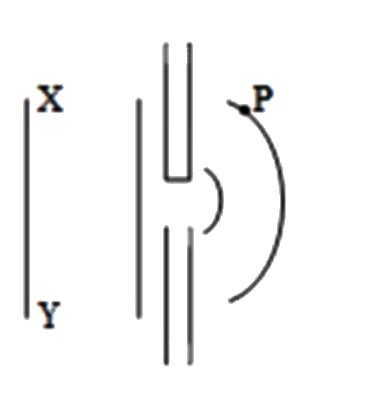
A monochromatic plane wave of speed c and wavelength `lamda` is diffracted at a small aperture . The diagram illustrates successive wavefront. After what time will some portion of the wavefront XY reach P ?

A

`(3lambda)/(2c)`

B

`(2lambda)/(c)`

C

`(3lambda)/(c)`

D

`(4lambda)/(c)`

Text Solution

Verified by Experts

The correct Answer is:

C
Promotional Banner

Topper's Solved these Questions

  • NTA JEE MOCK TEST 98

    NTA MOCK TESTS|Exercise PHYSICS|24 Videos
  • NTA NEET SET 100

    NTA MOCK TESTS|Exercise PHYSICS|45 Videos

Similar Questions

Explore conceptually related problems

Plane parallel wavefornts encounter the interference one medium and another as shown below The wave speed is different in the two media. what will happen to the distance between wavefront and the direction of travel wavefronts as the waves enter the second media?

Huygen was the figure scientist who proposed the idea of wave theory of light he said that the light propagates in form of wavelengths. A wavefront is a imaginary surface of every point of which waves are in the same. phase. For example the wavefront for a point source of light is collection of concentric spheres which have centre at the origin w_(1) is a wavefront w_(2) is another wavefront. The radius of the wavefront at time 't' is 'ct' in thic case where 'c' is the speed of light the direction of propagation of light is perpendicular to the surface of the wavelength. the wavefronts are plane wavefronts in case of a parallel beam of light. Huygen also said that every point of the wavefront acts as the source of secondary wavelets. The tangent drawn to all secondary wavelets at a time is the new wavefront at that time. The wavelets are to be considered only in the forward direction (i.e., the direction of propagation of light) and not in the reverse direction if a wavefront w_(1) and draw spheres of radius 'cDeltat' they are called secondary wavelets. Draw a surface w_(2) which is tangential to all these secondary wavelets w_(2) is the wavefront at time t+Deltat Huygen proved the laws of reflection and laws of refraction using concept of wavefront. Q. A point source of light is placed at origin, in air. the equation of wavefront of the wave at time t, emitted by source at t=0 is (take refractive index of air as 1)

Huygen was the figure scientist who proposed the idea of wave theory of light he said that the light propagates in form of wavelengths. A wavefront is a imaginary surface of every point of which waves are in the same. phase. For example the wavefront for a point source of light is collection of concentric spheres which have centre at the origin w_(1) is a wavefront w_(2) is another wavefront. The radius of the wavefront at time 't' is 'ct' in thic case where 'c' is the speed of light the direction of propagation of light is perpendicular to the surface of the wavelength. the wavefronts are plane wavefronts in case of a parallel beam of light. Huygen also said that every point of the wavefront acts as the source of secondary wavelets. The tangent drawn to all secondary wavelets at a time is the new wavefront at that time. The wavelets are to be considered only in the forward direction (i.e., the direction of propagation of light) and not in the reverse direction if a wavefront w_(1) and draw spheres of radius 'cDeltat' they are called secondary wavelets. Draw a surface w_(2) which is tangential to all these secondary wavelets w_(2) is the wavefront at time t+Deltat Huygen proved the laws of reflection and laws of refraction using concept of wavefront. Q. Wavefronts incident on an interface between the media are shown in the figure. the refracted wavefront will be as shown in

Huygen was the figure scientist who proposed the idea of wave theory of light he said that the light propagates in form of wavelengths. A wavefront is a imaginary surface of every point of which waves are in the same. phase. For example the wavefront for a point source of light is collection of concentric spheres which have centre at the origin w_(1) is a wavefront w_(2) is another wavefront. The radius of the wavefront at time 't' is 'ct' in thic case where 'c' is the speed of light the direction of propagation of light is perpendicular to the surface of the wavelength. the wavefronts are plane wavefronts in case of a parallel beam of light. Huygen also said that every point of the wavefront acts as the source of secondary wavelets. The tangent drawn to all secondary wavelets at a time is the new wavefront at that time. The wavelets are to be considered only in the forward direction (i.e., the direction of propagation of light) and not in the reverse direction if a wavefront w_(1) and draw spheres of radius 'cDeltat' they are called secondary wavelets. Draw a surface w_(2) which is tangential to all these secondary wavelets w_(2) is the wavefront at time t+Deltat Huygen proved the laws of reflection and laws of refraction using concept of wavefront. Q. Spherical wavefronts shown in figure, strike a plane mirror. reflected wavefront will be as shown in

Huygen was the figure scientist who proposed the idea of wave theory of light he said that the light propagates in form of wavelengths. A wavefront is a imaginary surface of every point of which waves are in the same. phase. For example the wavefront for a point source of light is collection of concentric spheres which have centre at the origin w_(1) is a wavefront w_(2) is another wavefront. The radius of the wavefront at time 't' is 'ct' in thic case where 'c' is the speed of light the direction of propagation of light is perpendicular to the surface of the wavelength. the wavefronts are plane wavefronts in case of a parallel beam of light. Huygen also said that every point of the wavefront acts as the source of secondary wavelets. The tangent drawn to all secondary wavelets at a time is the new wavefront at that time. The wavelets are to be considered only in the forward direction (i.e., the direction of propagation of light) and not in the reverse direction if a wavefront w_(1) and draw spheres of radius 'cDeltat' they are called secondary wavelets. Draw a surface w_(2) which is tangential to all these secondary wavelets w_(2) is the wavefront at time t+Deltat Huygen proved the laws of reflection and laws of refraction using concept of wavefront. Q. Certain plane wavefronts are shown in figure the refractive index of medius is

Huygen was the figure scientist who proposed the idea of wave theory of light he said that the light propagates in form of wavelengths. A wavefront is a imaginary surface of every point of which waves are in the same. phase. For example the wavefront for a point source of light is collection of concentric spheres which have centre at the origin w_(1) is a wavefront w_(2) is another wavefront. The radius of the wavefront at time 't' is 'ct' in thic case where 'c' is the speed of light the direction of propagation of light is perpendicular to the surface of the wavelength. the wavefronts are plane wavefronts in case of a parallel beam of light. Huygen also said that every point of the wavefront acts as the source of secondary wavelets. The tangent drawn to all secondary wavelets at a time is the new wavefront at that time. The wavelets are to be considered only in the forward direction (i.e., the direction of propagation of light) and not in the reverse direction if a wavefront w_(1) and draw spheres of radius 'cDeltat' they are called secondary wavelets. Draw a surface w_(2) which is tangential to all these secondary wavelets w_(2) is the wavefront at time t+Deltat Huygen proved the laws of reflection and laws of refraction using concept of wavefront. Q. Plane are incident on a spherical mirror as shown in the figure. the reflected wavefronts will be

NTA MOCK TESTS-NTA JEE MOCK TEST 99-PHYSICS
  1. The coefficient of linear expansion of an in homogeneous rod change li...

    Text Solution

    |

  2. A monochromatic plane wave of speed c and wavelength lamda is diffract...

    Text Solution

    |

  3. The x-z plane separates two media A and B of refractive indices mu(1) ...

    Text Solution

    |

  4. A particle executing SHM has a maximum speed of 0.5ms^(-1) and maximum...

    Text Solution

    |

  5. A small sphere of mass m suspended by a thread is first taken a side s...

    Text Solution

    |

  6. The surface of a metal is illuminated with the light of 400 nm The kin...

    Text Solution

    |

  7. The cylindrical tube of a spray pump has a cross-section of 8 cm^2, on...

    Text Solution

    |

  8. There are two waves having wavelength 100 cm and 101 cm and same veloc...

    Text Solution

    |

  9. An artificial satellite is made to move in circular orbits of differen...

    Text Solution

    |

  10. The figure shows two isotherms at temperatures T(1) and T(2). A gas is...

    Text Solution

    |

  11. A uniform solid cylindrical roller of mass 'm' is being pulled on a ho...

    Text Solution

    |

  12. Two spherical black bodies of radii R(1) and R(2) and with surface tem...

    Text Solution

    |

  13. A particle moves in space along the path z=ax^(3)+by^(2) in such a way...

    Text Solution

    |

  14. The radius of the Earth is 6400 km. If the height of an antenna is 500...

    Text Solution

    |

  15. The deceleration experienced by a moving motor boat, after its engine ...

    Text Solution

    |

  16. The relationship between the force F and position x of body is as show...

    Text Solution

    |

  17. Let lambda(alpha'), lambda(beta),and lambda'(alpha) denote the wavele...

    Text Solution

    |

  18. The values of two resistors are R(1)=(6+-0.3)kOmega and R(2)=(10+-0.2)...

    Text Solution

    |

  19. If the slab is brought inside the parallel plate capacitor with a spee...

    Text Solution

    |

  20. An arc of a circular loop of radius R is kept in the horizontal plane ...

    Text Solution

    |
