Home
Class 12
CHEMISTRY
In the hober's process of ammonia manufa...

In the hober's process of ammonia manufacture,
`N_(2)(g)+3H_(2)(g) rarr2NH_(3)(g)`
the rate of appearance of `NH_(3)` is :
`(d[NH_(3)])/(dt)=2xx10^(-4)"mol" L^(-1)"sec"^(-1)`
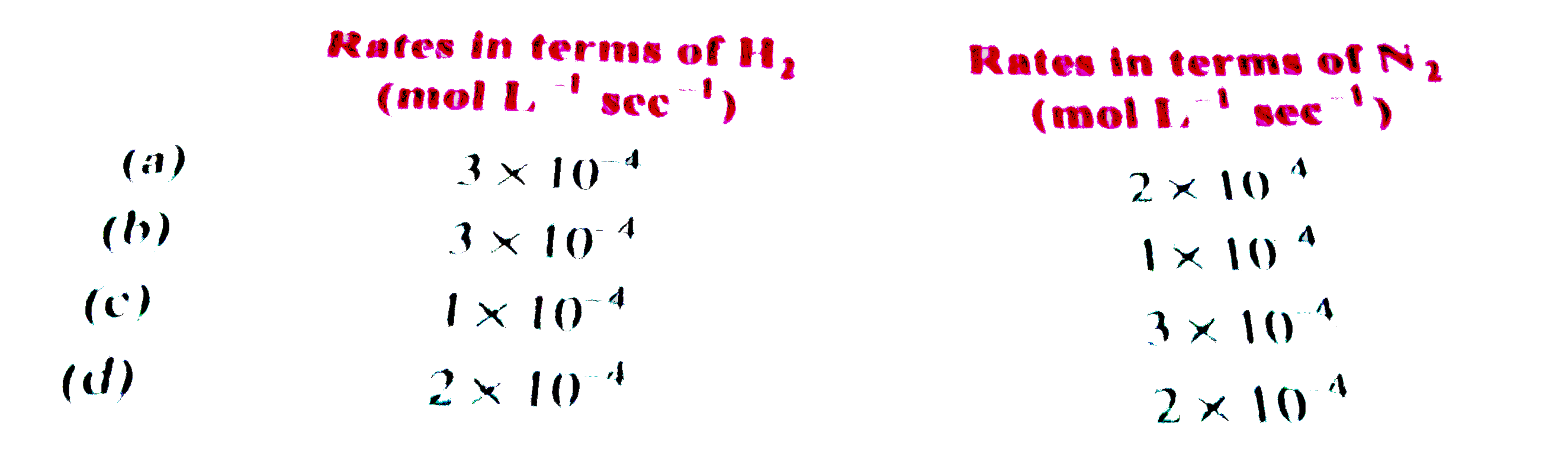
The rates of the reaction expressed in terms of `N_(2) and H_(2)` will be :

A

`{:(3xx10^(-4),2xx10^(-4)):}`

B

`{:(3xx10^(-4),1xx10^(-4)):}`

C

`{:(1xx10^(-4),3xx10^(-4)):}`

D

`{:(2xx10^(-4),2xx10^(-4)):}`

Text Solution

Verified by Experts

The correct Answer is:

B
Promotional Banner

Topper's Solved these Questions

  • NTA NEET SET 88

    NTA MOCK TESTS|Exercise CHEMISTRY|45 Videos
  • NTA NEET SET 90

    NTA MOCK TESTS|Exercise CHEMISTRY|45 Videos

Similar Questions

Explore conceptually related problems

In a reaction N_(2(g))+3H_(2(g))to2NH_(3(g)) rate of appearance of NH_(3) is 2.5xx10^(-4)molL^(-1)sec^(-1) then rate of reaction and rate of disappearance of H_(2) respectively is :-

In a catalyst experiment involving the Haber process N_(2) + 3H_(2) rarr 2NH_(3) , the rate of reaction was measured as Rate = (Delta[NH_(3)])/(Delta t) = 2.0 xx 10^(-4) mol L^(-1) s^(-1) What is the rate of reaction expressed in terms of (a) N_(2) (b) H_(2) ?

The standard enthyalpy of N_(2(g))+3H_(2(g)rarr2NH_(3(g)) is

In a catalytic experiment involving Haber's process, N_(2)(g)+3" H"_(2)(g)to2" NH"_(3)(g) , the rate of reaction was measured as : Rate =(d[NH_(3)])/(dt)=2.0xx10^(-4)"M s"^(-1) . If there were no side reactions, what was the rate of reaction expressed in terms of N_(2) ?

In a catalytic reaction involving the formation of ammonia by Haber's process N_(2)+3H_(2)rarr 2NH_(3) the rate of appearance of NH_(3) was measured as 2.5xx10^(-4) mol L^(-1)s^(-1) The rate of disappearance of H_(2) will be

The commercial poduction of ammonia is represented by the equation, N_(2)(g)+3H_(2)(g)rarr2NH_(3)(g) . If the rate of disappearance of H_(2)(g) is 1.2xx10^(-3) mol/min, what is the rate of appearance of NH_(3)(g) ?

For the reaction, 4NH_(3(g))+5O_(2(g))rarr 4NO_((g))+6H_(2)O_((g)) , the rate of reaction in terms of disappearance of NH_(3) is -(d[NH_(3)])/(dt) , then write the rate expression in terms of concentration of O_(2), NO and H_(2)O .

For the reaction : N_(2)(g)+3H_(2)(g)rarr2NH_(3)(g) . If rate of appearance of NH_(3) is 6.8xx10^(-3) gm/min, then rate of disappearance of H_(2)(g) at the same condition will be :

NTA MOCK TESTS-NTA NEET SET 89-CHEMISTRY
  1. Ph-CHO+Ph-CHOoverset(Na(2)[Fe(CO)(4)])rarrPh-overset(O)overset("||")C-...

    Text Solution

    |

  2. Depletion of ozone layer causes

    Text Solution

    |

  3. Among the carbonates of alkali metals which one has highest thermal st...

    Text Solution

    |

  4. The efficiency of a hypothetical cell is about 84% which involves the ...

    Text Solution

    |

  5. An acid solution of pH=6 is diluted 1000 times, the pH of the final so...

    Text Solution

    |

  6. The number of aromatic structures possible for the molecular formula C...

    Text Solution

    |

  7. Which of the following alkenes is the most stable ?

    Text Solution

    |

  8. During micelle formation :

    Text Solution

    |

  9. The graph between log t(1//2) and log a at a given temperature is ...

    Text Solution

    |

  10. Consider the following reaction CH3-underset((A))(CH2)-O-H+CH3-underse...

    Text Solution

    |

  11. In the given reaction [C6H5-CH2-CH2-overset(o+)(N)(CH3)2-CH2-CH3]overs...

    Text Solution

    |

  12. Select correct statement for Cr. 6NH3.Cl3 and Cr.5NH2.Cl3

    Text Solution

    |

  13. In the reaction CH(3)-C-=C-Hoverset(CH(3)MgBr)toCH(4)+(A)underset((i...

    Text Solution

    |

  14. In the hober's process of ammonia manufacture, N(2)(g)+3H(2)(g) rarr...

    Text Solution

    |

  15. The period number and group number of "Tantalum" (Z=73) are respective...

    Text Solution

    |

  16. Which of the following will not form Grignard reagent with Mg/dry ethe...

    Text Solution

    |

  17. A certain sample of cuprous sulphide is found to have composition Cu(1...

    Text Solution

    |

  18. The product of the reaction CHO+(C6H5-CHCO)2Ooverset(C6H5-CH2COONa//D...

    Text Solution

    |

  19. Which one of the following behaves both as a nucleophile and an electr...

    Text Solution

    |

  20. Here the compound Y is

    Text Solution

    |
