

Home
Class 12
CHEMISTRY
Which of the following will violates Auf...

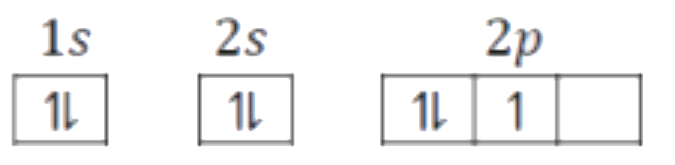
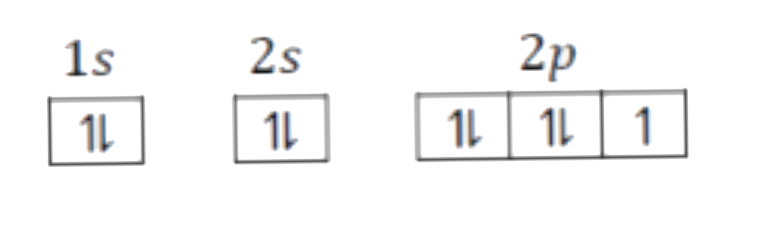
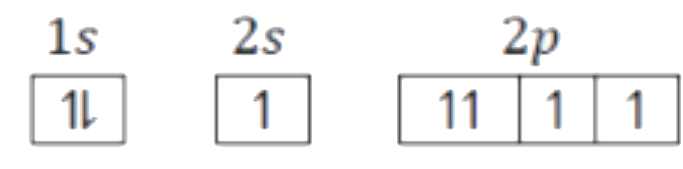
Which of the following will violates Aufbau principle as well as Pauli's exclusion principle ?

A

B

C

D

None of the above

Text Solution

AI Generated Solution

The correct Answer is:
To determine which option violates both the Aufbau principle and Pauli's exclusion principle, we need to understand what these principles state: 1. **Aufbau Principle**: This principle states that electrons occupy orbitals in order of increasing energy levels. The order of filling is typically: - 1s, 2s, 2p, 3s, 3p, 4s, 3d, 4p, etc. - This means that an electron will fill the lowest energy orbital available before moving to a higher energy orbital. 2. **Pauli's Exclusion Principle**: This principle states that no two electrons in an atom can have the same set of four quantum numbers. In simpler terms, if two electrons occupy the same orbital, they must have opposite spins. Now, let's analyze the options provided (let's assume options A, B, C, and D are given): ### Step-by-Step Solution: 1. **Examine Each Option**: - For each option, check the order of filling of the orbitals to see if it follows the Aufbau principle. - Check if any pair of electrons in the same orbital have the same spin, which would violate Pauli's exclusion principle. 2. **Option A**: - Check the filling order. If it follows the sequence of 1s, 2s, 2p, etc., then it adheres to the Aufbau principle. - Check the spins of electrons in any filled orbitals. If they are opposite, it adheres to Pauli's principle. 3. **Option B**: - Repeat the same checks as in Option A. 4. **Option C**: - Check the filling order. If it skips 2s and fills 2p first, it violates the Aufbau principle. - Check the spins of the electrons in the same orbital. If they have the same spin, it violates Pauli's exclusion principle. 5. **Option D**: - Again, check the filling order and the spins of electrons. 6. **Conclusion**: - After analyzing all options, if Option C is the only one that violates both principles, then it is the correct answer. ### Final Answer: - **Option C** violates both the Aufbau principle and Pauli's exclusion principle.
Promotional Banner

Topper's Solved these Questions

  • NTA NEET SET 89

    NTA MOCK TESTS|Exercise CHEMISTRY|45 Videos
  • NTA NEET SET 91

    NTA MOCK TESTS|Exercise CHEMISTRY|45 Videos

Similar Questions

Explore conceptually related problems

Which of the following violates the Aufbau principal ?

Pauli's exclusion principle states that

Pauli exclusion principle states that

Which of the following sequeous is correct as pe Aufbau principle ?

Pauli's exculsion principle states that :

Q.22 (b) :-The principle state that the value of four quantum numbers for a electron in a multi-electron atom will not be same is: i. Aufbau principle ii. Pauli's exclusion principle iii. Hund's Rule iv. None of above

NTA MOCK TESTS-NTA NEET SET 90-CHEMISTRY
  1. Which of the following 0.1 M complex compound solutions will hav...

    Text Solution

    |

  2. Which of the following is an amorphous substance ?

    Text Solution

    |

  3. Which of the following will violates Aufbau principle as well as Pauli...

    Text Solution

    |

  4. Hexachloroethane is also called

    Text Solution

    |

  5. In a reaction RCHO is reduced to RCH(3) usig amalgamated zinc and cenc...

    Text Solution

    |

  6. The products formed in the following reaction C(6)H(5)-O-CH(3)+HI ov...

    Text Solution

    |

  7. Terylene is a polymer obtianed from

    Text Solution

    |

  8. Aspirin is chemically :

    Text Solution

    |

  9. The IUPAC name of K4[Fe(CN)6] is

    Text Solution

    |

  10. For the combustion of n-octane C(8)H(18)+O(2)rarrCO(2)+H(2)O at 25^(...

    Text Solution

    |

  11. Which one is the electron deficient compound ?

    Text Solution

    |

  12. The IUPAC name of tertiary butyl chloride is

    Text Solution

    |

  13. Isomers which can be interconverted through rotation around a single b...

    Text Solution

    |

  14. An aqueous solution contain either Hg2^(2+) " or " Hg^(2+) the given s...

    Text Solution

    |

  15. 100 ml of 5 m H2SO4 of density 1 gm/ml is mixed with 100 ml of 8 m H2S...

    Text Solution

    |

  16. Benene diaxonium chloride in aqeous solution decomposes as : C6H5-N=N^...

    Text Solution

    |

  17. Which of the following has largest ionic size

    Text Solution

    |

  18. In NH3 solution of Zn^(2+),Zn^(2+) " form" [Zn(NH3)4]^(+2) In this sol...

    Text Solution

    |

  19. The reaction of , water gas (CO+H2)+H2 at 673 K, 300 atmosphere in pre...

    Text Solution

    |

  20. Beckmann's thermometer measures :

    Text Solution

    |