

Home
Class 12
CHEMISTRY
Consider the following sequence of react...

Consider the following sequence of reactions and identify the final product (Z) `C_(6)H_(6)+CH_(2)=CHCH_(2)Cl overset(AlCl_(2))rarr (X) overset((i)BH_(3),THF)underset((ii)H_(2)O_(2),OH^(-))rarr(Y)overset(H^(+)//Delta)rarrZ(C_(9)H_(10))`

A

`PhCH_(2)CH=CH_(2)`

B

`PhCH=CH-CH_(3)`

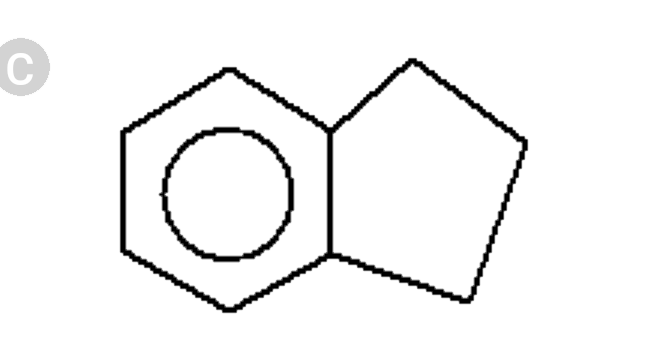
C

D

`PhC(CH_(3))=CH_(2)`

Text Solution

AI Generated Solution

The correct Answer is:
To solve the problem step by step, let's break down the sequence of reactions: ### Step 1: Electrophilic Substitution Reaction 1. **Starting Material**: Benzene (C₆H₆) is reacted with allyl chloride (CH₂=CHCH₂Cl) in the presence of a Lewis acid, AlCl₃. 2. **Mechanism**: The Lewis acid (AlCl₃) activates the allyl chloride, generating a more reactive electrophile (the allyl cation). Benzene undergoes electrophilic substitution, where the electrophile attacks the benzene ring. 3. **Product (X)**: The product of this reaction will be allylbenzene (C₆H₅-CH₂-CH=CH₂). ### Step 2: Hydroboration-Oxidation 1. **Reagents**: The product (X) is treated with BH₃ in tetrahydrofuran (THF), followed by H₂O₂ in the presence of OH⁻. 2. **Hydroboration**: BH₃ adds across the double bond of the allyl group. The hydrogen adds to the less substituted carbon, and the boron adds to the more substituted carbon, leading to the formation of a trialkylborane. 3. **Oxidation**: The subsequent treatment with H₂O₂ and OH⁻ converts the boron to an alcohol. This results in the formation of an alcohol with the structure: C₆H₅-CH₂-CH₂-CH₂OH (which we will call Y). ### Step 3: Protonation and Carbocation Formation 1. **Protonation**: The alcohol (Y) is treated with an acid (H⁺), which protonates the hydroxyl group, making it a better leaving group. 2. **Carbocation Formation**: The water molecule leaves, forming a carbocation at the end of the alkyl chain (C₆H₅-CH₂-CH₂-CH₂⁺). ### Step 4: Electrophilic Substitution Again 1. **Electrophilic Attack**: The carbocation can now act as an electrophile and will react with the benzene ring through another electrophilic substitution, forming a new carbon-carbon bond. 2. **Product Formation**: This leads to a new product that contains a five-membered ring structure attached to the benzene. ### Step 5: Final Heating Step 1. **Heating**: When the product is heated, a rearrangement occurs, leading to the loss of a hydrogen atom from the five-membered ring. 2. **Final Product (Z)**: The final product Z is a compound where the benzene ring is now fused to a five-membered ring, which corresponds to the structure of a bicyclic compound. ### Final Product The final product Z is thus a bicyclic compound formed from the fusion of the benzene ring and the five-membered ring structure. ### Summary of Final Product - **Final Product (Z)**: The final product Z is a bicyclic compound formed from benzene and a five-membered ring, which corresponds to option number 3 in the given choices.
Promotional Banner

Topper's Solved these Questions

  • NTA JEE MOCK TEST 77

    NTA MOCK TESTS|Exercise CHEMISTRY|25 Videos
  • NTA JEE MOCK TEST 79

    NTA MOCK TESTS|Exercise CHEMISTRY|25 Videos

Similar Questions

Explore conceptually related problems

Identify the final product in that follow sequence of reactions. CH_(2)=CH_(2)overset(Br_(2))rarr(X)overset(KCN)rarr (Y) overset(H_(3)O^(+))rarr (Z)

What is product of the following sequence of reactions ? (CH_(3))_(2)C=CHCH_(2)CH_(3)overset((i)BH_(3)//THF)underset((ii)H_(2)O_(2),OH^(-))rarr overset("PCC")underset(CH_(2)Cl_(2))rarr overset((i)CH_(3)MgBr)underset((ii)H_(3)O^(+))rarr

In the following sequence of reaction, the end product is : HC-=CHoverset(Hg^(2+)//H_(2)SO_(4))rarr(A) overset(CH_(3)MgX)underset([H_(2)O])rarr(B)overset([O])rarr(C)

Identify 'M' in the following sequence of reactions underset((M))(C_(8)H_(6)Cl_(2)O)overset(NH_(3))rarrC_(8)H_(8)ClNO overset(Br_(2))underset(NaOH)rarr

The final product of the following sequence of reaction is : (CH_(3)O)_(2)CHCH_(2)CH_(2)CH_(2)Broverset(Mg)(to) overset(H_(2)C=O)(to)underset("heat")overset(H_(3)O^(+))(to)

In the following sequence of reactions, the final product is C_(6)H_(6)overset(1.Br_(2)//Fe)underset(2.Mg//"ether")rarr(I)overset(HCHO)rarr(II)overset(Cl_(2)//Fe)rarr(III)overset(CrO_(3))underset("Pyridine")rarr(IV)

Consider the following sequence of reactions C_(2)H_(5)C -= CH overset(CH_(3)MgBr)rarr A underset((2)H_(2)O^(+))overset((1)HCHO) rarr B The product (B) is

Consider the following sequence of reactions. C_(6)H_(6) + CH_(3) CH = CH_(2) underset("heat")overset(H_(3)PO_(4))rarrA underset(2. H_(3)O^(+))overset(1. O_(2), "heat")rarr B + C The products (B) and (C) are:

What is the final product of the reaction? (CH_3)_(2) = CHCH_2CH_(3) overset((i) BH_3//THF)(rarr)overset(PCC)(rarr) underset((ii)H_2O^+)overset((i) CH_3MgBr)(rarr)

NTA MOCK TESTS-NTA JEE MOCK TEST 78-CHEMISTRY
  1. The aqueous 0.01 Molal solution of [Cr(NH(3))(6)](2)[Co(NH(3))(NO(2))(...

    Text Solution

    |

  2. For (A)+K(2)CO(3)+air overset(Heat)rarr(B) (B)+CI(2)rarr(C)pink Wh...

    Text Solution

    |

  3. Which of the following has smallest radius?

    Text Solution

    |

  4. If r(1) is the radius of first orbit of hydrogen atom, then the radii ...

    Text Solution

    |

  5. N2 and O2 are converted to mono cations N2^+ and O2^+ respectively, wh...

    Text Solution

    |

  6. In the carbylamine reaction, R-X converted R-Y via the intermediate Z,...

    Text Solution

    |

  7. The equilibrium constant for the reaction H(2)O(g)+CO(g)hArrH(2)(g)+CO...

    Text Solution

    |

  8. Ammonia forms the complex [Cu(NH3)4]^(2+) with copper ions in alkaline...

    Text Solution

    |

  9. Sodium carbonate is prepared by Solvay process. Which of the following...

    Text Solution

    |

  10. The reaction of p-HOC(6)H(4)COOH with excess Br(2) forms

    Text Solution

    |

  11. Melamine polymer is a copolymer of

    Text Solution

    |

  12. When an inorganic compound (X) having 3c - 2e as well as 2c - 2e bonds...

    Text Solution

    |

  13. Maltose on hydrolysis gives

    Text Solution

    |

  14. Which product will be obtained by Gridnard reaction, when Formaldehyde...

    Text Solution

    |

  15. Consider the following sequence of reactions and identify the final pr...

    Text Solution

    |

  16. An exothermic reaction, A rarr B, has an activation energy of "15 kcal...

    Text Solution

    |

  17. The enolic form of given compound contians CH(3)-CH(2)-overset(O)ove...

    Text Solution

    |

  18. A certain buffer solution sontains equal concentration of X^(-) and HX...

    Text Solution

    |

  19. In cyclic structure of (SO(3))(x) if x is number of SO(3) moleculles i...

    Text Solution

    |

  20. If number of lone pairs on central atom in XeF(2), XeF(4) and XeF(6) a...

    Text Solution

    |