

Home
Class 12
CHEMISTRY
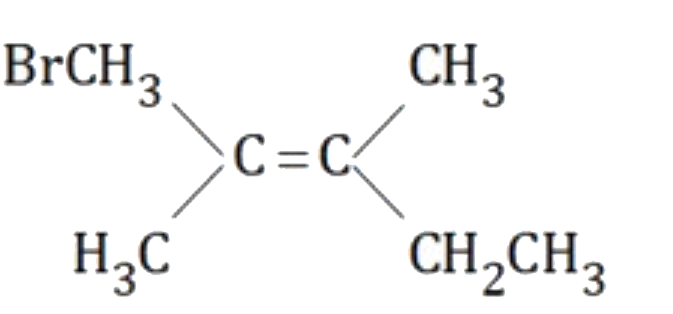
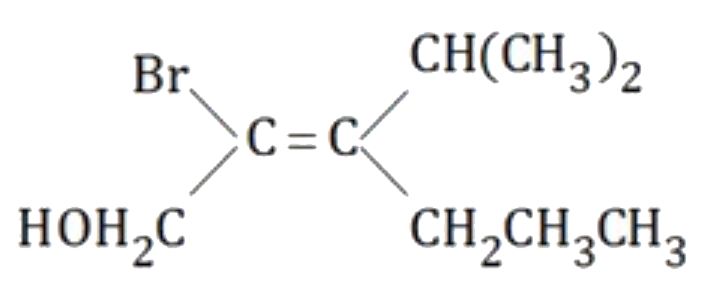
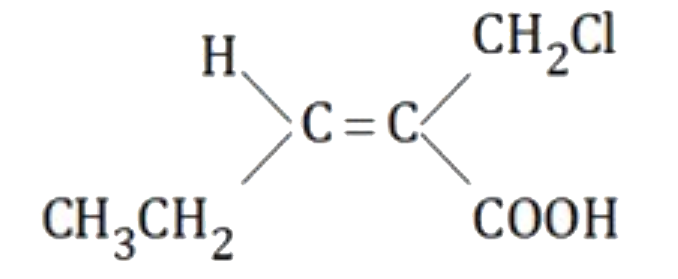
Select the Z - isomer from the following...

Select the Z - isomer from the following alkenes

A

B

C

D

Text Solution

AI Generated Solution

The correct Answer is:
To determine the Z-isomer from the given alkenes, we need to follow a systematic approach to assign priorities to the substituents attached to the double bond. Here’s a step-by-step solution: ### Step 1: Identify the double bond First, we need to identify the alkenes provided in the question. Alkenes have a carbon-carbon double bond (C=C), which is crucial for determining geometric isomerism. ### Step 2: Assign priorities to substituents For each alkene, we will assign priorities to the groups attached to the carbon atoms of the double bond. The Cahn-Ingold-Prelog priority rules are used for this purpose: - The atom with the higher atomic number gets higher priority. - If the first atoms are the same, we look at the next atoms in the substituent until a difference is found. ### Step 3: Determine the configuration Once we have assigned priorities, we can determine whether the configuration is Z or E: - **Z (from the German "zusammen")**: If the highest priority groups on each carbon are on the same side of the double bond. - **E (from the German "entgegen")**: If the highest priority groups are on opposite sides of the double bond. ### Step 4: Analyze each alkene 1. **Alkene 1**: Check if both substituents on one carbon are the same. If they are, we cannot determine Z or E. 2. **Alkene 2**: Assign priorities to the substituents. If the highest priority groups are on the same side, it is Z. 3. **Alkene 3**: Repeat the process. If the highest priority groups are on opposite sides, it is E. 4. **Alkene 4**: Assign priorities and check the configuration. ### Step 5: Select the Z-isomer After analyzing all the alkenes, we find the one where the highest priority groups are on the same side. This will be our Z-isomer. ### Conclusion Based on the analysis, the Z-isomer is found in **Option 3**. ---
Promotional Banner

Topper's Solved these Questions

  • NTA JEE MOCK TEST 80

    NTA MOCK TESTS|Exercise CHEMISTRY|25 Videos
  • NTA JEE MOCK TEST 82

    NTA MOCK TESTS|Exercise CHEMISTRY|25 Videos

Similar Questions

Explore conceptually related problems

The Z-isomers among the following are:

Select 'cis' isomer among the following:

Select pair of chain isomers from the following :

The IUPAC name of the following alkene is

The 'Z' -isomer is

NTA MOCK TESTS-NTA JEE MOCK TEST 81-CHEMISTRY
  1. In an atom, two electrons move around nucleus in circular orbits of ra...

    Text Solution

    |

  2. Select the Z - isomer from the following alkenes

    Text Solution

    |

  3. Consider the following reactions : 2XS+3O(2)overset(Delta)to 2XO+2SO...

    Text Solution

    |

  4. D is

    Text Solution

    |

  5. Three isothermal plots (P versus V) A, B and C are plotted at three te...

    Text Solution

    |

  6. Substance A(2)B(g) can undergoes decomposition to form two set of prod...

    Text Solution

    |

  7. overset(NaBH(4))(leftarrow) PhCH=CH-CHOunderset(2. H(3)O^(+))overset(1...

    Text Solution

    |

  8. (CH(3))(2)C=CHCOCH(3) can be oxidised to (CH(3))(2) C=CHCOOH by

    Text Solution

    |

  9. Pick out the incorrect statement.

    Text Solution

    |

  10. In a copper voltmeter, mass deposite in 30 seconds is 'm' gram. If the...

    Text Solution

    |

  11. The final product C in the following reaction is

    Text Solution

    |

  12. 0.2 gm sample of benzoic acid C(6)H(5)COOH is titrated with 0.12 M Ba(...

    Text Solution

    |

  13. (CH(3))(2)CHOH overset("Mild")underset("oxidation[O]")rarr (X) overset...

    Text Solution

    |

  14. Which of the following compound will given yellow precipitate on ...

    Text Solution

    |

  15. Which of the following oxyacids acts as most reducing agent?

    Text Solution

    |

  16. Consider the following acids 1. MeCH(2)COOH 2. Me(2)CHCOOH 3. Me...

    Text Solution

    |

  17. The plot of (1)/(Y(A))" Vs "(1)/(x(A))((1)/(Y(A))" on y - axis") where...

    Text Solution

    |

  18. The transition elements are more metallic then p - block elements beca...

    Text Solution

    |

  19. Which of the following reaction are possible ? (1) ArN(2)^(+) + CuBr...

    Text Solution

    |

  20. Which of the following order is correct for the property mentioned in ...

    Text Solution

    |