Home
Class 12
CHEMISTRY
Which of the following is least reactive...

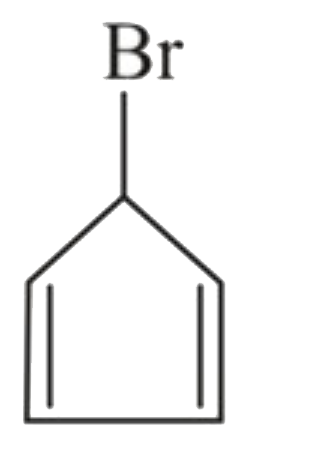
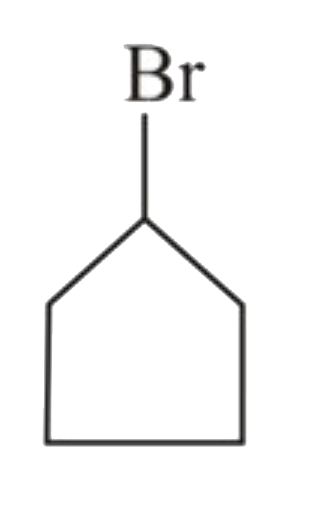
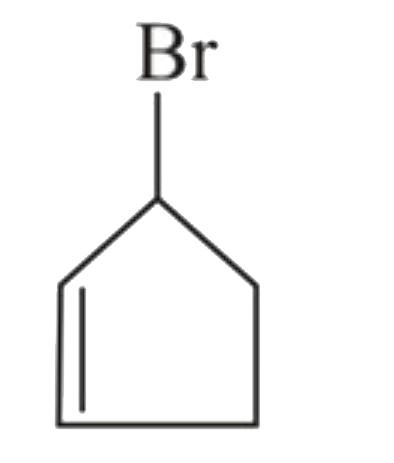
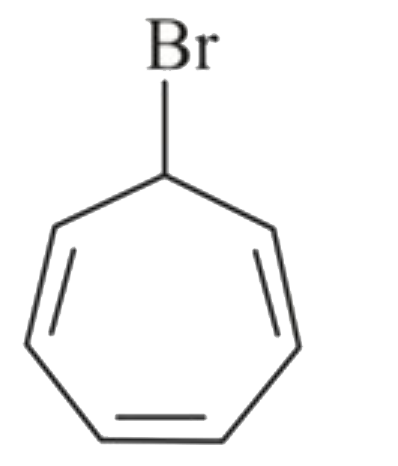
Which of the following is least reactive towards `S_(N)1`?

A

B

C

D

Text Solution

AI Generated Solution

The correct Answer is:

To determine which of the given compounds is least reactive towards the \( S_N1 \) reaction, we need to analyze the stability of the carbocations that would form during the reaction. The \( S_N1 \) reaction involves two main steps: the formation of a carbocation intermediate and the subsequent attack by a nucleophile. ### Step-by-Step Solution: 1. **Understanding \( S_N1 \) Mechanism**: - The \( S_N1 \) mechanism is a two-step process where the first step involves the formation of a carbocation. The stability of this carbocation is crucial because more stable carbocations will form more readily and thus lead to faster reactions. 2. **Identify the Compounds**: - We need to analyze the given compounds (let's assume they are labeled A, B, C, and D) for their ability to form stable carbocations. 3. **Carbocation Stability**: - Carbocation stability increases in the following order: - **Tertiary > Secondary > Primary > Methyl** - Additionally, resonance and inductive effects can stabilize carbocations. Compounds that can delocalize the positive charge through resonance will be more stable. 4. **Analyzing Each Compound**: - **Compound A**: If it has resonance stabilization (like an allylic or benzylic carbocation), it will be more stable. - **Compound B**: If it is a tertiary carbocation, it will be stable due to hyperconjugation and inductive effects. - **Compound C**: If it is a secondary carbocation, it will be less stable than tertiary but more stable than primary. - **Compound D**: If it is an anti-aromatic compound, it will be least stable due to the presence of 4n π electrons, making it anti-aromatic and thus less reactive. 5. **Conclusion**: - Among the compounds analyzed, the one that forms an anti-aromatic carbocation (Compound D) will be the least reactive towards \( S_N1 \) reactions due to its instability. ### Final Answer: - The compound that is least reactive towards \( S_N1 \) is **Compound D** (the anti-aromatic compound).
Promotional Banner

Topper's Solved these Questions

  • NTA JEE MOCK TEST 82

    NTA MOCK TESTS|Exercise CHEMISTRY|25 Videos
  • NTA JEE MOCK TEST 84

    NTA MOCK TESTS|Exercise CHEMISTRY|25 Videos

Similar Questions

Explore conceptually related problems

Which of the following is least reactive towards S_(N) 2 mechanism ?

Alkyl halides undergo nucleophilic substitution reactions in which halogen atom is replaced by other atom. RX + Nu:^(-) to Nu-R + X^(-) These reactions follow S_(N)1 and S_(N)2 type mechanism, in which S_(N)1 takes place in two steps while S_(N)2 takes place in single step. Due to their tendency to undergo substitution by a large number of nucleophiles, they form a variety of products. Which of the following is least reactive towards S_(N)2 mechanism ?

Which of the following is most reactive towards S_(N)1 reaction?

Which of the following is most reactive towards S_(N)2 reaction? CH_(3)Br, (CH_(3))_(2)CHBr, (CH_(3))_(3)CBr

Which of the following is most reactive towards S_(N)2 reaction? CH_(3)Br, (CH_(3))_(2)CHBr, (CH_(3))_(3)CBr

NTA MOCK TESTS-NTA JEE MOCK TEST 83-CHEMISTRY
  1. Ten moles of an ideal gas are filled in a closed vessel. The vessel ha...

    Text Solution

    |

  2. Which of the following is not a resonance structure of the other?

    Text Solution

    |

  3. Nitrogen dioxide can not be obtained from

    Text Solution

    |

  4. The S-S bond energy is if DeltaH(f)^(@)(E(t)-S-E(t))=-147kJ//mol,Delta...

    Text Solution

    |

  5. The major product in the reaction is

    Text Solution

    |

  6. BX(3)+NH(3) overset(B.T.) to BX(3) *NH(3)+Heat of adduct formation (De...

    Text Solution

    |

  7. A 250.0 mL sample of a 0.20M Cr^(3+) is electrolysed with a current of...

    Text Solution

    |

  8. Which of the following is least reactive towards S(N)1?

    Text Solution

    |

  9. For a second order reaction, 2Ararr Products, a plot of log t(1//2) v...

    Text Solution

    |

  10. Consider the following metallurgical processes: (I) Heating impure m...

    Text Solution

    |

  11. (A) overset(HCI+ZnCI(2))larr Me(3)C-CH(2)OH overset(SOCI(2))underset(P...

    Text Solution

    |

  12. The silicate anion in the mineral kinoite is a chain of three SiO(4) t...

    Text Solution

    |

  13. The compound (X) is

    Text Solution

    |

  14. What will be the pH of a solution formed by mixing 40cm^(2) of 0.1 M H...

    Text Solution

    |

  15. Which of the following compounds is likely to be a product Y in this c...

    Text Solution

    |

  16. One of the monomer of Nylon 6, 6 is an acid. How many -COOH groups are...

    Text Solution

    |

  17. How many chiral C - atoms are present in Cimetidine.

    Text Solution

    |

  18. If the highest oxidation states shown by any Lanthanide and any Actini...

    Text Solution

    |

  19. How many of these properties are intensive here Temperature, Refractiv...

    Text Solution

    |

  20. How many acidic hydrogen atoms are present in this compound

    Text Solution

    |
