

Home
Class 12
CHEMISTRY
Which graph correctly correlates E("cell...

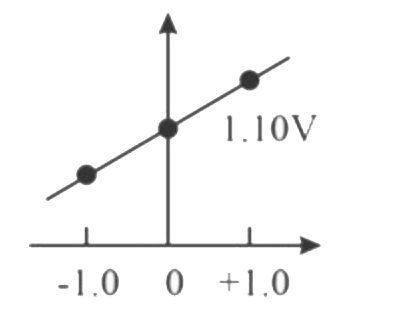
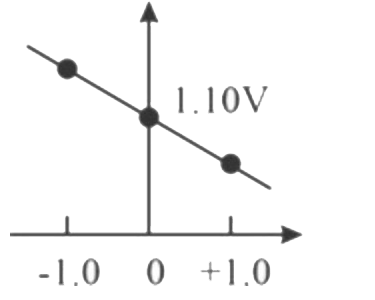
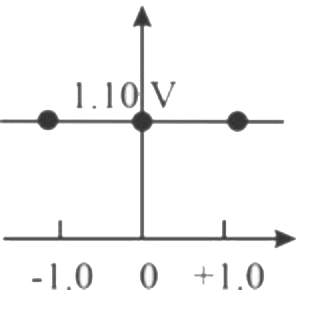
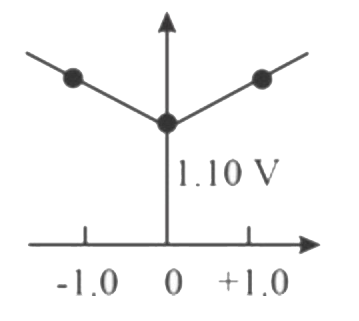
Which graph correctly correlates `E_("cell")` as a function of concentration for the cell (for different values of M nad M' `Zn(s)+Cu^(2+)(M)rarrZn^(2+(M')+Cu(s), E_("cell")^(@)=1.10V`
X - axis : `log_(10).([Zn^(2+)])/([Cu^(2+)]),` Y - axis : `E_("cell")`

A

B

C

D

Text Solution

AI Generated Solution

The correct Answer is:
To solve the problem, we will follow these steps: ### Step 1: Write the Cell Reaction The cell reaction is given as: \[ \text{Zn(s)} + \text{Cu}^{2+}(M) \rightarrow \text{Zn}^{2+}(M') + \text{Cu(s)} \] ### Step 2: Identify Oxidation and Reduction In this reaction: - Zinc (Zn) is oxidized to Zinc ions (\( \text{Zn}^{2+} \)). - Copper ions (\( \text{Cu}^{2+} \)) are reduced to Copper (Cu). ### Step 3: Determine the Number of Electrons Transferred From the reaction, we can see that 2 electrons are involved in the process: - Zn → \( \text{Zn}^{2+} + 2e^- \) (oxidation) - \( \text{Cu}^{2+} + 2e^- \rightarrow \text{Cu} \) (reduction) Thus, \( n = 2 \). ### Step 4: Write the Nernst Equation The Nernst equation for this cell reaction is: \[ E_{\text{cell}} = E^{\circ}_{\text{cell}} - \frac{RT}{nF} \ln Q \] Where \( Q \) is the reaction quotient given by \( Q = \frac{[\text{Zn}^{2+}]}{[\text{Cu}^{2+}]} \). ### Step 5: Substitute Values into the Nernst Equation Given \( E^{\circ}_{\text{cell}} = 1.10 \, \text{V} \), we can rewrite the Nernst equation as: \[ E_{\text{cell}} = 1.10 - \frac{0.0591}{n} \log \left( \frac{[\text{Zn}^{2+}]}{[\text{Cu}^{2+}]} \right) \] Substituting \( n = 2 \): \[ E_{\text{cell}} = 1.10 - 0.0591 \log \left( \frac{[\text{Zn}^{2+}]}{[\text{Cu}^{2+}]} \right) \] ### Step 6: Analyze the Graph In the equation, we see that: - The y-intercept (when \( \log \left( \frac{[\text{Zn}^{2+}]}{[\text{Cu}^{2+}]} \right) = 0 \)) is \( E_{\text{cell}} = 1.10 \, \text{V} \). - The slope is negative, indicating that as the log of the concentration ratio increases, \( E_{\text{cell}} \) decreases. ### Step 7: Conclusion Based on the analysis, the graph of \( E_{\text{cell}} \) versus \( \log \left( \frac{[\text{Zn}^{2+}]}{[\text{Cu}^{2+}]} \right) \) will have: - An intercept at \( 1.10 \, \text{V} \). - A downward slope. Thus, the correct option is the one that shows a negative slope starting from the intercept of \( 1.10 \, \text{V} \).
Promotional Banner

Topper's Solved these Questions

  • NTA JEE MOCK TEST 91

    NTA MOCK TESTS|Exercise CHEMISTRY|25 Videos
  • NTA JEE MOCK TEST 93

    NTA MOCK TESTS|Exercise CHEMISTRY|25 Videos

Similar Questions

Explore conceptually related problems

Which graph correctly correlates E_(cell) as a funcation of concentrations for the cell (for different values of M and M' )? Zn(s) + Cu^(2+) (M) rarr Zn^(2+) (M') + Cu(s), E_(cell)^(@) = 1.10 V X -axis : (log_(10)[Zn^(2+)])/([Cu^(2+)]) Y-axis : E_("cell")

Which graph correctly correlates E_(cell) as a function of concentration for the cell Zn(s)+2Ag^+(aq)toZn^(2+)(aq)+2Ag(s), E_(cell)^(@)=1.56V y-axis: E_(cell) , X-axis: log_(10)"([Zn^(2+)])/([Ag^+]^2)

Calculate the equilibrium costant log (K_(c)) for the reaction Zn(s)+Cu^(2+)(aq)rarrZn^(2+)(aq)+Cu(s) [Given E_(cell)^(2)=1.1 V ]

Calculate the standard free energy change for the reaction : Zn(s)|Zn^(2+)(1 M)||Cu^(2+)(1 M)|Cu(s) Given E_(cell)^(@)=1.10" V " .

For the redox process Zn (s) + Cu^(2+) hArr Zn^(2+) + Cu(s) E_("cell")^(@) = + 1.10V which graph correctly represents E_("cell") (Y-axis) as a function of log ([Zn^(2+)])/([Cu^(2+)]) (X-axis) ?

Consider the following cell reaction Cu(s)+2Ag^(+)(aq) rarr Cu^(2+) (aq) +2Ag(s) E_("cell")^(@)=0.46 V By boubling the concentration of Cu^(2+) , E_("cell") is

For the redox reaction: Zn(s) +Cu^(2+) (0.1M) rarr Zn^(2+) (1M)+Cu(s) taking place in a cell, E_(cell)^(@) is 1.10 volt. E_(cell) for the cell will be (2.303 (RT)/(F) = 0l.0591)

NTA MOCK TESTS-NTA JEE MOCK TEST 92-CHEMISTRY
  1. Which formula does not correctly represent the bonding capacity of the...

    Text Solution

    |

  2. Each of the compounmds Pt(NH(3))(6)Cl(4), Cr(NH(3))(6)Cl(3) and K(2)Pt...

    Text Solution

    |

  3. Which graph correctly correlates E("cell") as a function of concentrat...

    Text Solution

    |

  4. Arrange the following compounds in order of their reactivity towards L...

    Text Solution

    |

  5. Compound (C ) is

    Text Solution

    |

  6. The elevation in boiling point of a solution dT(b) is related with mol...

    Text Solution

    |

  7. Given the decreasing order of reactivity of the following compounds wi...

    Text Solution

    |

  8. Consider the following reaction and Identify (B)

    Text Solution

    |

  9. What is the equation form of Langmuir adsorption isotherm undre high p...

    Text Solution

    |

  10. Which is the correct order of decreasing boiling point of azeotropic m...

    Text Solution

    |

  11. In the following reaction, the final product can be prepared by two pa...

    Text Solution

    |

  12. Point out the incorrect statement among the following?

    Text Solution

    |

  13. What will be the order of reaction and rate constant for a chemical ch...

    Text Solution

    |

  14. In the Hoope’s process for refining of aluminium, the fused materials ...

    Text Solution

    |

  15. The oxidation number is changed in which of the following case?

    Text Solution

    |

  16. The temperature coefficient of e.m.f of a cell can be given by :

    Text Solution

    |

  17. Given the major product of the following reaction.

    Text Solution

    |

  18. How many unit cell are present in a cubic-shaped ideal crystal of NaCl...

    Text Solution

    |

  19. Which of the following pairs of compounds are more stable?

    Text Solution

    |

  20. A spherical ballon of 21 cm diameter is to be filled with H(2) at NTP ...

    Text Solution

    |