Home
Class 12
CHEMISTRY
The equalitative sketches I, II and III ...

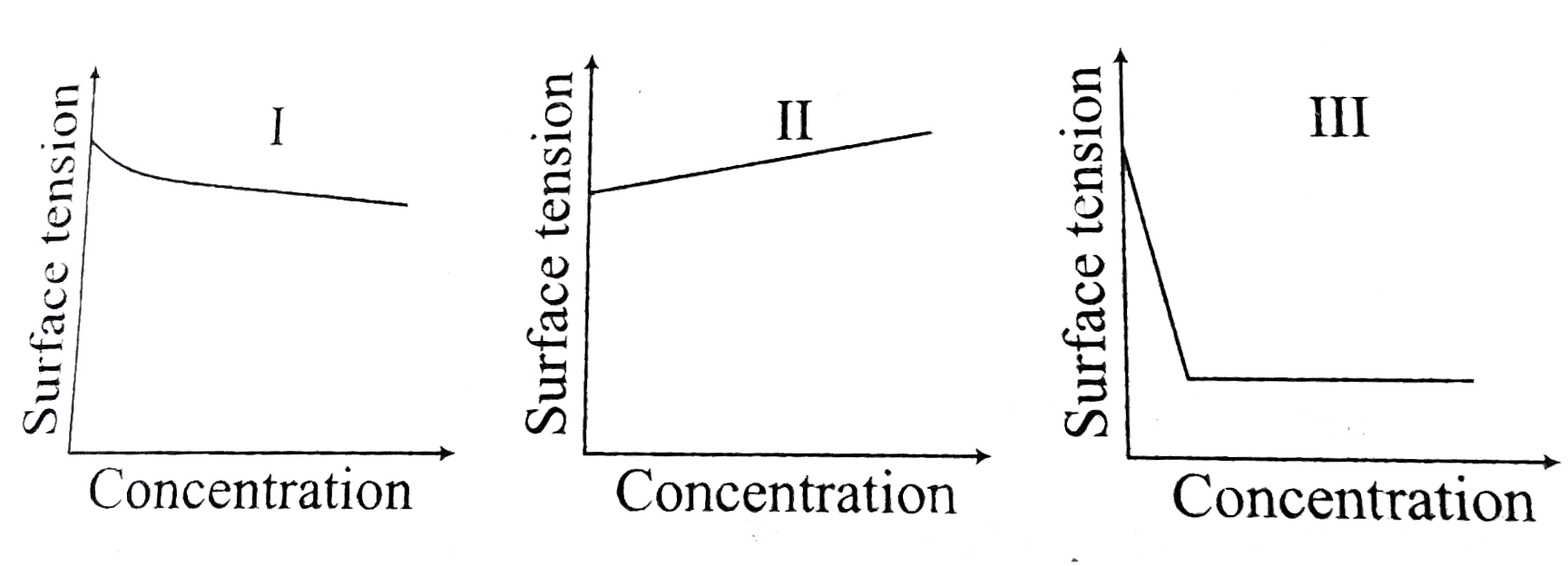
The equalitative sketches I, II and III given below show the variation of surface tension with molar concentration of three diferent aqueous solutions of `KCl, CH_(3)OH` and `CH_(3)(CH_(2))_(11)OSO_(3)^(-)Na^(+)` at room temperature.

The correct assignment of the sketches is

A

`I :KCl, II :CH_(3)OH, III : CH_(3)(CH_(2))_(11)OSO_(3)^(-)Na^(+)`

B

`I : CH_(3)(CH_(2))_(11)OSO_(3)^(-)Na^(+), II : CH_(3)OH, III :KCl`

C

`I : KCl, II : CH_(3)(CH_(2))_(11)PSO_(3)^(-)Na^(+), III : CH_(3)OH`

D

`I: CH_(3)OH, II : KCl, III : CH_(3)(CH_(2))_(11)OSO_(3)^(-)Na^(+)`

Text Solution

Verified by Experts

The correct Answer is:

D
Promotional Banner

Topper's Solved these Questions

  • NTA JEE MOCK TEST 94

    NTA MOCK TESTS|Exercise CHEMISTRY|25 Videos
  • NTA JEE MOCK TEST 96

    NTA MOCK TESTS|Exercise CHEMISTRY|25 Videos

Similar Questions

Explore conceptually related problems

The ease of esterification of the acids HCO OH(I),(CH_(3)CO Oh(II), and CH_(3)CH_(2)C O OH(III) with CH_(3)OH is

Identify the electrophile centre in the following : (i) CH_(3)CHO" " (ii) CH_(3)CH=CH_(2)" " (iii) CH_(3)COCH_(3)

What would be the nature of aqueous solution of the following salts ? (i) KNO_(3) (ii) Na_(2)CO_(3) (iii) CH_(3)COONa

Arrange the following in decreasing order of solubility in water (i) CH_(3)CH_(2)OH (ii) CH_(3)OH (iii) C_(6)H_(5)CH_(2)OH .

Compare the relative acidic strength of the following: (i) CH_(3)OH (ii) CH_(3)CH_(2)OH (iii) CH_(3)CH(OH)CH_(3) (iv) (CH_(3))_(3)COH .

Dipole moment of CH_(3)CH_(2)CH_(3)(I),CH_(3)CH_(2)OH(II) and CH_(3)CH_(2)F(III) is in order

Ease of esterification of following alcohol with HCOOH is (I) CH_(3)-CH_(2)OH" " (II) (CH_(3))_(2)CH-OH (III) (CH_(3))_(3)C-OH

Name the funtional groups present in each of the following compounds : (i) CH_(3)-CO-CH_(2)-CH_(3) (ii) CH_(3)-CH_(2)-COOH (iii) CH_(3)-CHO (iv) CH_(3)-CH_(2)OH

NTA MOCK TESTS-NTA JEE MOCK TEST 95-CHEMISTRY
  1. In Mayer's relation: C(P)-C(V)=R 'R' stands for:

    Text Solution

    |

  2. Products of the reaction which is given below will be CH(3)-underset...

    Text Solution

    |

  3. (Z) -3- bromo -3- hexene when treated with CH(3)O^(-)" in "CH(3)OH giv...

    Text Solution

    |

  4. Two oxides of nitrogen, NO and NO(2) are allowed to react together at ...

    Text Solution

    |

  5. A carbon compound contains 12.8% of carbon, 2.1% of hydrogen and 85.1%...

    Text Solution

    |

  6. Calcium lactate is a salt of weak organic acid and strong base represe...

    Text Solution

    |

  7. The octahedral complex/complex ion which shown both facial and meridio...

    Text Solution

    |

  8. The correct code for stability, of oxidation states for given cations ...

    Text Solution

    |

  9. The most appropriate sequence of the reactions for carrying out the fo...

    Text Solution

    |

  10. pH of 0.1 M monobasic acid is found to be 2 . Hence its osmotic pressu...

    Text Solution

    |

  11. The reduction of an oxide by aluminium is called

    Text Solution

    |

  12. Match list - I with list - II and select the correct answer using the ...

    Text Solution

    |

  13. Which of the following is second ion is more stable than the first

    Text Solution

    |

  14. The equalitative sketches I, II and III given below show the variation...

    Text Solution

    |

  15. A graph plotted between log k versus 1//T for calculating activation e...

    Text Solution

    |

  16. 60 g of gaseous C(2)H(6) are mixed with 28 g of carbon monoxide. The p...

    Text Solution

    |

  17. How many acidic H - atoms are present in this compound that can react ...

    Text Solution

    |

  18. moles of CO(2) evolved during given reaction? What is the value of '...

    Text Solution

    |

  19. A current of 2.0A passed for 5 hours through a molten metal salt depos...

    Text Solution

    |

  20. If XeOF(4) how many angles are of 90^(@)?

    Text Solution

    |
