Home
Class 12
CHEMISTRY
In each of the following pairs of ions i...

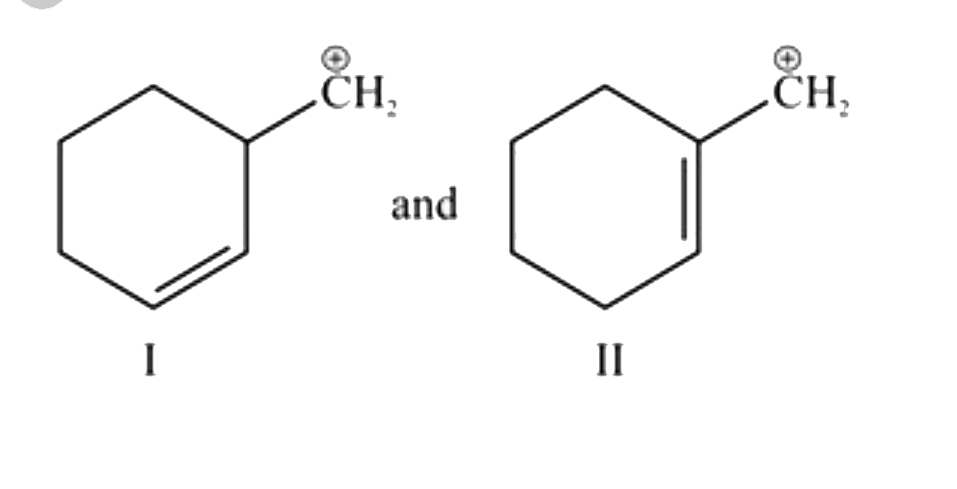
In each of the following pairs of ions in which I ion is more stable than II

A

`underset("I")(C_(6)H_(5)-overset(o+)CH_(2)) and underset("II")(CH_(2)=CH-overset(o+)CH_(2))`

B

`underset("I")(CH_(2))=overset(o+)CH and underset("II")(CH_(3))-overset(o+)CH_(2)`

C

D

`underset("I")({:(CH_(3)-CH-CH_(3)),(" |"),(CH_(3)-underset(o+)C-CH_(3)):}) and underset("II")({:(CH_(3)-N-CH_(3)),(" |"),(CH_(3)-underset(o+)C-CH_(3)):})`

Text Solution

AI Generated Solution

The correct Answer is:

To determine which ion is more stable in each pair, we will analyze the stability of the given ions based on resonance, inductive effects, and the presence of lone pairs. ### Step-by-Step Solution: 1. **Analyzing the First Pair: C6H5CH2+ vs. CH2=CH2+** - **C6H5CH2+ (Benzylic Carbocation)**: This carbocation is stabilized by resonance. The positive charge can be delocalized over the aromatic ring, allowing for multiple resonance structures. - **CH2=CH2+ (Vinylic Carbocation)**: This carbocation is less stable because it does not have significant resonance stabilization. The positive charge is localized and cannot be delocalized effectively. - **Conclusion**: C6H5CH2+ is more stable than CH2=CH2+. 2. **Analyzing the Second Pair: CH2=CH+ vs. CH3CH2+** - **CH2=CH+ (Vinylic Carbocation)**: This carbocation is not stabilized by any alkyl groups and has limited resonance. - **CH3CH2+ (Ethyl Carbocation)**: This carbocation is stabilized by the +I (inductive) effect from the adjacent alkyl group (ethyl group). - **Conclusion**: CH3CH2+ is more stable than CH2=CH+. 3. **Analyzing the Third Pair: CH2=CH+ vs. CH2=CH-CH2+** - **CH2=CH+ (Vinylic Carbocation)**: As previously mentioned, this carbocation has limited stabilization. - **CH2=CH-CH2+ (Allylic Carbocation)**: This carbocation can be stabilized by resonance, as the positive charge can be delocalized over the adjacent double bond. - **Conclusion**: CH2=CH-CH2+ is more stable than CH2=CH+. 4. **Analyzing the Fourth Pair: CH3C+(CH3)2 vs. CH3N+(CH3)2** - **CH3C+(CH3)2 (Tertiary Carbocation)**: This carbocation is stabilized by the +I effect from the two methyl groups. - **CH3N+(CH3)2 (Tertiary Ammonium Ion)**: The nitrogen has a lone pair that can stabilize the positive charge through back donation, which enhances stability. - **Conclusion**: CH3N+(CH3)2 is more stable than CH3C+(CH3)2. ### Final Answer: The only pair where the first ion is more stable than the second is the first pair: **C6H5CH2+ is more stable than CH2=CH2+.**
Promotional Banner

Topper's Solved these Questions

  • NTA JEE MOCK TEST 96

    NTA MOCK TESTS|Exercise CHEMISTRY|25 Videos
  • NTA JEE MOCK TEST 98

    NTA MOCK TESTS|Exercise CHEMISTRY|25 Videos

Similar Questions

Explore conceptually related problems

In which of the following pairs of carbarion the first one is more stable than correct.

In which of the following pairs, first species is more stable than second ?

Which of the following is second ion is more stable than the first

Which of the following pairs involves isoelectronic ions

In which of the following pairs the ions are isoelectronic?

NTA MOCK TESTS-NTA JEE MOCK TEST 97-CHEMISTRY
  1. The spinel structure consists of an array of O^(2-) ions in fcc arrang...

    Text Solution

    |

  2. Exess of KI reacts with CuSO(4) solution and then Na(2)S(2)O(3) soluti...

    Text Solution

    |

  3. In each of the following pairs of ions in which I ion is more stable t...

    Text Solution

    |

  4. The hybridisation of the central atom will change when

    Text Solution

    |

  5. V(1) mL of NaOH of normality X and V(2) mL of Ba(OH)(2) of mormality Y...

    Text Solution

    |

  6. If DeltaG^(@)[HI(g)=-1.7kJ], the equilibrium constant for the reaction...

    Text Solution

    |

  7. 1 - Bromo -2, 2 - dimethylcyclohexane on treatment with methanol give...

    Text Solution

    |

  8. The major product P of the following reaction is

    Text Solution

    |

  9. In which of the following compounds hydrolysis tkes plcae through S(N^...

    Text Solution

    |

  10. The voltage of the cell consisting of Li(s) and F(2)(g) electrodes is ...

    Text Solution

    |

  11. The voltage the characteristics is not common between [Cu(en)(2)]^(2+)...

    Text Solution

    |

  12. AgBr(s)+2S(2)O(3)^(2-)(aq)hAq Ag(S(2)O(3))(2)^(3-)(aq)+Br^(-)(aq) Gi...

    Text Solution

    |

  13. The incorrect statement regarding above reactions is

    Text Solution

    |

  14. In the reaction shown below, identify the correct combination of te in...

    Text Solution

    |

  15. For adsorption of a gas on a solid, the plot of log (x//m) vs log P is...

    Text Solution

    |

  16. One of the hydrolysed product of the following compound does not react...

    Text Solution

    |

  17. In the reaction sequence C(6)H(5)-underset(O)underset(||)C-CH(3)overse...

    Text Solution

    |

  18. When A(2) and B(2) are allowed to react, the equilibrium constant of t...

    Text Solution

    |

  19. Arrange reactivity of given compounds in decreasing order for hydrolys...

    Text Solution

    |

  20. In the reaction x A rarr yB, log{-(d[A])/(dt)}=log{+(d[B])/(dt)}+0.3 T...

    Text Solution

    |
