Home
Class 12
CHEMISTRY
1 - Bromo -2, 2 - dimethylcyclohexane o...

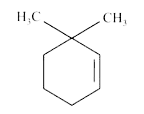
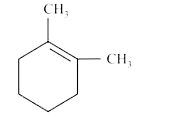
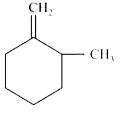
1 - Bromo -2, 2 - dimethylcyclohexane on treatment with methanol gives

A

B

C

D

all of these

Text Solution

AI Generated Solution

The correct Answer is:

To solve the problem of what 1-bromo-2,2-dimethylcyclohexane gives upon treatment with methanol, we will follow these steps: ### Step 1: Understand the structure of 1-bromo-2,2-dimethylcyclohexane 1-bromo-2,2-dimethylcyclohexane consists of a cyclohexane ring with a bromine atom (Br) at the 1-position and two methyl groups (CH3) at the 2-position. The structure can be represented as follows: ``` CH3 | Br --C-- CH3 | C / \ C C / \ C C ``` ### Step 2: Reaction with methanol When 1-bromo-2,2-dimethylcyclohexane is treated with methanol, which is a protic solvent, the bromine atom (a good leaving group) will leave first, forming a carbocation. ### Step 3: Formation of carbocation The leaving of bromine generates a carbocation at the 1-position of the cyclohexane. The structure of the carbocation can be depicted as: ``` CH3 | C+ | C / \ C C / \ C C ``` ### Step 4: Rearrangement of the carbocation The carbocation can undergo rearrangement. A methyl group can shift from the 2-position to stabilize the carbocation, leading to a more stable tertiary carbocation. ### Step 5: Elimination to form alkenes After the formation of the carbocation, a proton (H+) can be eliminated from an adjacent carbon atom, resulting in the formation of a double bond (alkene). ### Step 6: Possible products From the rearranged carbocation, two possible alkenes can be formed depending on which hydrogen is eliminated: 1. If the proton is removed from the carbon adjacent to the carbocation, we can form one alkene. 2. If the proton is removed from the other adjacent carbon, we can form another alkene. ### Conclusion In total, multiple products can be formed from this reaction, including different isomers of alkenes. Therefore, the treatment of 1-bromo-2,2-dimethylcyclohexane with methanol can yield several products, including: - 2,2-dimethylcyclohexene - 1,2-dimethylcyclohexene - Other possible isomers depending on the elimination of protons. ### Final Answer The treatment of 1-bromo-2,2-dimethylcyclohexane with methanol gives multiple alkene products. ---
Promotional Banner

Topper's Solved these Questions

  • NTA JEE MOCK TEST 96

    NTA MOCK TESTS|Exercise CHEMISTRY|25 Videos
  • NTA JEE MOCK TEST 98

    NTA MOCK TESTS|Exercise CHEMISTRY|25 Videos

Similar Questions

Explore conceptually related problems

Cis-1,2-dimethylcyclohexane

Trans-1-2-dimethylcyclohexane

Benzamide on treatment with Br_2 and alkali gives

1-bromo-2,2-dimetylpropane

2-Phenyl-2-chloropropane on treatment with alc. KOH gives mainly

2-Phenyl-2-chloropropane on treatment with alc. KOH gives mainly

Anisole on treatment with Br_(2)//CS_(2) gives :

NTA MOCK TESTS-NTA JEE MOCK TEST 97-CHEMISTRY
  1. V(1) mL of NaOH of normality X and V(2) mL of Ba(OH)(2) of mormality Y...

    Text Solution

    |

  2. If DeltaG^(@)[HI(g)=-1.7kJ], the equilibrium constant for the reaction...

    Text Solution

    |

  3. 1 - Bromo -2, 2 - dimethylcyclohexane on treatment with methanol give...

    Text Solution

    |

  4. The major product P of the following reaction is

    Text Solution

    |

  5. In which of the following compounds hydrolysis tkes plcae through S(N^...

    Text Solution

    |

  6. The voltage of the cell consisting of Li(s) and F(2)(g) electrodes is ...

    Text Solution

    |

  7. The voltage the characteristics is not common between [Cu(en)(2)]^(2+)...

    Text Solution

    |

  8. AgBr(s)+2S(2)O(3)^(2-)(aq)hAq Ag(S(2)O(3))(2)^(3-)(aq)+Br^(-)(aq) Gi...

    Text Solution

    |

  9. The incorrect statement regarding above reactions is

    Text Solution

    |

  10. In the reaction shown below, identify the correct combination of te in...

    Text Solution

    |

  11. For adsorption of a gas on a solid, the plot of log (x//m) vs log P is...

    Text Solution

    |

  12. One of the hydrolysed product of the following compound does not react...

    Text Solution

    |

  13. In the reaction sequence C(6)H(5)-underset(O)underset(||)C-CH(3)overse...

    Text Solution

    |

  14. When A(2) and B(2) are allowed to react, the equilibrium constant of t...

    Text Solution

    |

  15. Arrange reactivity of given compounds in decreasing order for hydrolys...

    Text Solution

    |

  16. In the reaction x A rarr yB, log{-(d[A])/(dt)}=log{+(d[B])/(dt)}+0.3 T...

    Text Solution

    |

  17. Number of aldol products in the given reaction C(6)H(5) - CHO + CH(3...

    Text Solution

    |

  18. The atomic structure of He^(+) arises due to transition from n(2) to n...

    Text Solution

    |

  19. An alloy of Pb-Ag weighing 1.08g was dissolved in dilute HNO(3) and th...

    Text Solution

    |

  20. Consider the following ligands NH(2)^(-), acac, OH^(-), Gly, O(2)^(-),...

    Text Solution

    |
