Home
Class 12
PHYSICS
A bullet is moving horizontally with cer...

A bullet is moving horizontally with certain velocity. It pierces two paper discs rotating coaxially with angular speed `omega` separated by a distance l. IF the hole made by bullet on second disc is shifted by an angle `theta` with respect to the first, find velocity of bullet.

Text Solution

Verified by Experts
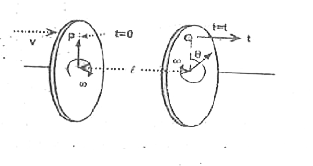
Let the bullet take a time t to travel from one disc to the other with a velocity
`implies`The distance between the discs
l=vt
`impliest=(l)/(v)`
When the bullet is about to hit the second disc at Q, the hole made by the bullet on the first disc at P will rotate through an angle during the time t
`implies theta=omegat`
Using (1)&(2)
`t=(l)/(v)=theta//omega`
`impliesv=omegal//theata`
Promotional Banner

Topper's Solved these Questions

  • KINEMATICS

    FIITJEE|Exercise Problem (objective)|14 Videos
  • KINEMATICS

    FIITJEE|Exercise Comprehension (I)|3 Videos
  • KINEMATICS

    FIITJEE|Exercise NUMERICAL BASED QUESTIONS DECIMAL TYPE|5 Videos
  • HEAT AND TEMPERATURE

    FIITJEE|Exercise NUMERICAL BASES QUESTIONS|1 Videos
  • LAWS OF MOTION

    FIITJEE|Exercise COMPREHENSION-III|2 Videos

Similar Questions

Explore conceptually related problems

Two paper discs are mounted on a rotating vertical shaft. The shaft rotates with a constant angular speed omega and the separation between the discs is H. A bullet is fired vertically up so that it pierces through the two discs. It creates holes H1 and H2 in the lower and the upper discs. The angular separation between the two holes (measured with respect to the shaft axis) is theta . Find the speed (v) of the bullet. Assume that the speed of the bullet does not change while travelling through distance H and that the discs do not complete even one revolution in the interval the bullet pierces through them.

A rough disc of mass m rotates freely with an angular velocity omega . If another rough disc of mass m/2 and same radius but spinning in opposite sense with angular speed omega is kept on the first disc. Then:

A disc of mass M and radius r is rotating with an angular velocity omega . If gently, two masses m each are placed at a distance r//2 on either side of the axis of rotation, what will be the new angular velocity ?

A disc of radius R is moving on a rough horizontal surface with velocity v and angular speed omega at an instant as shown in figure. Choose the correct statement.

The figure shows a system consisting of (i) a ring the outer radius 3R rolling clockwise without slipping on a horizontal surface with angular speed omega and (ii) an inner disc of radius 2R rotating anti clockwise with angular speed omega//2. The ring and disc are separated. The point P on the inner disc is at a distance R from the origin, where OP makes an angle of 30^@ with the horizontal. Then with respect to the horizontal surface,

A horizontal turn table in the form of a disc of radius r carries a gun at G and rotates with angular velocity omega_(0) about a vertical axis passing through the centre O . The increase in angular velocity of the system if the gun fires a bullet of mass m with a tangential velocity v with respect to the gun is (moment of inertia of gun + table about O is I_(0)

A bullet of mass m collides inelastically at the periphery of a disc of mass M and radius R, with a speed v as shown. The disc rotates about a fixed horizontal axis. Find the angular velocity of the disc bullet system just after the impact.

A rotating disc moves in the positive direction of x -axis as shown. Find the equation y(x) describing the position of the instantaneous axis of rotation if at the initial moment the centre C of the disc was located at origin after which a. it moved with constant acceleration a (initial velocity zero) while the disc rotating anticlockwise with constant angular velocity omega . b. it moved with constant velocity v while the disc started rotating anticlockwise with a constant angular acceleration a (with initial angular velocity zero).

If two disc of moment of inertia l_(1) and l_(2) rotating about collinear axis passing through their centres of mass and perpendicular to their plane with angular speeds omega_(1) and omega_(2) respectively in opposite directions are made to rotate combinedly along same axis, then the magnitude of angular velocity of the system is

A thin uniform circular disc of mass M and radius R is rotating in a horizontal plane about an axis passing through its centre and perpendicular to its plane with an angular velocity omega. another disc of the same dimensions but of mass M/4 is placed gently on the first disc coaxially. The angular velocity of the system now is 2 omega //sqrt5.

