Home
Class 12
PHYSICS
The vector difference between the absolu...

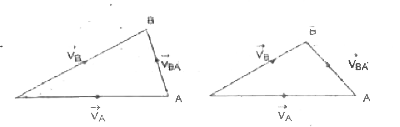
The vector difference between the absolute velocities of two bodies is called their relative velocity. The concept of relative velocity enables us to treat one body as being at rest while the other is in motion with the relative velocity. This jormalism greatly simplifies many problems. If `vecv_(A)`is the absolute velocity of a body A and `vec_(B)`that of another body B then the relative velocity of A in relation to B is `vec_(AD)=vecV_(A)-vecv_(B)` and `vecv_(BA)=vecv_(B)`-`vecv_(A)`.
The principle follows here is that the relative velocity of two bodies remains unchaged if the same additional velocity is imparted to both the bodies. A simple way of carrying out this operation is to be represent the velocities in magnitude and direction from a common point. Then the line joining the tips of the vectors represents the relative velocity
Q A river is flowing from west to east at a speed of 5 m/s. A man on the south bank of the river, capable of swimming at 10 m/s in still water, wants to cross the river without drifting, he. should swim

A

due north

B

`30^(@)` east of north

C

`30^(@)` west of north

D

`60^(@)` east of north

Text Solution

Verified by Experts

The correct Answer is:

C
Promotional Banner

Topper's Solved these Questions

  • KINEMATICS

    FIITJEE|Exercise ASSIGNMENT PROBLEMS (OBJECTIVE) LEVEL-II (MATRIX MATCH TYPE)|4 Videos
  • KINEMATICS

    FIITJEE|Exercise NUMERICAL BASED QUESTIONS|3 Videos
  • KINEMATICS

    FIITJEE|Exercise ASSIGNMENT PROBLEMS (OBJECTIVE) LEVEL-II (COMPREHENSIONS-II)|3 Videos
  • HEAT AND TEMPERATURE

    FIITJEE|Exercise NUMERICAL BASES QUESTIONS|1 Videos
  • LAWS OF MOTION

    FIITJEE|Exercise COMPREHENSION-III|2 Videos

Similar Questions

Explore conceptually related problems

The vector difference between the absolute velocities of two bodies is called their relative velocity. The concept of relative velocity enables us to treat one body as being at rest while the other is in motion with the relative velocity. This jormalism greatly simplifies many problems. If vecv_(A) is the absolute velocity of a body A and vec_(B) that of another body B then the relative velocity of A in relation to B is vec_(AD)=vecV_(A)-vecv_(B) and vecv_(BA)=vecv_(B) - vecv_(A) . The principle follows here is that the relative velocity of two bodies remains unchaged if the same additional velocity is imparted to both the bodies. A simple way of carrying out this operation is to be represent the velocities in magnitude and direction from a common point. Then the line joining the tips of the vectors represents the relative velocity Q A train A moves to the east with velocity of 40 km/hr and a train B moves due north with velocity of 30 km/hr. The relative velocity of A w.rt. B is

Relative Velocity|Questions

Can the relative velcity ot two bodies be greater than the absolute velcity of either body.

In perfectily inelastaic collition the relative velocity of the bodies

Define relative velocity. Deduce an expression for relative velocity of one object with respect to another in terms of their velocities relative to the earth.

Problems on Relative Velocity of Rain and Woman

Relative Angular Velocity

Kinematics - Problems On Relative Velocity

In the above question, if another body is at rest, then velocity of the compound body after collision is

Questions based on Relative velocity and Multiplication of Vectors
