Home
Class 12
PHYSICS
Three particles each of mass m can slide...

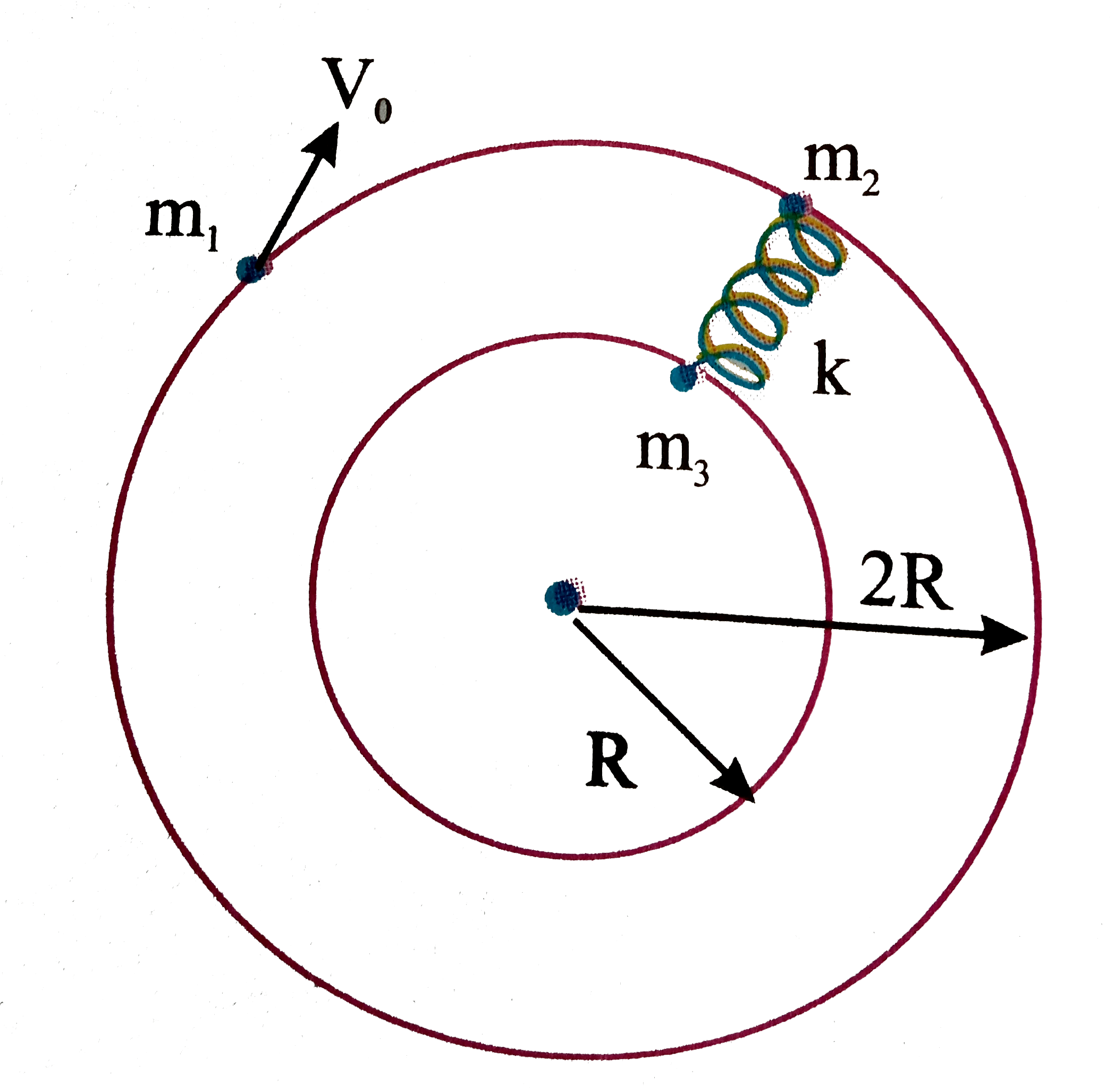
Three particles each of mass `m` can slide on fixed friction less circular tracks in the same horizontal plane as shown. Particle `m_(1)(=m)` moves with velocity `v_(0)` and hits particle `m_(2)(=m)`, the coefficient of restitution being `e=0.5` . Assume that `m_(2)` and `m_(3)(=m)` are at rest initially and lie along a radial line before impact, and the spring is initially unstretched.

Velocity of `m_(2)` immediately after impact is

A

`1/4 v_( 0)sqrt((m)/(5K))`

B

`3/4 v_(0)sqrt((m)/(5K))`

C

`1/3 v_(0)sqrt((m)/(5K))`

D

`1/8 v_(0)sqrt((m)/(5K))`

Text Solution

Verified by Experts

The correct Answer is:

B

By the conservation of linear momentum between `m_(1)` and `m_(2)` and by using coefficient of restitution velocity `m_(2)` just after collision `(3v_(0))/(4)`.
After the collision, the maximum extension in the spring occurs when angular velocity of `m_(2)` and `m_(3)` about O become same. Now by conservation of angular momentum about .O. and energy conservation
Velocity of `m_(2)=2 R omega=3/5 v_(0)`
Velocity of `m_(3)=R omega = (3)/(10)v_(0)` and `Deltax` maximum `=3/4 v_(0) sqrt((m)/(5K))`
Promotional Banner

Topper's Solved these Questions

  • WORK, ENERGY AND POWER

    FIITJEE|Exercise NUMERICAL BASED QUESTIONS|4 Videos
  • WORK, ENERGY AND POWER

    FIITJEE|Exercise MATRIX MATCH TYPE|6 Videos
  • WORK, ENERGY AND POWER

    FIITJEE|Exercise SOLVED PROBLEMS ( OBJECTIVE) ASSERTION REASONING TYPE|1 Videos
  • TEST PAPERS

    FIITJEE|Exercise PHYSICS|747 Videos

Similar Questions

Explore conceptually related problems

There particles each of mass m can slide on fixed frictioless circular tracks in the same horizontal plane as shown. Particle m_(1)(=m) moves with velocity v_(0) and hits particle m_(2)(=m) , the cofficient of restitution being e=0.5 . Assume that m_(2) and m_(3)(=m) are at rest initially and lie along a radial line before impact, and the spring is initially unstretched. Velocity of m_(2) immediately after impact is

Three particles each of mass m can slide on fixed frictionless horizontal circular tracks in the same horizontal plane as shown in the figure. The coefficient of restitution being e = 0.5 . Assuming that m_(2) and m_(3) are at rest initially and lie along a radial line before impact and the string is initially unstretched, then maximum extension in spring in subsequent motion

A particle moving with velocity (2hati-3hatj) m/s collides with a surface at rest in xz–plane as shown in figure and moves with velocity (2hati+2hatj) m/s after collision. Then coefficient of restitution is :

A particle of mass m_(1) collides head on with a stationary particles of mass m_(2) . If (m_(1))/(m_(2)) gte, where e is the coefficient of restitution, then :

A particle of mass m is strikes on ground at an angle of incidence 30^(@) with initial speed of 5 m/s . Calculate (i) its velocity after impact (ii) angle of reflection . Given that the coefficient of restitution is 1/(sqrt(3))

A particle of mass 'm' is projected with velocity v_(0) at an angle 'alpha' with the horizontal. The coefficient of restitution for any of its impact with the smooth ground is e . Find total time taken by the particle before it stops moving vertically?

A particle of mass m moving with velocity u collides elastically head on with a particle of mass 2m at rest. After collision the heavier particle moves with velocity?

A wedge of mass M is kept at rest on smooth surface a particle of mass m hits the wedge normally. Find the velocity of wedge and particle just after collision. Take coefficient of restitution as e .

A particle of mass m moving with a constant velocity v hits another identical stationary particle. If coefficient of restitution is e then ratio of velocities of two particles after collision is
