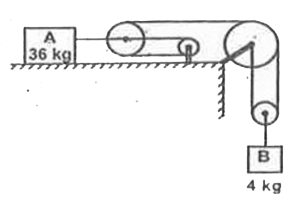
Text Solution
Verified by Experts
The correct Answer is:



Topper's Solved these Questions
WORK, ENERGY AND POWER
FIITJEE|Exercise ASSIGNMENT PROBLEMS ( OBJECTIVE) (LEVEL-I)|36 VideosWORK, ENERGY AND POWER
FIITJEE|Exercise ASSIGNMENT PROBLEMS ( OBJECTIVE) (LEVEL-I) (ASSERTION REASONING TYPE)|2 VideosWORK, ENERGY AND POWER
FIITJEE|Exercise ASSIGNMENT PROBLEMS ( SUBJECTIVE) (LEVEL-I) Numerical|8 VideosTEST PAPERS
FIITJEE|Exercise PHYSICS|747 Videos
Similar Questions
Explore conceptually related problems
FIITJEE-WORK, ENERGY AND POWER -ASSIGNMENT PROBLEMS ( SUBJECTIVE) (LEVEL-II & III)
- A block of mass m slides from the top of an inclined plane of angle o...
Text Solution
|
- A small body of mass m is located on a horizontal plane at the point O...
Text Solution
|
- A chain is held on a frictionless table with 1//n th of its length han...
Text Solution
|
- If the system is released from rest, determine the speeds of both mas...
Text Solution
|
- Given k1=1500Nm^-1, k2=500Nm^-1, m1=2kg, m2=1kg. Find: a. potenti...
Text Solution
|
- A spring of mass m lies on a smooth table. One, end of it is clamped t...
Text Solution
|
- A spherical balll of mass m is the highest point in the space between ...
Text Solution
|
- Two beads of masses m(1) and m(2) connected by an inextensible string ...
Text Solution
|
- A paricle of mass m moves along a circle of radius R with a normal acc...
Text Solution
|
- A ring of mass m=1kg can slide over a smooth vertical rod. A light str...
Text Solution
|
- A point mass m starts from rest and slides down the surface of a frict...
Text Solution
|
- Two identical particles each of mass m are connected by a light spring...
Text Solution
|
- A spring is attached with a block of mass m and a fixed horizontal roo...
Text Solution
|
- A loop of mass M with two identical rings of mass 3/2 M each at its to...
Text Solution
|
- A heavy particle is suspended by a stirng of length l. The particle is...
Text Solution
|