Home
Class 12
PHYSICS
In the situations shown in the figure su...

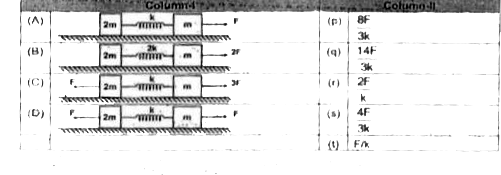
In the situations shown in the figure surfaces are frictionless. Find the maximum extension of the springs if blocks are initially at rest and springs are initially in natural lengths.

Text Solution

Verified by Experts

The correct Answer is:

(A) `rarr` (s), (B) `rarr` (s), (C) `rarr` (q), (D) `rarr` (r)
Promotional Banner

Topper's Solved these Questions

  • WORK, ENERGY AND POWER

    FIITJEE|Exercise Exercise|16 Videos
  • WORK, ENERGY AND POWER

    FIITJEE|Exercise ASSIGNMENT PROBLEMS ( SUBJECTIVE) (LEVEL-I) Short Answer Type Question|2 Videos
  • WORK, ENERGY AND POWER

    FIITJEE|Exercise NUMERICAL BASED QUESTIONS|4 Videos
  • TEST PAPERS

    FIITJEE|Exercise PHYSICS|747 Videos

Similar Questions

Explore conceptually related problems

Find the maximum tension in the spring if initially spring at its natural length when block is released from rest.

A block ofmass m is attached with a spring in its natural length, of spring constant k. The other end A of spring is moved with a constant acceleration 'a' away from the block as shown in the figure -3.74 . Find the maximum extension in the spring. Assume that initially block and spring is at rest w.r.t ground frame:

For shown situation find the maximum elongation in the spring. Neglect friction everywhere. Initiallthe blocks are at rest and spring is unstreched.

In the situation shown in figure all contact surfaces are smooth. The force constant of the spring is K. Two forces F are applied as shown. The maximum elongation produced in the spring is how many times of F//K (initially the spring is relaxed)?

Assertion: Two blocks A and B are connected at the two ends of an ideal spring as shwon in figure. Initially, spring was released. Now block B is pressed. Linear momentum of the system will not remain constan till the spring reaches its initial natural length. Reason: An external force will act from the wall on block A.

The ball strikes the block and sticks to it. Find the maximum compression of spring. ( L : natural length of spring)

A block of mass m collides with another block of mass 3m completely inelastically as shown in figure. What is the maximum value of v ( in m//s) for which the block B does not move. Assume that initially spring is in natural length and blocks A and B are at rest. (K//m=100 S.I. unit )

A block of mass M is kept on a smooth surface and touches the two springs as shown in the figure but not attached to the springs. Initially springs are in their natural length. Now, the block is shifted (l_(0)//2) from the given position in such a way that it compresses a spring and released. The time - period of oscillation of mass will be
