Home
Class 12
PHYSICS
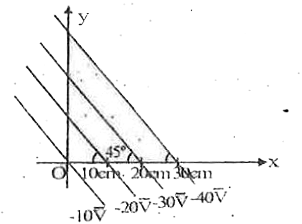
The gravitational field strength vecE an...

The gravitational field strength `vecE` and gravitational potential `V` are releated as
`vecE=-((deltaV)/(deltax)hati+(deltaV)/(deltay)hatj+(deltaV)/(deltaz)hatk)`

In the figure, transversal lines represent equipotential surfaces. A particle of mass `m` is released from rest at the origin. The gravitational unit of potential , `1vecV=1cm^(2)//s^(2)`
`x`-component of the velocity of the particle at the point `(4cm,4cm)` is

A

`4cm//s`

B

`2cm//s`

C

`2sqrt(2)(cm)/(s)`

D

`1cm//s`

Text Solution

Verified by Experts

The correct Answer is:

C
Promotional Banner

Topper's Solved these Questions

  • GRAVITATION

    FIITJEE|Exercise Assertion & Reasoning type|1 Videos
  • GRAVITATION

    FIITJEE|Exercise Numerical based Questions|4 Videos
  • GRAVITATION

    FIITJEE|Exercise Solved problem (Objective)|15 Videos
  • GMP ASSESMENT

    FIITJEE|Exercise Numerical Based|61 Videos
  • HEAT AND TEMPERATURE

    FIITJEE|Exercise NUMERICAL BASES QUESTIONS|1 Videos

Similar Questions

Explore conceptually related problems

The gravitational field strength vecE and gravitational potential V are releated as vecE=-((deltaV)/(deltax)hati+(deltaV)/(deltay)hatj+(deltaV)/(deltaz)hatk) In the figure, transversal lines represent equipotential surfaces. A particle of mass m is released from rest at the origin. The gravitational unit of potential , 1vecV=1cm^(2)//s^(2) y -component of E a the point whose co-ordinates are (4cm,4cm) is

The gravitational field strength vecE and gravitational potential V are releated as vecE=-((deltaV)/(deltax)hati+(deltaV)/(deltay)hatj+(deltaV)/(deltaz)hatk) In the figure, transversal lines represent equipotential surfaces. A particle of mass m is released from rest at the origin. The gravitational unit of potential , 1vecV=1cm^(2)//s^(2) Speed of the particle (v) ( y is in cm and v in cm/s) as function of its y -co-ordinate is

The gravitational field strength vecE and gravitational potential V are releated as vecE=-((deltaV)/(deltax)hati+(deltaV)/(deltay)hatj+(deltaV)/(deltaz)hark) In the figure, transversal lines represent equipotential surfaces. A particle of mass m is released from rest at the origin. The gravitational unit of potential , 1vecV=1cm^(2)//s^(2) Speed of the particle (v) ( y is in cm and v is in cm//s) as function of its y-co ordinate is

A particle of mass 1 kg is released from rest at a point where gravitational potential is 5 J/kg. After some time, it passes through a point B with a speed of 1 m/s. What is the gravitational potential at B ?

We know that electric field (E ) at any point in space can be calculated using the relation vecE = - (deltaV)/(deltax)hati - (deltaV)/(deltay)hatj - (deltaV)/(deltaz)hatk if we know the variation of potential (V) at that point. Now let the electric potential in volt along the x-axis vary as V = 2x^2 , where x is in meter. Its variation is as shown in figure Will the particle perform a simple harmonic motion? Also, find the time period of its oscillations.

We know that electric field (E ) at any point in space can be calculated using the relation vecE = - (deltaV)/(deltax)hati - (deltaV)/(deltay)hatj - (deltaV)/(deltaz)hatk if we know the variation of potential (V) at that point. Now let the electric potential in volt along the x-axis vary as V = 2x^2 , where x is in meter. Its variation is as shown in figure Draw the variation of electric field (E ) along the x-axis.

We know that electric field (E ) at any point in space can be calculated using the relation vecE = - (deltaV)/(deltax)hati - (deltaV)/(deltay)hatj - (deltaV)/(deltaz)hatk if we know the variation of potential (V) at that point. Now let the electric potential in volt along the x-axis vary as V = 2x^2 , where x is in meter. Its variation is as shown in figure A charge particle of mass 10 mg and charge 2.5 muC is released from rest at x = 2 m . Find its velocity when it crosses origin.

The gravitational field in a certain region is given as vec(E) = (3N kg^(-1)) hat(i) + (5N kg^(-1)) hat(j) (a) What will be magnitude of gravitational force acting on a particle of mass 3 g which is placed at the origin ? (b) What will be gravitational potential at point (12m, 0) and (0, 6m) considering that potential at origin is zero ? (c ) A particle of mass 3 kg is moved from the origin to the point (9m, 4m). Calculate the change of gravitational potential energy. (d) If the above particle is moved from (5m, 0) to (0, 5m), then find the change in potential energy.

A particle of mass 1kg moves along the curve y=x^(2) Magnitude of angular momentum of the particle about origin,when particle has x co-ordinate is (1)/(2)m and x-component of velocity is 4m/s is

The gravitational field in a region is given by the equation E=(5i + 12j) N//kg . If a particle of mass 2kg is moved from the origin to the point (12m, 5m) in this region, the change in the gravitational potential energy is
