Home
Class 12
CHEMISTRY
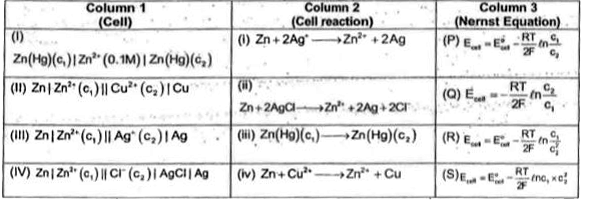
Which of the following combination is co...


Which of the following combination is correct?

A

I,I,P

B

II,III,Q

C

III,III,P

D

IV,II,S

Text Solution

Verified by Experts

The correct Answer is:
D
Promotional Banner

Topper's Solved these Questions

  • ELECTROCHEMISTRY

    FIITJEE|Exercise Matrix Match Type Questions|8 Videos
  • CONCEPT OF ACIDS AND BASES

    FIITJEE|Exercise SINGLE INTEGER ANSWER TYPE QUESTIONS|4 Videos
  • ELECTROPHILIC AROMATIC SUBSTITUTION

    FIITJEE|Exercise NUMERICAL BASED QUESTIONS INDICATED BY DIGITAL INTERGER|1 Videos

Similar Questions

Explore conceptually related problems

Which of the following combinations is correct?

Which of the following combinations is correct ?

Which of the following combinations is correct for wheat

Which of the following combinations is correct for wheat?

Which of the following combinations are correct for a binary solution, in which the solute as well as solvent are liquid?

The following processes occur during photosynthesis A. reduction of carbon dioxide B. the splitting of water C. the synthesis of glucose D. formation of oxygen gas E. formation of ATP. Which one of the following combinations is correct for the light phase

Knowledge Check

  • Which of the following combinations is correct?

    A
    Metal ions loosely attached with apoenzyme - Activators
    B
    Non protein organic part attached to apoenzyme firmly - Prosthetic group
    C
    Non protein organic part attached loosely to apoenzyme-Coenzyme
    D
    All of the above
  • Which of the following combinations is correct?

    A
    Metal ions loosely attached with Apoenzyme - Activators.
    B
    Non - protein organic part attached tightly to the Apoenzyme - Prosthetic group .
    C
    Non - protein organic part attached loosely to the Apoenzyme - Coenzyme .
    D
    all of these
  • Which of the following combinations is correct ?

    A
    `U_(rms) prop sqrtT and U_(rms) prop sqrtM`
    B
    `U_(rm s) prop sqrtT and U_(rm s) prop (1)/(sqrtM)`
    C
    `U_(rm s) prop (1)/(sqrtT) and U_(rm s) prop (1)/(sqrtM)`
    D
    `U_(rm s) prop (1)/(sqrtT) and U_(rm s) prop sqrtM`