

Home
Class 12
PHYSICS
A metallic rod of length l is hinged at ...

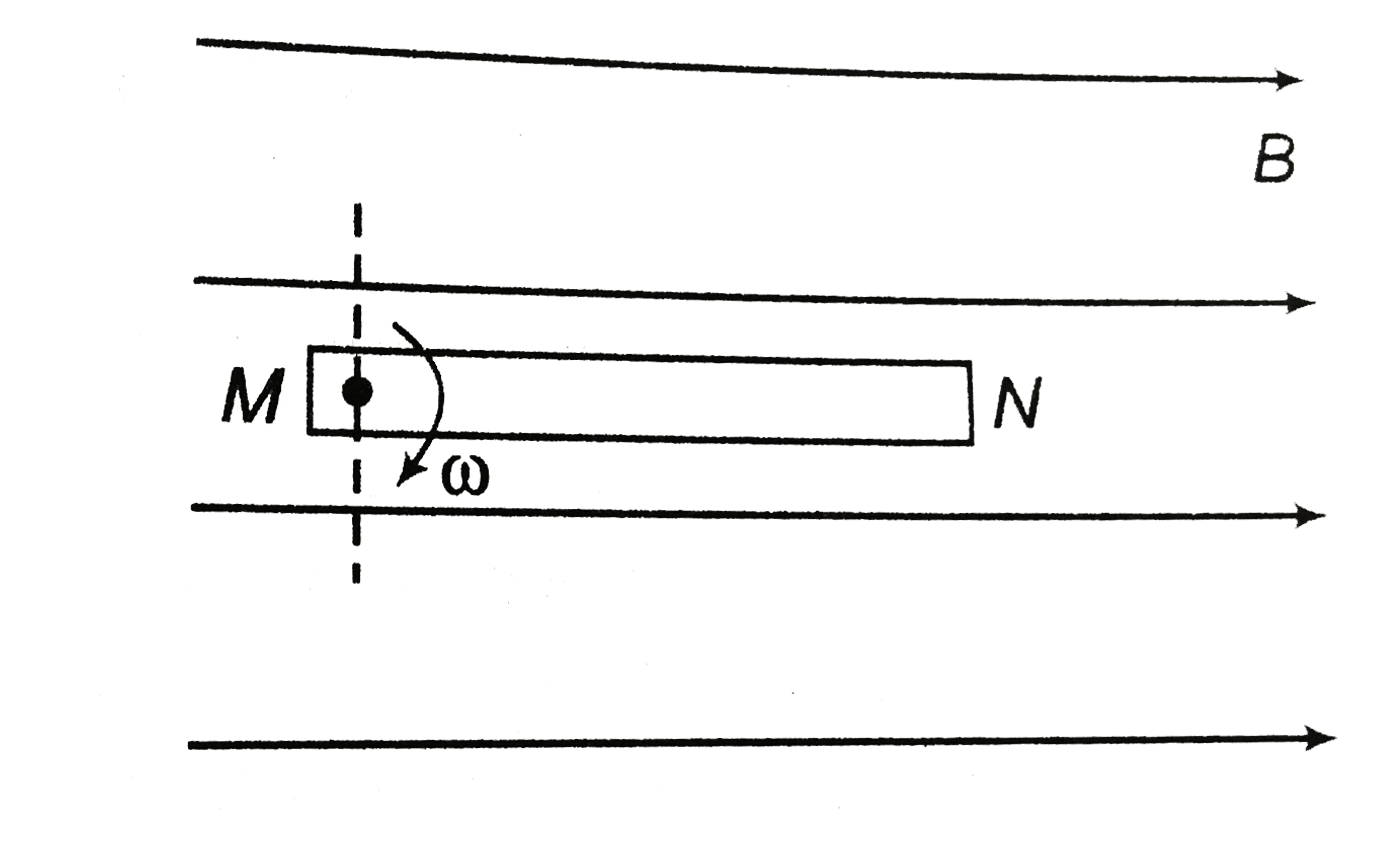
A metallic rod of length `l` is hinged at the point `M` and is rotating about an axis perpendicular to the plane of paper with a constant angular velocity `omega`. A uniform magnetic field of intensity `B` is acting in the region (as shown in the figure) parallel to the plane of paper. The potential difference between the points `M` and `N`

Promotional Banner

Similar Questions

Explore conceptually related problems

A horizontal rod of length 'l' rotates about a vertical axis with a uniform angular velocity 'omega' . A uniform magnetic field of induction B exists parallel to the axis of rotation. The potential different between the ends of the rod is

A copper rod of length l is rotated about one end perpendicular to the magnetic field B with constant angular velocity omega . The induced e.m.f between the two ends is

A copper rod of length l is rotated about one end perpendicular to the uniform magnetic field B with constant angular velocity omega . The induced e.m.f. between its two ends is

A copper rod of length l is rotated about one end perpendicular to the uniform magnetic field B with constant angular velocity omega . The induced e.m.f. between its two ends is

A rod of length l rotates with a uniform angular velocity omega about its perpendicular bisector. A uniform magnetic field B exists parallel to the axis of rotation. The potential difference between the two ends of the rod is

A rod of length l rotates with a small but uniform angular velocity omega about its perpendicular bisector. A uniform magnetic field B exists parallel to the axis of rotation. The potential difference between the centre of the rod and an end is

A rod of length l rotates with a small but uniform angular velocity omega about its perpendicular bisector. A uniform magnetic field B exists parallel to the axis of rotation. The potential difference between the centre of the rod and an end is