Home
Class 12
CHEMISTRY
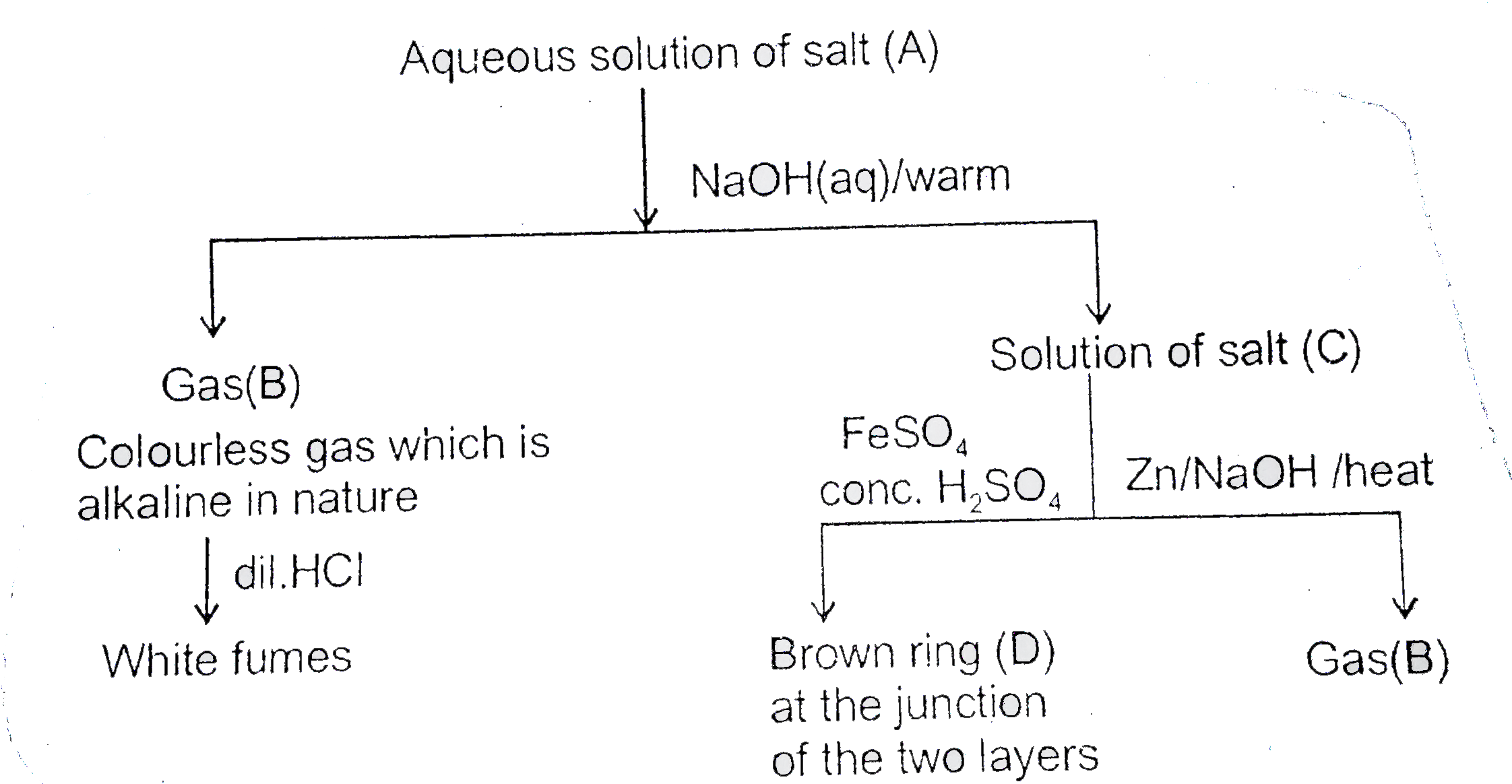
Salt(A) on heating gives a colourless ne...


Salt`(A)` on heating gives a colourless neutral gas which supports combustion.
From the aforesaid, flow diagram, answer the following questions.
The basic radical of salt `(A)` and gas `B` both gives brown precipitate with Nessler's reagent.The composition of the brown precipitate is:

A

`(NH_(4))_(2)[HgI_(4)]`

B

`Hg(NH_(2))NO_(3)`

C

`HgO.HG(NH_(2))I`

D

`(NH_(4))_(3)[Co(NO_(2))_(6)]`

Text Solution

Verified by Experts

The correct Answer is:

C

`NH_(4)^(+)+2[HgI_(4)]^(2-)+4OH^(-)toHgO.Hg(NH_(2))Idarr+7I^(-)+3H_(2)O`
Hence the cation is `NH_(4)^(+)`
Promotional Banner

Topper's Solved these Questions

  • QUALITATIVE ANALYSIS PART 1

    RESONANCE|Exercise Board level exercis|24 Videos
  • QUALITATIVE ANALYSIS PART 1

    RESONANCE|Exercise EXERCISE 1 PART 1 QUALITATIVE ANALYSIS|13 Videos
  • QUALITATIVE ANALYSIS (ANION)

    RESONANCE|Exercise Matching List Type|1 Videos
  • RANK BOOSTER

    RESONANCE|Exercise All Questions|620 Videos

Similar Questions

Explore conceptually related problems

Salt (A) on heating gives a colourless neutral gas which supports combustion. From the aforesaid, flow diagram, answer the following questions. Which of the following statement is correct ?

Salt (A) on heating gives a colourless neutral gas which supports combustion. From the aforesaid, flow diagram, answer the following questions. The compound (A) contains the following acid radical.

Ammonium salts give a brown precipitate with Nessler's reagent due to the formation of ___________.

Basic radical which gives Nessler's reagent test in which brown precipitate or brown colouration obtained

Unknown salt + AI-powder +NaOH (conc) rarr Gas comes out which Nessler's reagent brown. The salt may be:

A compound containing acetate radical is made to react with neutral ferric chloride. The solution is then diluted with water and boiled for 1-2 minutes. A reddish brown precipitate is obtained.Give the chemical composition of reddish brown precipitate.

RESONANCE-QUALITATIVE ANALYSIS PART 1-A.L.P
  1. Salt(A) on heating gives a colourless neutral gas which supports combu...

    Text Solution

    |

  2. A red solid is insoluble in water.However it becomes soluble if some K...

    Text Solution

    |

  3. When a salt is heated with dilute H(2)SO(4) and KMnO(4) solution, the ...

    Text Solution

    |

  4. Solution of a salt in dilute H(2)SO(4) or acetic acid produces deep bl...

    Text Solution

    |

  5. A test tube containing a nitrate and another containing a bromide and ...

    Text Solution

    |

  6. An inorganic salt when heated with concentrated H(2)SO(4) evolves a co...

    Text Solution

    |

  7. Chromyl chloride vapours are dissolved in water and acetic acid and ba...

    Text Solution

    |

  8. When CS(2) layer containing both Br(2) and I(2) (2:1) is shaken with e...

    Text Solution

    |

  9. A metal salt solution gives a yellow precipitate with silver nitrate.T...

    Text Solution

    |

  10. Which of the following will not give positive chromyl chloride test ?

    Text Solution

    |

  11. A white sodium salt dissolves in water to give a solution which is neu...

    Text Solution

    |

  12. A one litre flask is full of reddish brown bromine fumes.The intensity...

    Text Solution

    |

  13. Identify the compound which turns black with ammonia solution.

    Text Solution

    |

  14. A white crystalline substance dissolves in water.On passing H(2)S in t...

    Text Solution

    |

  15. The composition of golden spangles is:

    Text Solution

    |

  16. Select the incorrect statement(s).

    Text Solution

    |

  17. Original solution of salt or mixture should not be prepared in concent...

    Text Solution

    |

  18. White precipitate of PbSO(4) gets dissolved in:

    Text Solution

    |

  19. What final product(s) is/are formed in the following series of reacton...

    Text Solution

    |

  20. Which of the following sulphides do not dissolve in 50% HNO(3) but dis...

    Text Solution

    |

  21. Which of the following statement(s) is/are correct ?

    Text Solution

    |
