


Similar Questions
Explore conceptually related problems
Recommended Questions
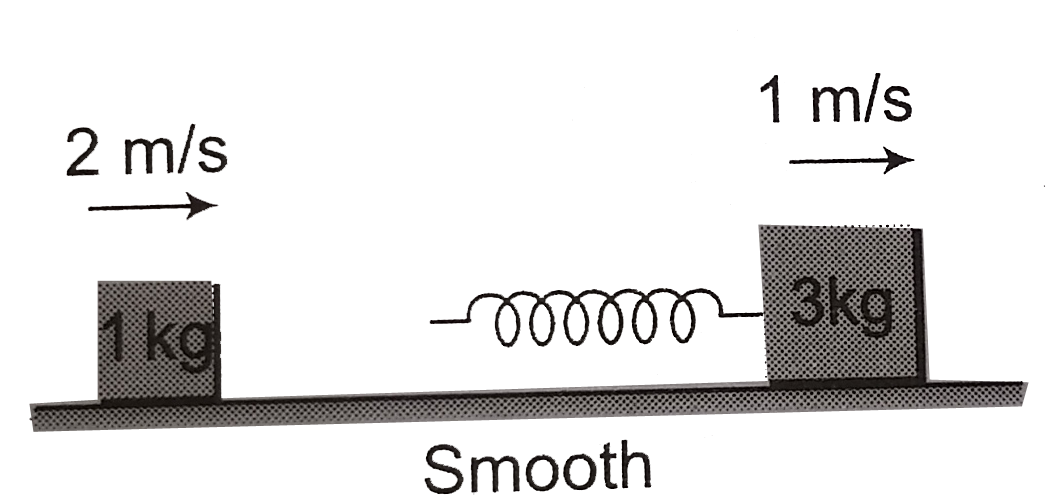
- Two blocks of masses 1 kg and 3 kg are moving with velocities 2 m//s a...
Text Solution
|
- Each of the blocks shown in figure has mass 1 kg. The rear block moves...
Text Solution
|
- A block of mass 2.0 kg is moving on a frictionless horizontal surface ...
Text Solution
|
- A ball of mass 1 kg moving with velocity 3 m//s, collides with spring ...
Text Solution
|
- A block of mass m moving at a speed v0 compresses a spring of spring c...
Text Solution
|
- A block of mass 200 g is given velocity 2(m)//(s) on a horizontal surf...
Text Solution
|
- A block of mass m = 25 kg on a smooth horizontal surface with a veloci...
Text Solution
|
- Two blocks of masses 1 kg and 3 kg are moving with velocities 2 m//s a...
Text Solution
|
- 2 mass of block 2 kg & 4 kg are attached to a stiffness spring 100 N/m...
Text Solution
|