

Home
Class 11
PHYSICS
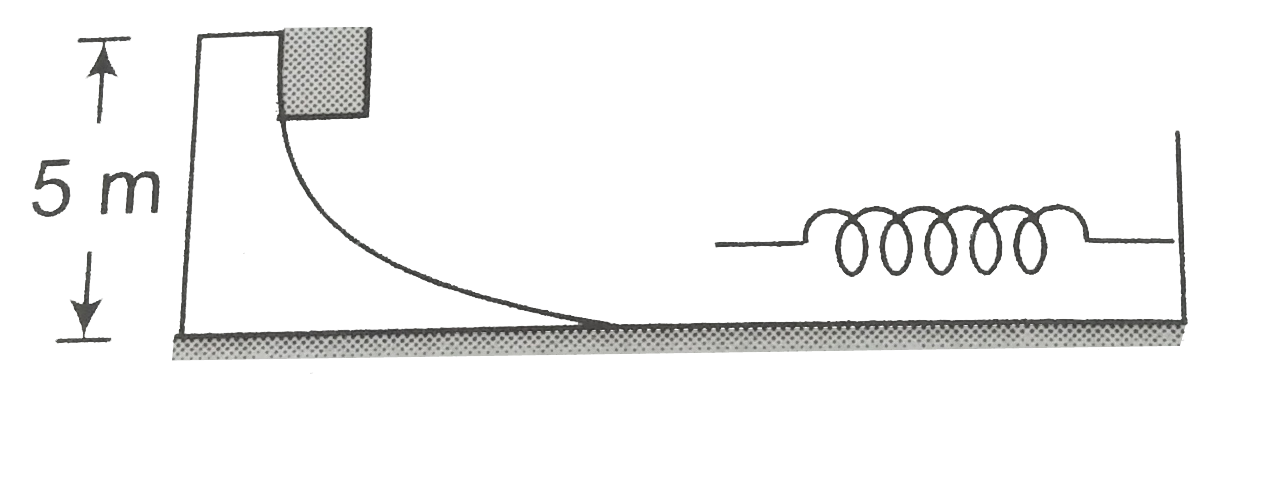
The figure shows a smooth curved track t...


The figure shows a smooth curved track terminating in a smooth horizontal part. A spring of spring constant `400(N)//(m)` is attached at one end to a wedge fixed rigidly with the horizontal part . A 40 g mass is released from rest at a height of 5 m on the curved track. The maximum compression of the spring will be

Promotional Banner

Similar Questions

Explore conceptually related problems

Figure shows a smooth curved track terminating in a smooth horizontal part. A spring of sprng constant 400 N/m is asttached at one end ot a wedge fixed rigidly with the horizontal part. A 40 g mas is released from rest at a height of 4.9 m n the curved track. Find the maximumcompression of the spring.

Figure shows a smooth curved track terminating in a smooth horizontal part. A spring of sprng constant 400 N/m is asttached at one end ot a wedge fixed rigidly with the horizontal part. A 40 g mas is released from rest at a height of 4.9 m n the curved track. Find the maximumcompression of the spring.

Figure shows a smooth curved track terminating in a smooth horizontal part. A spring of sprng constant 400 N/m is asttached at one end ot a wedge fixed rigidly with the horizontal part. A 40 g mas is released from rest at a height of 4.9 m n the curved track. Find the maximumcompression of the spring.

A slab of mass 'm' is released from a height x to the top a spring of force constant k. The maximum compression of the spring is y. Then

A smooth curved surface of height 10 m is ended horizontally. A spring of force constant 200 Nm^(-1) is fixed at the horizontal end as shown in figure when an object of mass 10g is released from the top, it travels along the curved path and collides with the spring. Then, the maximum compression in the spring is (Take, g = 10ms^(-2) )

A smooth curved surface of height 10 m is ended horizontally. A spring of force constant 200 Nm^(-1) is fixed at the horizontal end as shown in figure when an object of mass 10g is released from the top, it travels along the curved path and collides with the spring. Then, the maximum compression in the spring is (Take, g = 10ms^(-2) )

A small mass 'm' is sliding down on a smooth curved incline form a height 'h' and finally moves through a horizontal smooth surface. A light spring of force constant K is fixed with a vertical rigid stand on the horizontal surface, as shown in the figure. Find the value for the maximum compression in the spring if mass 'm' is released from rest from height 'h' and hits the spring in the horizontal surface. .

A body of mass 5 kg moving with a speed of 1.5 m/s on a horizontal smooth surface collides with a nearly weightless spring of force constant k = 5 N/m. The maximum compression of the spring would be

A body of mass 5 kg moving with a speed of 1.5 m/s on a horizontal smooth surface collides with a nearly weightless spring of force constant k = 5 N/m. The maximum compression of the spring would be

mass of 0.5 kg moving with a speed of 1.5 m//s on a horizontal smooth surface, collides with a nearly weightless spring of force constant k = 50 N/m. The maximum compression of the spring would be