

Home
Class 11
PHYSICS
A car moves with speed v on a horizontal...

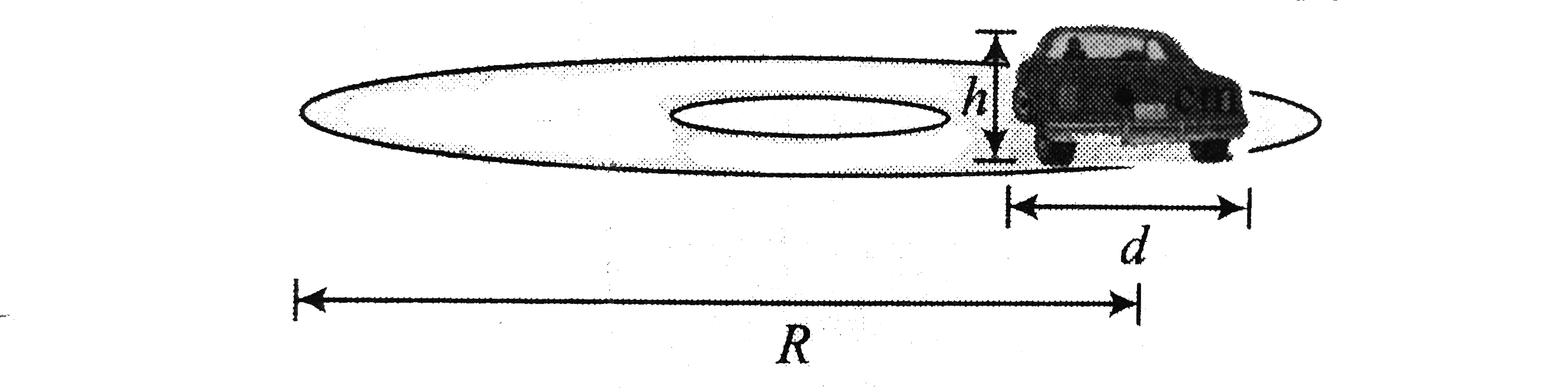
A car moves with speed `v` on a horizontal circular track of radius `R`. A head-on view of the car is shown in figure. The height of the car's centre of mass above the ground `h`, and the separation between its inner and outer wheel, is `d`. The road is dry, and the car does not skid. Show that the maximum speed the car can have without overturning is given by `v_(max)=sqrt((gRd)/(2h))`. To reduce the risk of rollover, should one increase or decrease `h`? Should one increase or decrease the width `d` of the wheel base?

Promotional Banner

Similar Questions

Explore conceptually related problems

A car moves with speed v on a horizontal circular track of radius R . A head-on view of the car is shown in figure. The height of the car's centre of mass above the ground is h , and the separation between its inner and outer wheels is d The road is dry, and the car does not skid. The maximum speed the car can have without overturning is : .

A car of maas M is moving on a horizontal circular path of radius r. At an instant its speed is v and is increasing at a rate a.

A car of maas M is moving on a horizontal circular path of radius r. At an instant its speed is v and is increasing at a rate a.

A car of maas M is moving on a horizontal circular path of radius r. At an instant its speed is v and is increasing at a rate a.

A car of mass Mis moving on a horizontal cirular path of radius r. At some instant its speed is v and in increasing at a rate a, then

A car of mass m travelling at speed v moves on a horizontal track. The centre of mass of the car describes a circle of radius r . If 2a is the separation of the inner and outer wheels and h is the height of the centre of mass above the ground, show that the limiting speed beyond which the car will overturn in given by v^(2)=(gra)/h

A car goes on a horizontal circular road of radius R. The speed of car is increasing at constant rate a m/ s^2 . If the friction coefficient between the road and the tyre is mu , then the limiting speed of car is

A car goes on a horizontal circular road of radius R. The speed of car is increasing at constant rate a m/ s^2 . If the friction coefficient between the road and the tyre is mu , then the limiting speed of car is