

Home
Class 11
CHEMISTRY
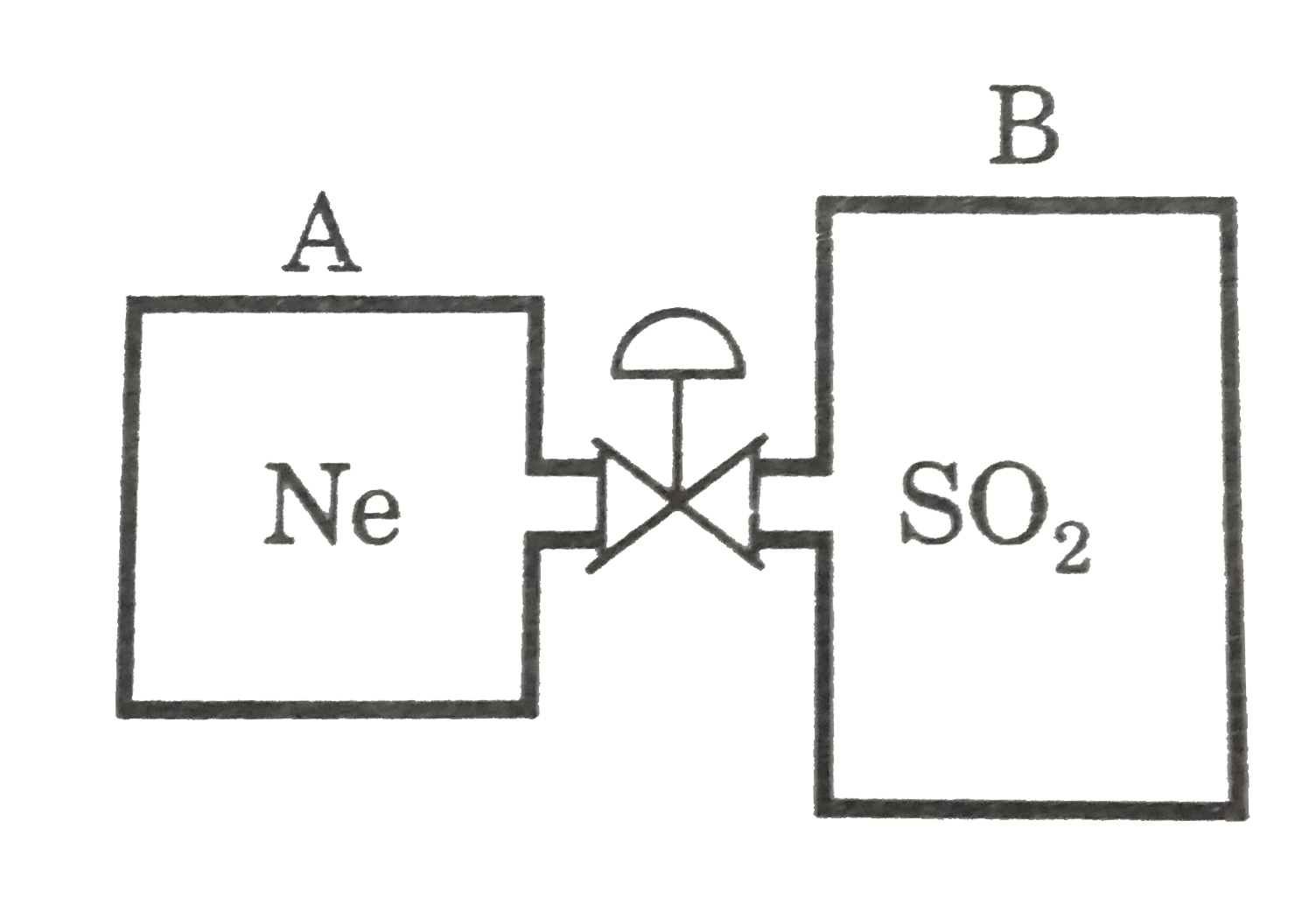
Two rigid adiabatic vessel A and B which...

Two rigid adiabatic vessel A and B which initially ,contain two gases at different temperature are connected by pipe line with value of negligible volume .The vessel A contain 2 moles Ne gas `(C_(p.m)=(5)/(2)R)` at 300 K, vessel B contain 3 moles of `SO_(2) gas (C_(p.m)=4 R)` at 400 K .
The volume of the A and B vessel is 4 and 6 litre repectively .
The final total pressue (in atm ) when valve is opened and 12 kcal heat supplied throught it to vessels .
[Use :` R =2 cal //"mole" K "and" R=0.08 L . atm//"mole"` K as
per desire ]

Promotional Banner

Similar Questions

Explore conceptually related problems

Two rigid adiabatic vessels A and B which initially, contain two gases at different temperature are connected by pipe line with value of negligible volume. The vessel 'A' contain 2 moles Ne gas (C_(p.m) = (5)/(2)R) at 300K, vessel 'B' contain 3 moles of SO_(2) gas (C_(p.m) = 4R) at 400K. The volume of A & B vessel is 4 and 6 litre respectively. The final total pressure (in atm) when value is opened and 12 Kcal heat supplied through it to vessels. [Use: R= 2 cal/mol, K and R= 0.08L. atm/mol K as per desire]

Three closed rigid vessels, A, B and C, which initially contain three different gases at different temperatures are connected by tube of negligible volume, without any energy transfer with surroundings. The vessel A contain 2 mole Ne gas, at 300 K, vessel 'B' contain 2 mole SO_(2) gas at 400 K and vessel 'C' contain 3 mole CO_(2) gas at temperature 500 K. What is the final pressure (in atm) attained by gases when all valves of connecting three vessels are opened and additional 15.6 kcal hear supplied to vessels through valve. The volume of A, B and C vessel is 2, 2 and 3 litre respectively Given :R =2 calorie/mol-K, C_(v)(Ne)=3//2R,C_(v)(CO)=5//2R and C_(v)(SO_(2))=3R

Three closed rigid vessels, A, B and C, which initially contain three different gases at different temperatures are connected by tube of negligible volume, without any energy transfer with surroundings. The vessel A contain 2 mole Ne gas, at 300 K, vessel 'B' contain 2 mole SO_(2) gas at 400 K and vessel 'C' contain 3 mole CO_(2) gas at temperature 500 K. What is the final pressure (in atm) attained by gases when all valves of connecting three vessels are opened and additional 15.6 kcal hear supplied to vessels through valve. The volume of A, B and C vessel is 2, 2 and 3 litre respectively Given :R =2 calorie/mol-K, C_(v)(Ne)=3//2R,C_(v)(CO)=5//2R and C_(v)(SO_(2))=3R

Three closed rigid vessels, A, B and C, which initially contain three different gases at different temperatures are connected by tube of negligible volume, without any energy transfer with surroundings. The vessel A contain 2 mole Ne gas, at 300 K, vessel 'B' contain 2 mole SO_(2) gas at 400 K and vessel 'C' contain 3 mole CO_(2) gas at temperature 500 K. What is the final pressure (in atm) attained by gases when all valves of connecting three vessels are opened and additional 15.6 kcal hear supplied to vessels through valve. The volume of A, B and C vessel is 2, 2 and 3 litre respectively Given :R =2 calorie/mol-K, C_(v)(Ne)=3//2R,C_(v)(CO)=5//2R and C_(v)(SO_(2))=3R

Two closed vessel A and B of equal volume of 8.21 L are connected by a narrow tube of negligible volume with open valve. The left hand side container is found to contain 3 mole CO_(2) and 2 mole of He at 400 K. What is the partial pressure of He in vessel B at 400 K?

Two closed vessel A and B of equal volume of 8.21 L are connected by a narrow tube of negligible volume with open valve. The left hand side container is found to contain 3 mole CO_(2) and 2 mole of He at 400 K. What is the partial pressure of He in vessel B at 400 K? (a)2.4 atm (b)8atm (c)12atm (d)None of these

Two vessels of the same volume contain the same gas at same temperature. If the pressure in the vessels is in the ratio of 1 : 2, then