

Home
Class 11
PHYSICS
An object A is kept at the point x=3m an...

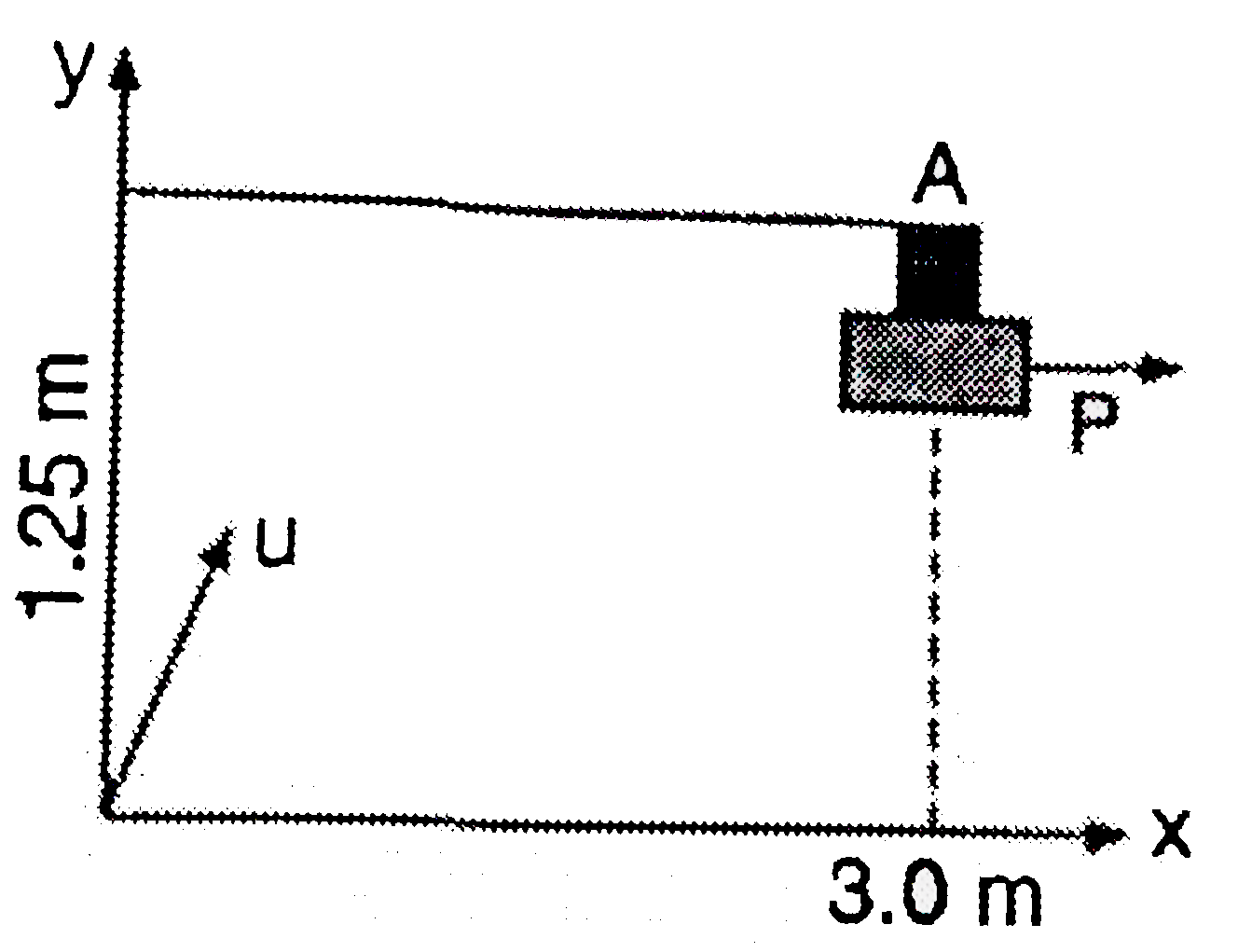
An object A is kept at the point x=3m and y=1.25m on a plank P reaised above the groun. At tiem t=0 the palnk starts moving along the +x-direction with an accleration 1.5 `m//s^(2)`. At the same instant a stone is projected from the origin with a velocity u as shown. A stationary person on the ground observers the stone hitting the object during its downward motion at an angle of `45^(@)` to the horizontal. All the motions are in the x-y plane. Find u and the time after which the stone hits the object. Take `g=10m//s^(2)`.

Promotional Banner

Similar Questions

Explore conceptually related problems

An object A is kept fixed at the point x= 3 m and y = 1.25 m on a plank p raised above the ground . At time t = 0 the plank starts moving along the +x direction with an acceleration 1.5 m//s^(2) . At the same instant a stone is projected from the origin with a velocity vec(u) as shown . A stationary person on the ground observes the stone hitting the object during its downward motion at an angle 45(@) to the horizontal . All the motions are in the X -Y plane . Find vec(u) and the time after which the stone hits the object . Take g = 10 m//s

An object A is kept fixed at the point x= 3 m and y = 1.25 m on a plank p raised above the ground . At time t = 0 the plank starts moving along the +x direction with an acceleration 1.5 m//s^(2) . At the same instant a stone is projected from the origin with a velocity vec(u) as shown . A stationary person on the ground observes the stone hitting the object during its downward motion at an angle 45(@) to the horizontal . All the motions are in the X -Y plane . Find vec(u) and the time after which the stone hits the object . Take g = 10 m//s

An object A is kept fixed at the point x= 3 m and y = 1.25 m on a plank p raised above the ground . At time t = 0 the plank starts moving along the +x direction with an acceleration 1.5 m//s^(2) . At the same instant a stone is projected from the origin with a velocity vec(u) as shown . A stationary person on the ground observes the stone hitting the object during its downward motion at an angle 45(@) to the horizontal . All the motions are in the X -Y plane . Find vec(u) and the time after which the stone hits the object . Take g = 10 m//s

An object A is kept fixed at the point x= 3 m and y = 1.25 m on a plank p raised above the ground . At time t = 0 the plank starts moving along the +x direction with an acceleration 1.5 m//s^(2) . At the same instant a stone is projected from the origin with a velocity vec(u) as shown . A stationary person on the ground observes the stone hitting the object during its downward motion at an angle 45^@ to the horizontal . All the motions are in the X -Y plane . Find vec(u) and the time after which the stone hits the object . Take g = 10 m//s

A stone is released from the top of a tower 90m high. At the same instant a second stone is projected vertically upwards from the ground with a velocity of 30 m//s . When and where will the two stones meet?

An object at rest at the origin begins to move in the +x direction with a uniform acceleration of 1 m//s^(2) for 4s and then it continues moving with a uniform velocity of 4 m/s in the same direction. The x-t graph for object's motion will be -

An object starts from rest at the origin and moves along the x axis with a constant acceleration of 4m//s^(2) . Its average velocity as it goes from x=2 m to x=8 m is :

A stone is allowed to fall from the top of a tower 300 m height and at the same time another stone is projected vertically up from the ground with a velocity 100 m//s . Find when and where the two stones meet?

A stone is dropped from the top of a tower 200 m high. At the same time, another stone is projected vertically upwards from the ground with a velocity of 40m//s . Calcuate when and where the two stones will mest.

A balloon starts rising from the ground with an acceleration of 1.25 m/ s^2 . A stone is released from the balloon after 10s. Determine (i) maximum height of stone from the ground. (ii) time taken by stone to reach the ground. (Assume, g = 10 m/ s^2 )