

Home
Class 11
PHYSICS
Two identical balls (A) and (B) each of ...

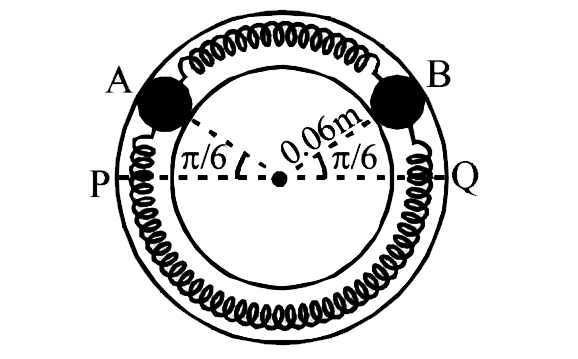
Two identical balls (A) and (B) each of mass (0.1 kg), are attached to two identical massless springs. The spring - mass system is constrained to move inside a riged smooth pipe bant in the form of a circle as shown in Fig. The pipe is fixed in a horizontal plane.
The centres of the balls can move in a circle of radius (0.06 pi) meter. Each spring has a natural length `zof0.06 pi` meter and spring spring constant5 `0.1 N//m`. Initially, both the balls are displaced by an angle `theta = pi// 6` radian with respect to the diameter (pQ) of the circle (as shown in Fig.) and released from, rest.
.
(i) Calculate the frequency of oscillation of ball (B).
(ii) Find the speed of ball (A) when (A) and (B) are at the two ends of the diameter (PQ).
(iii) What is the total energy of the system.

Promotional Banner

Similar Questions

Explore conceptually related problems

Two identical balls A and B each of mass 0.1 kg are attached to two identical mass less is springs. The spring-mass system is constrained to move inside a right smooth pipe bent in the form of a circle as shown in figure . The pipe is fixed in a horizontal plane. The center of the balls can move in a circle of radius 0.06 m . Each spring has a natural length of 0.06 pi m and force constant 0.1 N//m . Initially, both the balls are displaced by an angle theta = pi//6 radians with respect to diameter PQ of the circle and released from rest. a. Calculate the frequency of oscillation of the ball B.

Two identical balls A and B each of mass 0.1 kg are attached to two identical mass less is springs. The spring-mass system is constrained to move inside a right smooth pipe bent in the form of a circle as shown in figure . The pipe is fixed in a horizontal plane. The center of the balls can move in a circle of radius 0.06 m . Each spring has a natural length of 0.06 pi m and force constant 0.1 N//m . Initially, both the balls are displaced by an angle theta = pi//6 radians with respect to diameter PQ of the circle and released from rest. a. Calculate the frequency of oscillation of the ball B. b. What is the total energy of the system ? c. Find the speed of the ball A when A and B are at the two ends of the diameter PQ.

Two identical balls A and B each of mass 0.1 kg are attached to two identical mass less is springs. The spring-mass system is constrained to move inside a right smooth pipe bent in the form of a circle as shown in figure . The pipe is fixed in a horizontal plane. The center of the balls can move in a circle of radius 0.06 m . Each spring has a natural length of 0.06 pi m and force constant 0.1 N//m . Initially, both the balls are displaced by an angle theta = pi//6 radians with respect to diameter PQ of the circle and released from rest. a. Calculate the frequency of oscillation of the ball B. b. What is the total energy of the system ? c. Find the speed of the ball A when A and B are at the two ends of the diameter PQ.

Two identical balls A and B eavh of mass 0.1 kg are attached to two identical mass less is springs. The spring-mass system is consetrained to move inside a right smooth pipe bent in the form of a circle as shown in figure . The pipe is fixed in a horigental plane. The center of the balls can move in a circle of radius 0.06 m . Each spring has a natural length of 0.06 pi m and force constant 0.1 N//m . Initially, both the balls are displaced bu an angle theta = pi//6 dadius withrespect to diameter PQ of the circle and released from rest. a. Calculate the frequency of oscillation of the ball B. b. What is the total energy of the system ? c. Find the speed of the bal A when A and B are at the two ends of the diameter PQ.

Two identical balls A and B eavh of mass 0.1 kg are attached to two identical mass less is springs. The spring-mass system is consetrained to move inside a right smooth pipe bent in the form of a circle as shown in figure . The pipe is fixed in a horigental plane. The center of the balls can move in a circle of radius 0.06 m . Each spring has a natural length of 0.06 pi m and force constant 0.1 N//m . Initially, both the balls are displaced bu an angle theta = pi//6 dadius withrespect to diameter PQ of the circle and released from rest. a. Calculate the frequency of oscillation of the ball B. b. What is the total energy of the system ? c. Find the speed of the bal A when A and B are at the two ends of the diameter PQ.

A particle of mass m is attached to three identical massless springs of spring constant 'k' as shown in the figure. The time period of vertical oscillation of the particle is

Two identical blocks each of mass 1kg are joined together with a compressed spring. When the system is released the two blocks appear to be moving with unequal speeds in the opposite directions as shown in fig. Choose the correct statement -

Two identical blocks each of mass 1kg are joined together with a compressed spring. When the system is released the two blocks appear to be moving with unequal speeds in the opposite directions as shown in fig. Choose the correct statement -

Two bodies A and B each of mass M are fixed together by a massless spring A force F acts on the mass B as shown in fig At the instant shown the mass A has acceleration a. What is the acceleration of mass B?