

Home
Class 11
PHYSICS
For what value of M will the masses be i...

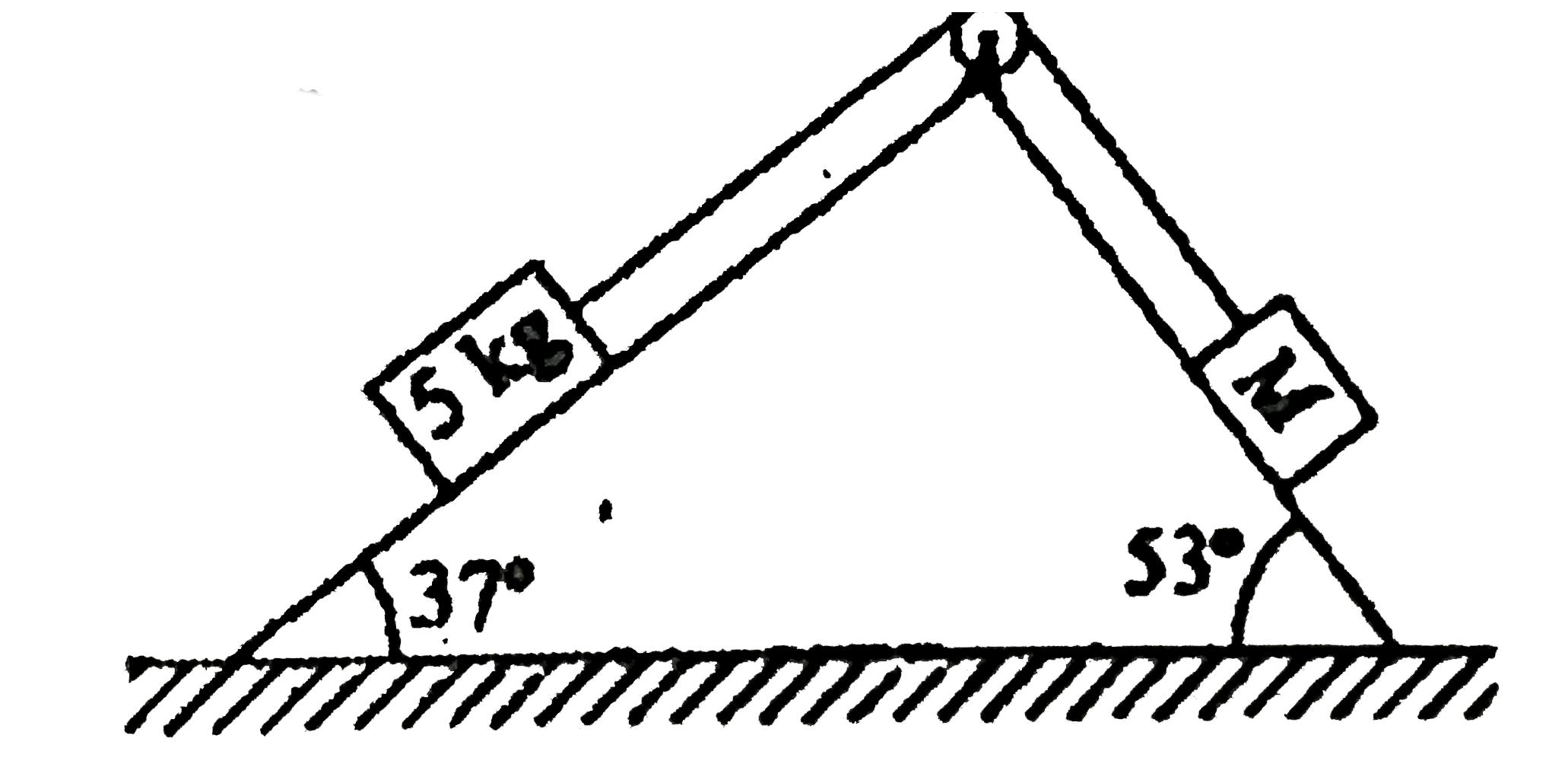
For what value of M will the masses be in equilibrium. Masses are placed on fixed wedge :

Promotional Banner

Similar Questions

Explore conceptually related problems

Coefficient of friction between block of mass m and fixed wedge is mu = 0.5 . For what value of (m)/(M) frictional force between block of mass m and wedge becomes zero ?

Block A of mass m is placed over a wedge of same mass m. Both the block and wedge are placed on a fixed inclined plane. Assuming all surfaces to be smooth calculate the displacement of the block A in ground frame in 1s .

Block A of mass m is placed over a wedge of same mass m. Both the block and wedge are placed on a fixed inclined plane. Assuming all surfaces to be smooth, the displacement of the block A in ground frame in 1s is (gsin^(2)theta)/(x+sin^(2)theta) then the value of x is:

A block of mass m is at rest over the rough surface of the fixed wedge.

A wedge of inclination theta is placed on a smooth surface. Ablock of mass m placed on the wedge is found to be stationary w.r.t the wedge . Select the correct alternative .

A wedge with mass M rests on a frictionless horizontal surface A block with mass m is placed on the wedge. There is no friction between the block and the wedge. A horizontal force f is applied to the wedge. What magnitude F must have if the block is to remain at constant height above the table top?

A block of mass M is placed on a horizontal surface. It is tied with an inextensible string that passes through ideal pulleys. A mass m is connected to the pulley as shown. For what value of m, the block M will accelerate towards the fixed pulley ?

A block of mass M is placed on a horizontal surface. It is tied with an inextensible string that passes through ideal pulleys. A mass m is connected to the pulley as shown. For what value of m, the block M will accelerate towards the fixed pulley ?

A ball of mass M is in equilibrium between a vertical wall and the inclined surface of a wedge. The inclination of the wedge is theta = 45^(@) and its mass is very small compared to that of the ball. The coefficient of friction between the wedge and the floor is mu and there is no friction elsewhere. Find minimum value of mu for which this equilibrium is possible