

Home
Class 11
PHYSICS
Charge Q is uniformly distributed only o...

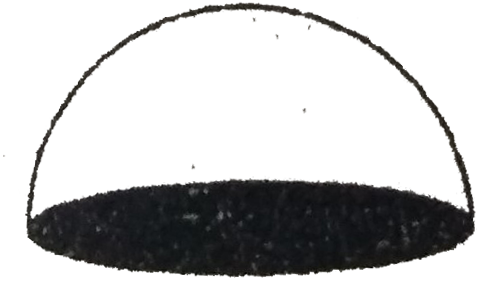
Charge Q is uniformly distributed only on curved surface of a thin hemispherical shell. A,B and C are three points on the circular base of hemisphere, such that A is the centre. Let the electric potential at points A, B and C be `V_A, V_B, V_C` respectively. Then

Promotional Banner

Similar Questions

Explore conceptually related problems

Mass M is uniformly distributed only on curved surface of a thin hemispherical shell. A, B and C are three points on the circular base of hemisphere, such that A is the centre. Let the gravitational potential at poins A, B and C be V_(A), V_(B), V_(C) respectively. Then :

Mass M is uniformly distributed only on curved surface of a thin hemispherical shell. A, B and C are three points on the circular base of hemisphere, such that A is the centre. Let the gravitational potential at poins A, B and C be V_(A), V_(B), V_(C) respectively. Then :

In the given circuit find the |V_(A) - V_(B)| where V_(A), V_(B) are electric potentials at the points A and B.

A circuit has a section ABC if the potential at point A,B and C are V_(1) , V_(2) and V_(3) respectively , calculate the potential at point O

A circuit has a section ABC if the potential at point A,B and C are V_(1) , V_(2) and V_(3) respectively , calculate the potential at point O

Figure shown three points A, B and C in a region of unifrom electric field vecE . The line AB is perpendicular and BC is parallel to the field lines. Then which of the following holds good. Where V_(A), V_(B) and V_(C) represenet the electric potential at points A, B and C respectively

Figure shown three points A, B and C in a region of unifrom electric field vecE . The line AB is perpendicular and BC is parallel to the field lines. Then which of the following holds good. Where V_(A), V_(B) and V_(C) represenet the electric potential at points A, B and C respectively

A hollow conducting sphere is placed in an electric field produced by a point charge placed at P as shown in figure. Let V_(A), V_(B), V_(C ) be the potentials at points A, B and C respectively. Then