Home
Class 12
PHYSICS
Consider a sphere of radius R with char...

Consider a sphere of radius R with charge density distributed as `rho (R) = kr` for `r le R, rho (R) = 0` for `r gt R`.
(a) Find the electric field at all points r.
(b) suppose the total charge on the sphere is 2e, where e is the electron charge. Where can two protons be embedded such that the force on each of them is zero. Assume that the introduction of the proton does not alter the negative charge distribution.

Text Solution

Verified by Experts
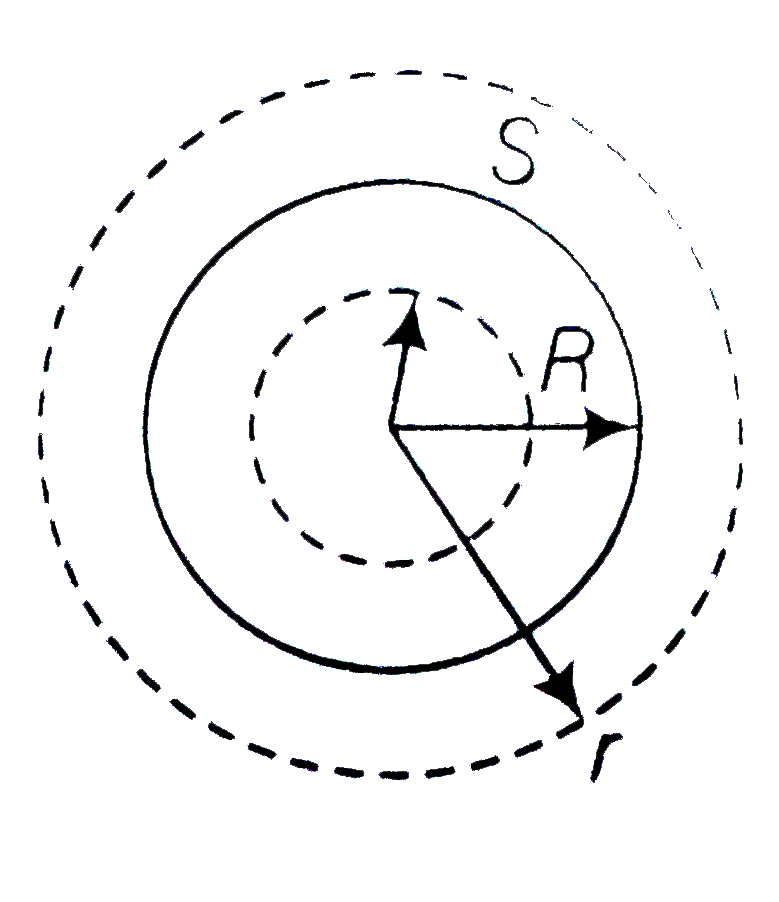

(a) Let us consider a sphere S of radius R and two hypothetic sphere of radius `r lt R and r gt R`
Now, for point rltR, electric field intenstiy will be given by:
`ointE.dS=(1)/(epsi_(0))intrhodV`
[For dV, `V=(4)/(3)pir^(3)impliesdV=3xx(4)/(3)pir^(3)dr=4pir^(2)dr`]
`impliesointE.dS=(1)/epsi_(0))4piKint_(0)^(r)r^(3)dr` (`becausep(r)=Kr`)
`implies(E)4pir^(2)=(4piK)/(epsi_(0))(r^(4))/(4)`
`impliesE=(1)/(epsi_(0))Kr^(2)`
here, charge density of positive.
So, direction of E is radially outwards.
For points `r gtR`, electric field intenstiy will be given by
`ointE.dS=(1)/(epsi_(0))intrho.dV`
`impliesE(4pir^(2))=(4piK)/(epsi_(0))int_(0)^(R)r^(3)dr=(4piK)/(epsi_(0))(R^(4))/(4)`
`impliesE=(K)/(4epsi_(0))(R^(4))/(r^(2))`
Charge density is again positive. So, the directio of E is radially outward.
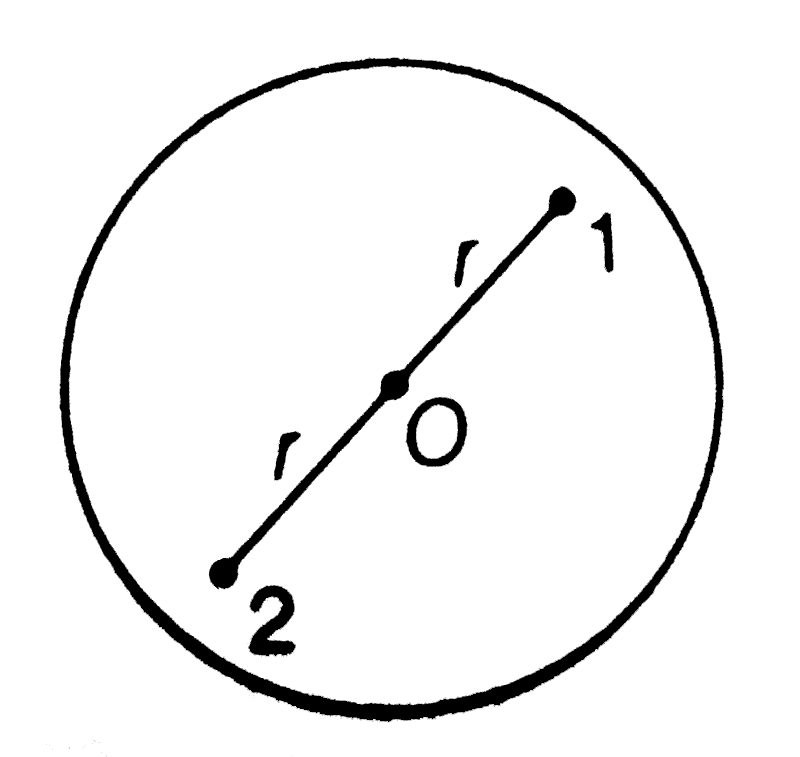
(b). The two protons must be on the opposite sides of the centre along a diameter folloiwng the rule of symmetry. this can be shown by the figure given below. cahrge on the sphere.

`q=int_(0)^(R)rhodV=int_(0)^(R)(Kr)4pir^(2)dr`
`q=4piK(R^(4))/(4)=2e`
`thereforeK=(2e)/(piR^(4))`
If protons 1 and 2 are embedded at distance r from the centre of the sphere as shown, the attractive force on proton 1 due to charge distribution is
`F_(1)=eE=(-eKr^(2))/(4epsi_(0))`
Repulsive force on proton 1 due to proton 2 is
`F_(2)=(e^(2))/(4piepsi_(0)(2r)^(2))` ltBrgt Net force on proton 1,
`F=F_(1)+F_(2)`
`=F=(-eKr^(2))/(4epsi_(0))+(e^(2))/(16piepsi_(0)r^(2))`
so, `F=[(-er^(2))/(4epsi_(0))(Ze)/(4piR^(4))+(e^(2))/(16piepsi_(0)r^(4))]`
Thus, net force on proton 1 will be zero, when
`(er^(2)2e)/(4epsi_(0)piR^(4))=(e^(2))/(16piepsi_(0)r)`
`impliesr^(4)=(R^(4))/(8)`
`impliesr=(R)/((8)^(1//4))` ltBrgt This is the distance of each of the two protons from the centre of the sphere.
Promotional Banner

Topper's Solved these Questions

  • DUAL NATURE OF RADIATION AND MATTER

    NCERT EXEMPLAR|Exercise Dual Nature Of Radiation And Matter|29 Videos
  • ELECTROMAGNETIC INDUCTION

    NCERT EXEMPLAR|Exercise Electromagnetic Induction|32 Videos

Similar Questions

Explore conceptually related problems

Consider a sphere of radius R with charge density distributed as rho (R) = kr for r le R and = 0 for r gt R . (a) Find the electric field at all points r. (b) suppose the total charge on the sphere is 2e, where e is the electron charge. Where can two protons be embedded such that the force on each of them is zero. Assume that the introduction of the proton does not alter the negative charge distribution.

A sphere of radius R contains charge density rho(r )=A (R-r ) , for 0 lt r lt R . The total electric charge inside the sphere is Q. The electric field inside the sphere is

A solid ball of radius R has a charge density rho given by rho = rho_(0)(1-(r )/(R )) for 0le r le R The electric field outside the ball is :

Consider a spherical symmetric charge distribution with charge density varying as rho={[rho_(0)(1-(r)/(R)),r R]} The electric field at r , r le R will be

A sphere of radius R contains charge density rho(r )=A (R-r ) , for 0 lt r lt R . The total electric charge inside the sphere is Q. The value of A in terms of Q and R is

A sphere of radius R_(0 carries a volume charge density proportional to the distance (x) from the origin, rho=alpha x where alpha is a positive constant.The total charge in the sphere of radius R_(0) is

A charge +Q , is uniformaly distributed within a sphere of radius R. Find the electric field, due to this charge distribution, at a point distant r form the centre of the spehre where : (i) 0 lt r lt R and (ii) r gt R

NCERT EXEMPLAR-ELECTRIC CHARGES AND FIELD-Electric Charges And Field
  1. Refer to the arrangement of charges in Fig and a Gaussian surface of r...

    Text Solution

    |

  2. A positive charge Q is uniformly distributed along a circular ring of ...

    Text Solution

    |

  3. An arbitrary surface encloses a dipole. What is the electric flux thro...

    Text Solution

    |

  4. A metal spherical shell has an inner radius R(1) and outer radius R(2...

    Text Solution

    |

  5. The dimensions of an atom are of the order of an Angstrom. Thus there ...

    Text Solution

    |

  6. If the total charge enclosed by a surface is zero, does it imply that...

    Text Solution

    |

  7. Sketch the electric field lines for a unifomly charged hollow cylinder...

    Text Solution

    |

  8. What will be the total flux through the faces of the cube, with side o...

    Text Solution

    |

  9. A paisa coin is made up Al-Mg alloy and weighs 0.75 g. It has a squar...

    Text Solution

    |

  10. Consider a coin, It is electrically neutral and contains equal amounts...

    Text Solution

    |

  11. Figure represents a crystal unit of cesium chloride, CsCl. The cesium ...

    Text Solution

    |

  12. Two charge q and –3q are placed fixed on x–axis separated by distance ...

    Text Solution

    |

  13. Fig. shows the electric field lines around three points charges A,B,C....

    Text Solution

    |

  14. Five charges , q each are placed at the corners of a regular pentagon ...

    Text Solution

    |

  15. In 1959 Lyttleton and Bondi suggested that the expansion of the univer...

    Text Solution

    |

  16. Consider a sphere of radius R with charge density distributed as rho ...

    Text Solution

    |

  17. Two fixed, identical conducting plates (alpha and beta), each of surfa...

    Text Solution

    |

  18. There is another useful system of units, besides the SI/MKS. A system,...

    Text Solution

    |

  19. Two charges -q each are fixed separated by distance 2d. A third charge...

    Text Solution

    |

  20. Total charge -Q is uniformly spread along length of a ring of radius R...

    Text Solution

    |