Home
Class 12
PHYSICS
Two fixed, identical conducting plates (...

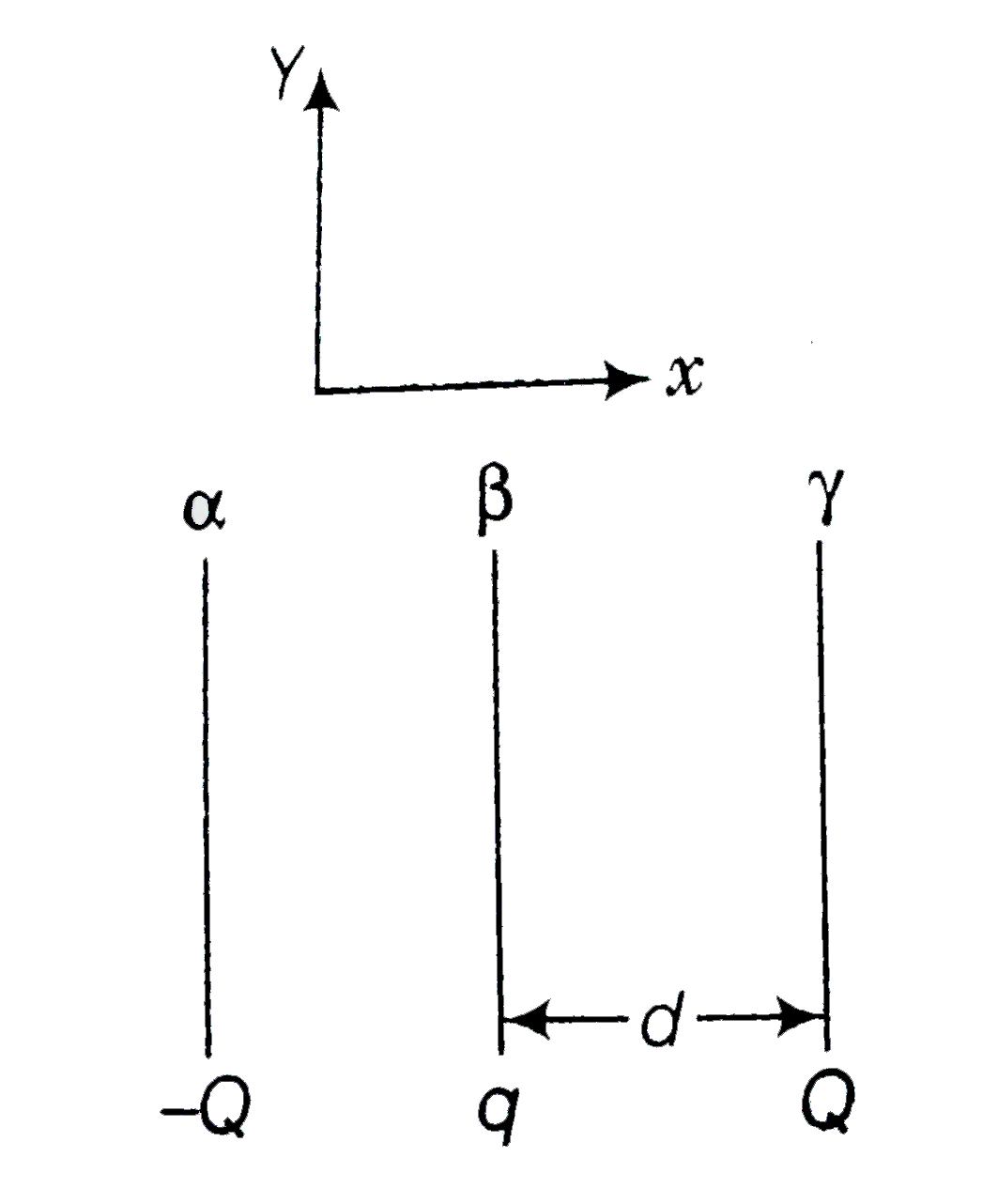
Two fixed, identical conducting plates `(alpha and beta)`, each of surface area S are charged to -Q and q, respectively, where Q `gt` q `gt` 0. A third identical plate `(gamma)`, free to move is located on the other side of the plate with charge Q at a distance d (figure). The third plate is released and collides with the plate `beta`. Assume the collision is elastic and the time of collision is sufficient to redistribute charge amongst `beta and gamma`.
(a) Find the electric field acting on the plate `gamma` before collision.
(b) Find the charges on `beta and gamma` after the collision.
(c) Find the velocity of the plate `gamma` after the collision and at a distance d from the plate `beta.`

Text Solution

Verified by Experts

(a). Find electric field at plate `gamma` before collision is equal to the sum of electric field at plate `gamma` due to plate `alpha and beta`.
The electric field at plate `gamma` due to plate `alpha` is `E_(1)=(-Q)/(S(2epsi_(0)))` to the left.
The electric field at plate `gamma` due to plate `beta` is `E_(2)=(q)/(S(2epsi_(0)))`, to the right
Hence, the ent electric field at plate `gamma` before collision,
`E=E_(1)+E_(2)=(q-Q)/(S(2epsi_(0)))`, to the left if `Q gt q`
(b) During collision, plates `beta and gamma` are together. Their potentials become same.
Suppose charge on plate `beta ` is `q_(1)` and cahrge on plate `gamma` is `q_(2)`. At any point O, in between the two plates, the electric field must be zero.
Electric field at O due to plate `alpha=(-Q)/(S(2epsi_(0)))`, to the left
Electric field at O due to plate `beta=(q_(1))/(S(2epsi_(0)))`, to the right ltBrgt Electric field at O due to plate `gamma=(q_(2))/(S(2epsi_(0)))`, to the left
As the electric field at O is zero, therefore ltBrgt `(Q+q_(2))/(S(2epsi_(0)))=(q_(1))/(S(2epsi_(0)))`
`thereforeQ+q_(2)=q_(1)`
`Q=q_1+q_2` . . .(i)
As there is no loss of charge o collision, ltBrgt `Q+q=q_(1)+q_(2)`
On solving eqs. (i) and (ii), we get
`q_(1)=(Q+q//2)`=charge on plate `beta`
`q_(2)=(q//2)`=charge on plate `gamma`
(c) After collision, at a distance d from plate `beta`.
Let the velocity of plate `gamma` be v. After the collision, electric field at plate `gamma` is
`E_(2)=(-Q)/(2epsi_(0)S)+((Q+q//2))/(2epsi_(0)S)=(q//2)/(2epsi_(0)S)` to the right
just before collision, electric field at plate `gamma` is `E_(1)=(Q-q)/(2epsi_(0)S)`
If `F_(1)` is force on plate `gamma` before collision, then `F_(1)=E_(1)Q=((Q-q)Q)/(2epsi_(0)S)`
Total work done by the electric field is round trip movement of plate `gamma`
`W=(F_(1)+F_(2))d`
`=([(Q-q)Q+(q//2)^(2)]d)/(2epsi_(0)S)=((Q-q//2)^(2)d)/(2epsi_(0)S)` ltBrgt If m is mass of plate `gamma`, the KE gained by plate `gamma=(1)/(2)mv^(2)`
According to work-energy principle, `(1)/(2)mv^(2)=W=((Q-q//2)^(2)d)/(2epsi_(0)S)`
`gamma=(Q-q//2)((d)/(mepsi_(0)S))^(1//2)`.
Promotional Banner

Topper's Solved these Questions

  • DUAL NATURE OF RADIATION AND MATTER

    NCERT EXEMPLAR|Exercise Dual Nature Of Radiation And Matter|29 Videos
  • ELECTROMAGNETIC INDUCTION

    NCERT EXEMPLAR|Exercise Electromagnetic Induction|32 Videos

Similar Questions

Explore conceptually related problems

Force between two conducting large plates , with charges Q and Q/2 as shown in the figure, is (Area of each face of plate =A)

Two identical metal plates each having surface area A, having charges q_1 and q_2 , are placed facing each other at a separation d. Find the charge appearing on surface (1),(2),(3), and (4). Assume the size of the plate is much larger than the separation between the plates.

Two large conducting plates of a parallel plate capacitor are given charges Q and 3Q respectively. If the electric field in the region between the plates is E_0 , then the force of interaction between the plates is

Three identical conducting plain parallel plates, each of area A are held with equal (/ between successive surfaces. Charges 2Q , and 3Q are placed on them. Neglecting edge effects, find the Charge on the left face of the middle plate

Three identical conducting plates P_(1),P_(2) and P_(3) are kept at a distance d from each other. If q,-q,2q are the charges in P_(1),P_(2) and P_(3) respectively, the electric field between P_(1) and P_(2) is (where A is area of plate)

Five identical plates are connected across a battery as follows : If the charge on plate 1 be +q , then the charges on the plates 2, 3, 4 and 5 are

Three identical metallic plates are kept parallel to one another at separations a and b. The outer plates are connected to the ground and the middle plate is given charge Q. Then, the charge on the right side of middle plate is

Two infinite conduting plates 1 and 2 are separated by a distance l . A point chagre q is located between the plates at a distance x from plate 1. Find the charges induced on each plate.

Identical metal plates are located in air at equal distance d from one another. The area of each plate is equl to A Evaluate the capacitance of the system between P and Q if the plates are interconnected as shown in. .

NCERT EXEMPLAR-ELECTRIC CHARGES AND FIELD-Electric Charges And Field
  1. Refer to the arrangement of charges in Fig and a Gaussian surface of r...

    Text Solution

    |

  2. A positive charge Q is uniformly distributed along a circular ring of ...

    Text Solution

    |

  3. An arbitrary surface encloses a dipole. What is the electric flux thro...

    Text Solution

    |

  4. A metal spherical shell has an inner radius R(1) and outer radius R(2...

    Text Solution

    |

  5. The dimensions of an atom are of the order of an Angstrom. Thus there ...

    Text Solution

    |

  6. If the total charge enclosed by a surface is zero, does it imply that...

    Text Solution

    |

  7. Sketch the electric field lines for a unifomly charged hollow cylinder...

    Text Solution

    |

  8. What will be the total flux through the faces of the cube, with side o...

    Text Solution

    |

  9. A paisa coin is made up Al-Mg alloy and weighs 0.75 g. It has a squar...

    Text Solution

    |

  10. Consider a coin, It is electrically neutral and contains equal amounts...

    Text Solution

    |

  11. Figure represents a crystal unit of cesium chloride, CsCl. The cesium ...

    Text Solution

    |

  12. Two charge q and –3q are placed fixed on x–axis separated by distance ...

    Text Solution

    |

  13. Fig. shows the electric field lines around three points charges A,B,C....

    Text Solution

    |

  14. Five charges , q each are placed at the corners of a regular pentagon ...

    Text Solution

    |

  15. In 1959 Lyttleton and Bondi suggested that the expansion of the univer...

    Text Solution

    |

  16. Consider a sphere of radius R with charge density distributed as rho ...

    Text Solution

    |

  17. Two fixed, identical conducting plates (alpha and beta), each of surfa...

    Text Solution

    |

  18. There is another useful system of units, besides the SI/MKS. A system,...

    Text Solution

    |

  19. Two charges -q each are fixed separated by distance 2d. A third charge...

    Text Solution

    |

  20. Total charge -Q is uniformly spread along length of a ring of radius R...

    Text Solution

    |
