Home
Class 12
PHYSICS
A test charge q is made to move in the ...

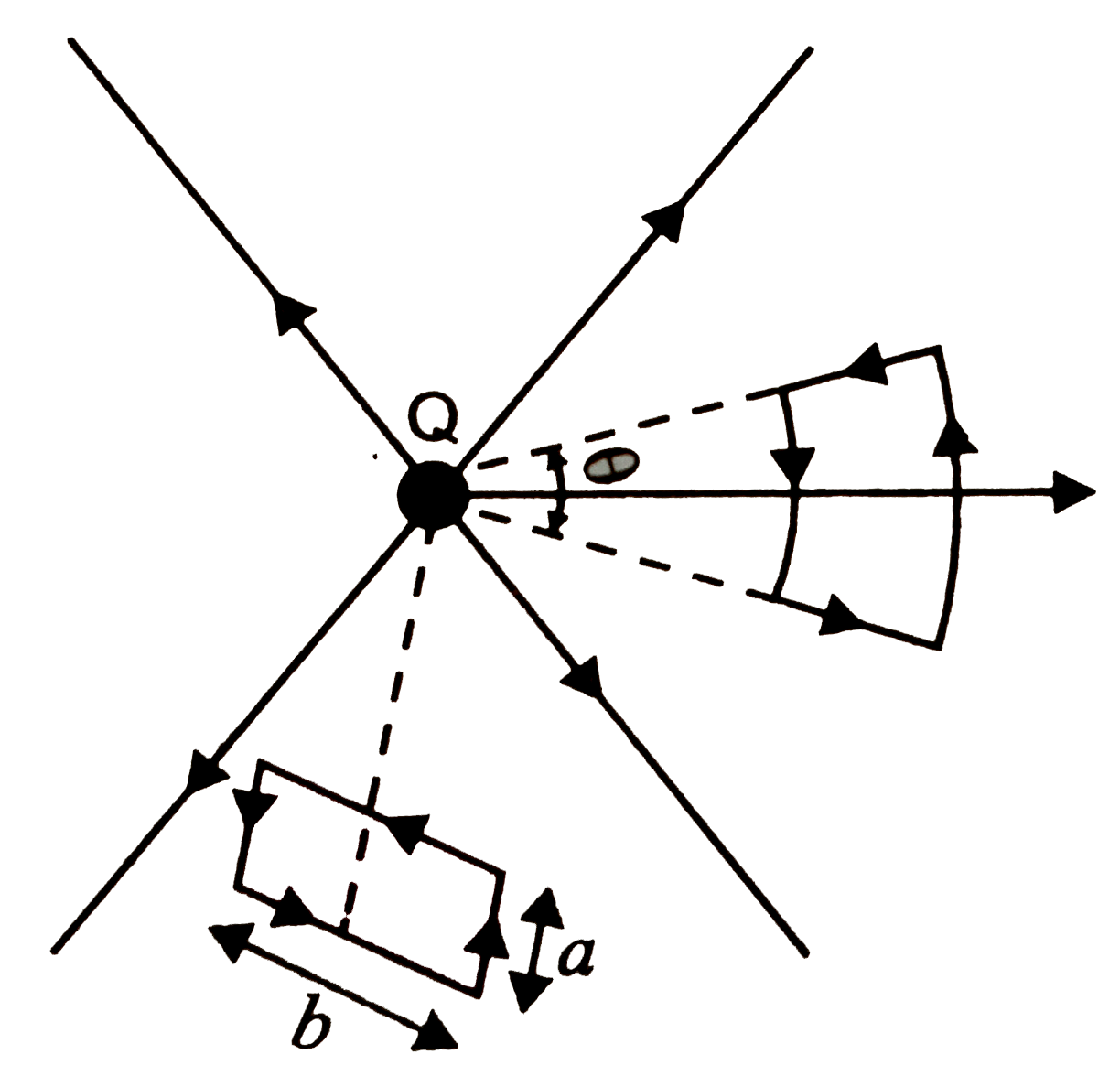
A test charge q is made to move in the electric field of a point charge Q along two different closed paths. Fig. First path has sections along and perpendicular loop of the same area as the first loop. How does the work done compare in the two cases?

Text Solution

Verified by Experts

As electric field is conservative, work done will be zero in both cases.
Promotional Banner

Topper's Solved these Questions

  • ELECTROMAGNETIC WAVES

    NCERT EXEMPLAR|Exercise Electromagnetic Waves|32 Videos
  • MAGNETISM AND MATTER

    NCERT EXEMPLAR|Exercise Magnetism And Matter|25 Videos

Similar Questions

Explore conceptually related problems

A point charge q is rotated along a circle in the electric field generated by anotherj point charge Q. The work done by the electric field on the rotatin charge in one complete revolution is

A point charge Q is moved along a ciruclar path around another fixed point charge. The work done is zero

How much work is done in moving a charge of 5C across two points having a potential difference of 16V?

In the electric field of a point charge ( + q) , placed at the centre of a circle , a certain test charge is carried from point A to B, C,D and E Least amount of work is done along the path

Plot a graph comparing the variation of potential ‘V’ and electric field ‘E’ due to a point charge ‘Q’ as a function of distance r from point charge (ii) Find the ratio of the potential differences that must be applied across the parallel and the series combination of two identical capacitors so that the energy stored, in the two cases, becomes the same.

How much work is done in moving a charge of 2 C across two points having a potential difference of 12 V ?

An isolated conducting sheet of area A and carrying a charge Q is placed in a uniform electric field E, such that the electric field is perpendicular to the sheet and covers all the sheet. Find out the charges appearing on its two surfaces.

NCERT EXEMPLAR-ELECTROSTATIC POTENTIAL AND CAPACITANCE-Electrostatic Potential And Capacitance
  1. Consider two conducting spheres of radii R(1) and R(2) with R(1) gt R(...

    Text Solution

    |

  2. Do free electrons travel to region of higher potential or lower potent...

    Text Solution

    |

  3. Can there be a potential difference between two adjacent conductors c...

    Text Solution

    |

  4. Can the potential function have a maximum or minimum is free space ?

    Text Solution

    |

  5. A test charge q is made to move in the electric field of a point cha...

    Text Solution

    |

  6. Prove that a closed equipotenitial surface with no charge within itsel...

    Text Solution

    |

  7. A capacitor has some dielectric between its plates, and the capacitor ...

    Text Solution

    |

  8. Prove that, if an insulated, uncharged conductor is placed near a ch...

    Text Solution

    |

  9. Calculate potential energy of a point charge -q placed along the axis...

    Text Solution

    |

  10. Calculate potential on the axis of a ring due to charge Q uniformly ...

    Text Solution

    |

  11. Find the equatio of the equipotentials for an infinite cylinder of rad...

    Text Solution

    |

  12. Two point charges of magnitude +q and -q are placed at (-d//2,0,0) and...

    Text Solution

    |

  13. A parallel palte capacitor is filled by a dielectric whose relative p...

    Text Solution

    |

  14. A capacitor is made of two circular plates of radius R each, separate...

    Text Solution

    |

  15. (a) In a quark model of elementary particles, a neutron is made of one...

    Text Solution

    |

  16. Two metal spheres, one fo radius R and the other of radius 2R, both ...

    Text Solution

    |

  17. In the circuit shown in Fig, initially K(1) is closed and K(2) is open...

    Text Solution

    |

  18. Calculate potential on the axis of a disc of radius R due to a charge ...

    Text Solution

    |

  19. Two charges q(1) and q(2) are placed at (0,0,d) and (0,0,-d) respectiv...

    Text Solution

    |

  20. Two charges -q each are separated by dsitance 2d. A third charge +q i...

    Text Solution

    |
