

Home
Class 12
PHYSICS
(a) In a quark model of elementary parti...

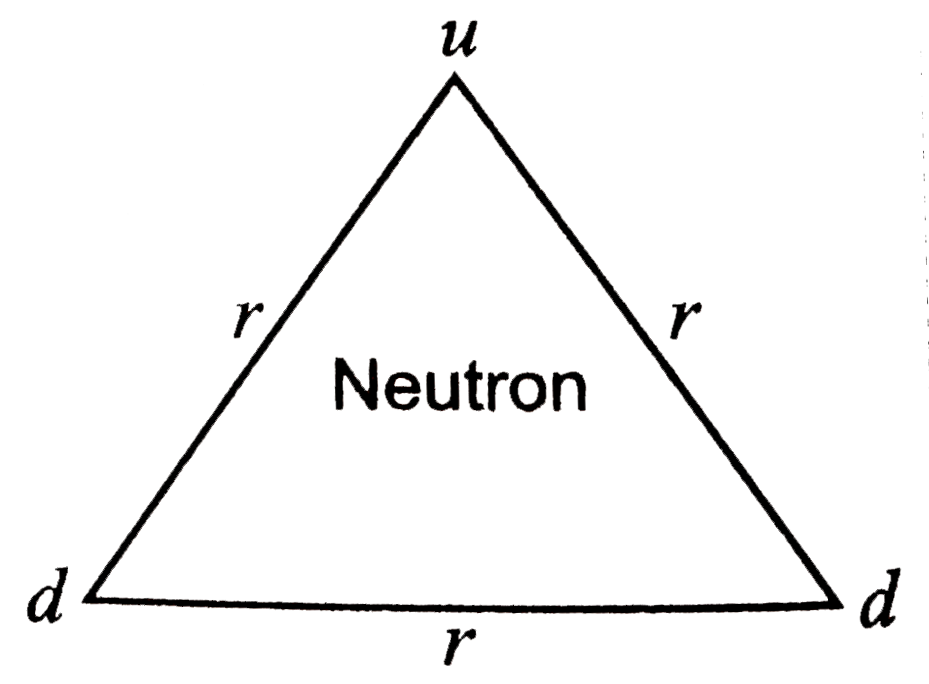
(a) In a quark model of elementary particles, a neutron is made of one up quarks [charge `(2//3)`e] and two down quarks [charges - `(1//3) e`]. Assume that they have a triangle configuration with side length of the order of `10^(-15) m`. Calculate electrostatic potential energy of neutron and compare it with its mass 939 MeV.
(b) Repeat above exercise for a proton which is made of two up and one down quark.

Text Solution

Verified by Experts

This system is made up of thre charges. The potential energy of the system is equal to the algebraic sum of PE of each pair. So,
`U=(1)/(4piepsi_(0)){(q_(d)q_(d))/(r)-(q_(u)d_(d))/(r)-(q_(u)q_(d))/(r)}`
`=(9xx10^(9))/(10^(-15))(1.6xx10^(-19))^(2)[{(1//3)^(2)-(2//3)(1//3)-(2//3)(1//3)}]`
`=2.304xx0^(-13){(1)/(9)-(4)/(9)}=-7.68xx10^(-14)J`
`=4.8xx10^(5)eV=0.48meV=5.11xx10^(-4)(m_(n)c^(2))`
Promotional Banner

Topper's Solved these Questions

  • ELECTROMAGNETIC WAVES

    NCERT EXEMPLAR|Exercise Electromagnetic Waves|32 Videos
  • MAGNETISM AND MATTER

    NCERT EXEMPLAR|Exercise Magnetism And Matter|25 Videos

Similar Questions

Explore conceptually related problems

Calculate the electrostatic potential energy for a system of three point charges q placed at the corners of an equilateral triangle of side ‘a’.

Three charges +q, 2 q and -4q are placed on the three vertices of an equale-laterail triangle of each side 0*1m . Calculate electrostatic potential energy of the system, take q = 10^(-7) C

Compare a proton and a neutron in respect of mass and charge.

Compare an electron, a proton and a neutron in respect of their relative masses and charges.

Calculation OF charge in space by E ||Electrostatic Potential

Three charges of 1 nC, 2 nC and 3 nC are placed at the corners of an equilateral triangle of side sqrt(3) m. Calculate electrostatic potential at a point equidistant from the three corners of the triangle.

Define a neutron. Mention its mass and charge.

NCERT EXEMPLAR-ELECTROSTATIC POTENTIAL AND CAPACITANCE-Electrostatic Potential And Capacitance
  1. Consider two conducting spheres of radii R(1) and R(2) with R(1) gt R(...

    Text Solution

    |

  2. Do free electrons travel to region of higher potential or lower potent...

    Text Solution

    |

  3. Can there be a potential difference between two adjacent conductors c...

    Text Solution

    |

  4. Can the potential function have a maximum or minimum is free space ?

    Text Solution

    |

  5. A test charge q is made to move in the electric field of a point cha...

    Text Solution

    |

  6. Prove that a closed equipotenitial surface with no charge within itsel...

    Text Solution

    |

  7. A capacitor has some dielectric between its plates, and the capacitor ...

    Text Solution

    |

  8. Prove that, if an insulated, uncharged conductor is placed near a ch...

    Text Solution

    |

  9. Calculate potential energy of a point charge -q placed along the axis...

    Text Solution

    |

  10. Calculate potential on the axis of a ring due to charge Q uniformly ...

    Text Solution

    |

  11. Find the equatio of the equipotentials for an infinite cylinder of rad...

    Text Solution

    |

  12. Two point charges of magnitude +q and -q are placed at (-d//2,0,0) and...

    Text Solution

    |

  13. A parallel palte capacitor is filled by a dielectric whose relative p...

    Text Solution

    |

  14. A capacitor is made of two circular plates of radius R each, separate...

    Text Solution

    |

  15. (a) In a quark model of elementary particles, a neutron is made of one...

    Text Solution

    |

  16. Two metal spheres, one fo radius R and the other of radius 2R, both ...

    Text Solution

    |

  17. In the circuit shown in Fig, initially K(1) is closed and K(2) is open...

    Text Solution

    |

  18. Calculate potential on the axis of a disc of radius R due to a charge ...

    Text Solution

    |

  19. Two charges q(1) and q(2) are placed at (0,0,d) and (0,0,-d) respectiv...

    Text Solution

    |

  20. Two charges -q each are separated by dsitance 2d. A third charge +q i...

    Text Solution

    |