

Home
Class 12
CHEMISTRY
The d-electron configurations of Cr^(2+)...

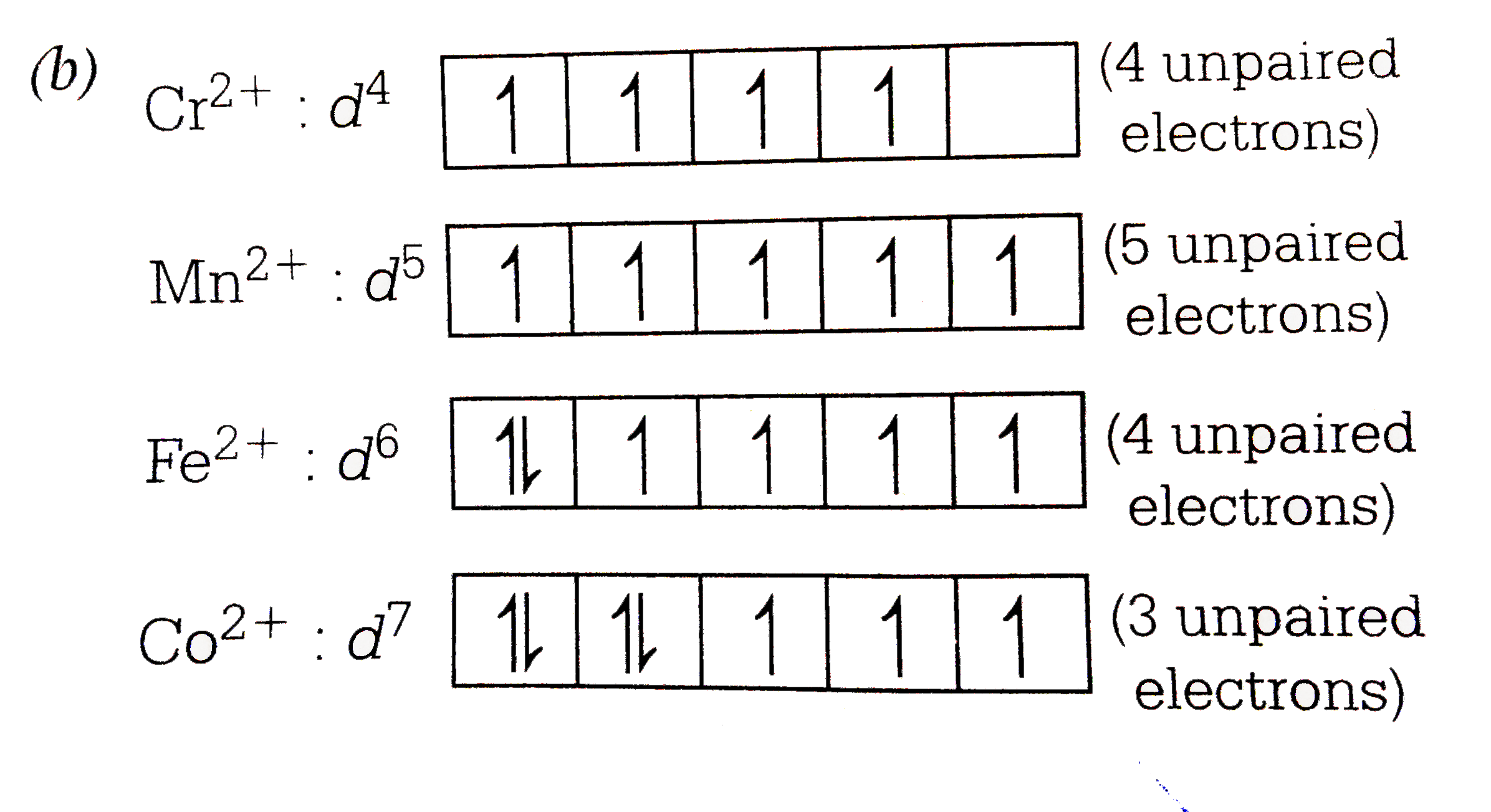
The d-electron configurations of `Cr^(2+), Mn^(2+), Fe^(2+)` and `Co^(2+)` are `d^4, d^5, d^6` and `d^7` respectively. Which one of the following will exhibit minimum paramagnetic behavious?

A

`[Fe(H_(2)O)_(6)]^(2+)`

B

`[Co(H_(2)O)_(6)]^(2+)`

C

`[Cr(H_(2)O)_(6)]^(2+)`

D

`[Mn(H_(2)O)_(6)]^(2+)`

Text Solution

Verified by Experts

The correct Answer is:
B


`therefore [Co(H_(2)O)_(6)]^(2+)` has minimum number of unpaired electrons and thus, shows miniumum paramagnetic behaviour.
Higher the unpaired `e^(-)`.
Higher the magnetic moment
`mu = sqrt(n(n+2))`
n=Number of unpaired `e^(-)`
Promotional Banner

Topper's Solved these Questions

  • THERMODYNAMICS

    NEET PREVIOUS YEAR (YEARWISE + CHAPTERWISE)|Exercise QUESTIONS|68 Videos

Similar Questions

Explore conceptually related problems

The d-electronic configuration of Cr^(2+), Mn^(2+), Fe^(2+) and Ni^(2+) are, 3^(4), 3d^(5), 3d^(6) and 3d^(8) respectively. Which of the following aqua complexes will exhibit the minimum paramagnetic behavior?

The d electron congfiguration of Cr^(2+) , Mn^(2+) , Fe^(2+) and Ni^(2+) are 3d^(4) , 3d^(5) , 3d^(6) and 3d^(8) respectively. Which one of the folowing aqua complexes will exhibit the minimum paramagnetic behaviour ? (At. No . Cr = 24, Mn = 25, Fe = 26, Ni = 28)

The d electron configuration of Cr^(2+) , Mn^(2+) , Fe^(2+) and Ni^(2+) aru 3d^(4) , 3d^(5) 3d^(6) and 3d^(8) respectively. Which one of the following aqua complexes will exhibit the maximum paramagnetic behaviour? (At. No. Cr= 24, Mn=25, Fe = 26, Ni = 28)

The d- electron configurations of Mn^(2+),Fe^(2+),Co^(3+) and Ni^(2+) ard 3d^(5),3d^(6),3d^(6),3d^(8) , respectively Which of the following aqua complexes will exhibit the minimum paramagnetic behviour ? .

Which one of the following ions exhibits d-d transition and paramagnetism as well ?

NEET PREVIOUS YEAR (YEARWISE + CHAPTERWISE)-TRANSITION ELEMENTS D- AND F- BLOCK ELEMENTS-MCQ TYPES
  1. Which of the following statements about the interstitial compounds is ...

    Text Solution

    |

  2. Identify the alloy containing a non metal as a constitunt in it

    Text Solution

    |

  3. The d-electron configurations of Cr^(2+), Mn^(2+), Fe^(2+) and Co^(2+)...

    Text Solution

    |

  4. For the four successive transition elements (Cr, Mn, Fe, and Co), the ...

    Text Solution

    |

  5. Acidified K(2)Cr(2)O(7) solution turns green when Na(2)SO(3) is added ...

    Text Solution

    |

  6. Which of the following ions will exhibit colour in aqueous solution ?

    Text Solution

    |

  7. Which one of the following ions has electronic configuration [Ar]3d^(6...

    Text Solution

    |

  8. Which of the following pairs has the same size ?

    Text Solution

    |

  9. Which of the following ions is the most stable in aqueous solution ? ...

    Text Solution

    |

  10. Identify the incorrect statement among the following:

    Text Solution

    |

  11. In which of the following paris both the ions are coloured in aqueous ...

    Text Solution

    |

  12. Copper sulphate dissolves in excess of KCN to give :

    Text Solution

    |

  13. More number of oxidation states are exhibited by the actinoids than by...

    Text Solution

    |

  14. The aqueous solution containing which one of the following ions will b...

    Text Solution

    |

  15. Four successive members of the first row transition elements are liste...

    Text Solution

    |

  16. Among the following series of transition metal ions, the one where all...

    Text Solution

    |

  17. Lanthanides are

    Text Solution

    |

  18. Which one of the following characteristics of the transition metals is...

    Text Solution

    |

  19. The correct order of ionic radii Y^(3+) , La^(3+) , Eu^(3+) and Lu^(3+...

    Text Solution

    |

  20. The basic character of the transition metal monoxide follows the order

    Text Solution

    |