Home
Class 12
CHEMISTRY
Which of the following complex ion is no...

Which of the following complex ion is not expected to absorb visible light?

A

`[Ni(CN)_(4)]^(2-)`

B

`[Cr(NH_(3))_(6)]^(3+)`

C

`[Fe(H_(2)O)_(6)]^(2+)`

D

`[Ni(H_(2)O)_(6)]^(2+)`

Text Solution

Verified by Experts

The correct Answer is:
A

(a) Key Idea For the absorption of visible light presence of unpaired d-electrons is the necessity.
(a) In `[Ni(CN)_(4)]^(2-)`, Ni is peresent as `Ni^(2+).`
`Ni^(2+)=[Ar] 3d^(8) 4s^(0)`
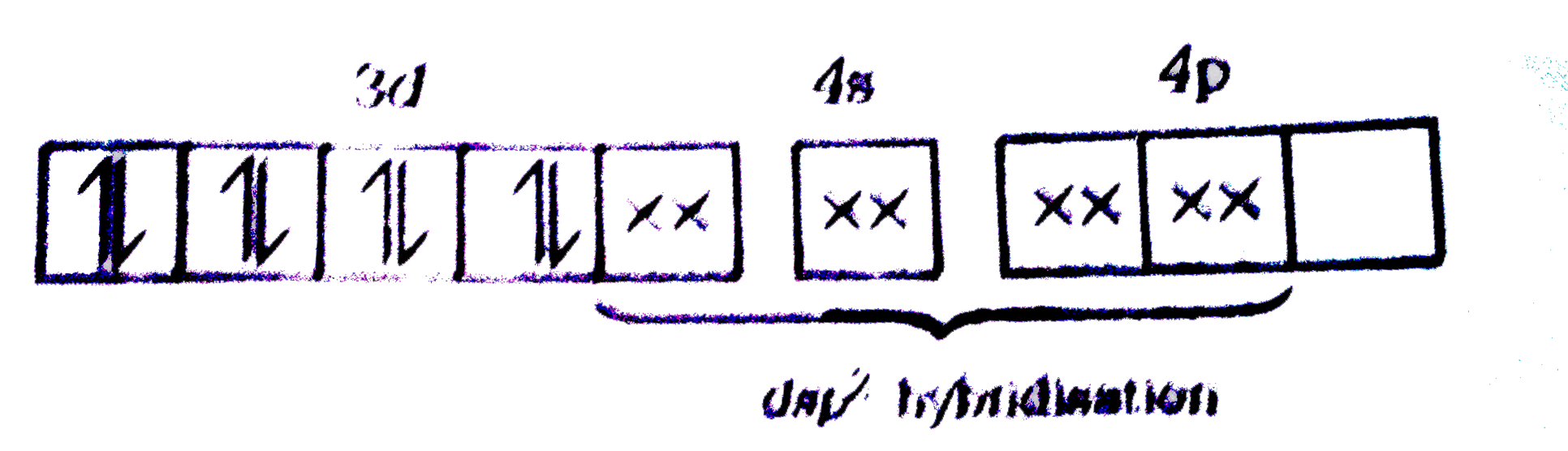
`therefore" "[Ni(CN)_(4)]^(2-)=`

(Pairing occurs because `CN^(-)` is a strong field ligand). Since in `[Ni(CN)_(4)]^(2-)`, no unpaired electron is present in d-orbitals so it does not absorb visilble light.
(b) In `[Cr(NH_(3))_(6)]^(3+)`, Cr is present as `Cr^(3+).`
`Cr^(3+)=[Ar] 3d^(3) 4s^(0)` (Three unpaired electrons)
(c) In `[Fe(H_(2)O)_(6)]^(3+)`, Fe is present as `Fe^(2+)`.
`[Ar] 3d^(6) 4s^(0)` (Four unpaired electrons)
(d) In `[Ni (H_(2)O)_(6)]^(2+),` Ni is present as `Ni^(2+).`
`Ni^(2+)=[Ar] 3d^(8) 4s^(0)` (Two paired electrons)
The complex given in option (b), (c), (d) have unpaired electrons, thus absorb visible light.
In presence of `NH_(3)" and H_(2)O` pairing does not occur as they are strong field ligand.
Promotional Banner

Topper's Solved these Questions

  • CHEMICAL PERIODICITY

    NEET PREVIOUS YEAR (YEARWISE + CHAPTERWISE)|Exercise Exercise|35 Videos
  • ELECTROCHEMISTRY

    NEET PREVIOUS YEAR (YEARWISE + CHAPTERWISE)|Exercise Exercise|49 Videos

Similar Questions

Explore conceptually related problems

Which of the following complex ion is not expected to absob visible light ?

Which of the following complex ions is not expected to absorve visible light ?

Which of the following complex ions is expected to absorb visible light?

Which of the following complexions is expected to absorb visible light ? (Al. No. Zn=30, SC=21, Ti= 22, Cr= 24)

Which of the following complex ion (s) is//are not expected to sbsorb visible light?

Which of the following complex ions is octachedral ?

NEET PREVIOUS YEAR (YEARWISE + CHAPTERWISE)-COORDINATION COMPOUNDS-EXERCISE
  1. The complex [Co(NH(3))(6)][Cr(CN)(6)]" and "[Cr(NH(3))(6)][Co(CN)(6)] ...

    Text Solution

    |

  2. The complex, [Pt(py)(NH3)BrCl] will have how many geometrical isomers?

    Text Solution

    |

  3. Which of the following complex ion is not expected to absorb visible l...

    Text Solution

    |

  4. Crystal field stabilization energy for high spin d^4 octahedral comple...

    Text Solution

    |

  5. The existence of two different coloured comlexes with the composition ...

    Text Solution

    |

  6. Amongst [TiE(6)]^(2-), [CoF(6)]^(3-), Cu(2)Cl(2) and [NiCl(4)]^(2-) [A...

    Text Solution

    |

  7. Which of the following complex ions is expected to absorb visible ligh...

    Text Solution

    |

  8. Which of the following does not show optical isomerism ?

    Text Solution

    |

  9. In which of the following coordination entites the magnitude of Delta(...

    Text Solution

    |

  10. Which of the following complexes exhibits the highest paramagnetic beh...

    Text Solution

    |

  11. Which of the following will give a pair of enontiomorphs ? en = NH(2...

    Text Solution

    |

  12. The d electron congfiguration of Cr^(2+) , Mn^(2+) , Fe^(2+) and Ni^(2...

    Text Solution

    |

  13. [Cr(H2 O)6]Cl3 (at no. of Cr = 24) has a magnetic moment of 3.83 B.M. ...

    Text Solution

    |

  14. [Co(NH(3))(4)(NO(2))(2)]CI exhibits

    Text Solution

    |

  15. Which one of the following is expected to exhibit optical isomerism (e...

    Text Solution

    |

  16. Which of the following is an inner orbital complex as well as diamagne...

    Text Solution

    |

  17. Among |Ni(CO)(4)|, |Ni(CN)(4)|^(2-), |NiCl(4)|^(2-) species, the hybri...

    Text Solution

    |

  18. Considering H2O as a weak field ligand, the number of unpaired electro...

    Text Solution

    |

  19. CN^(-) is a strong field ligand. This is due to the fact that

    Text Solution

    |

  20. Which of the following does not have a metal carbon bond?

    Text Solution

    |

