Home
Class 12
CHEMISTRY
Crystal field stabilization energy for h...

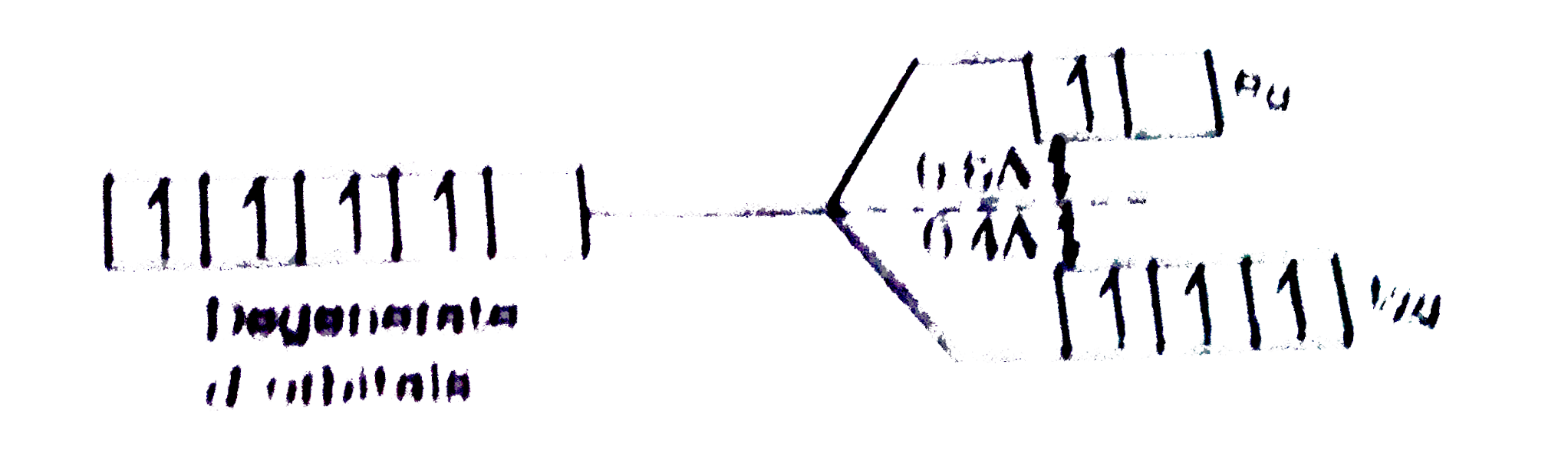
Crystal field stabilization energy for high spin `d^4` octahedral complex is

A

`-1.8Delta_(0)`

B

`-1.6Delta_(0)+P`

C

`-1.2Delta_(0)`

D

`-0.6Delta_(0)`

Text Solution

Verified by Experts

The correct Answer is:
D

(d) Key Idea In case of high spin complex, `Delta_(o)` is small. Than the pairing energy. That means, the energy required to pair up the fourth electorn with the electrons of lower energy d-orbitals would be higher than that required to place the electrons in the higher d-orbital Thus, painng does not occur. For high spin `d^(4)` octahedral complex.

`therefore` Crystal field stabilisation energy
`=(-3xx0.4+1xx0.6)Delta_(o)`
`=(-1.2+0.6)Delta_(o)=-0.6Delta_(o)`
Promotional Banner

Topper's Solved these Questions

  • CHEMICAL PERIODICITY

    NEET PREVIOUS YEAR (YEARWISE + CHAPTERWISE)|Exercise Exercise|35 Videos
  • ELECTROCHEMISTRY

    NEET PREVIOUS YEAR (YEARWISE + CHAPTERWISE)|Exercise Exercise|49 Videos

Similar Questions

Explore conceptually related problems

What is the crystal field stabilization energy for high spin d^6 octahedral complex?

The values of the crystal field stabilization energies for a high spin d^6 metal ion in octahedral and tetrahedral fields, respectively, are :

The magnitude of crystal field stabilization energy (CFSE) in tetrahedral complexes is considerably less than in the octahedral field beause

The vlaue for crystal field stabilisation energy for an octahedral comlex, [CoCI_(6)]^(4-) is 18000 cm^(-1) The value of crystal field stabilisation energy for tetrahedral complex is

What is crystal field stabilisation energy for high spin d^6 configuration for octahedral & tetrahedral complexes.

Crystal field stabilization is important for :

The splitting diagram for square planar complexes is more complex than for octahedral and tetrahedral complexes and is shown below with the relative energies of each orbital. Which of the following set of de^(-) have same crystal field stabilisation energy value for tetrahedral complex neglecting pairing energy (P) : (P) d^(1), d^(6)" "(Q) d^(2), d^(7) (R ) d^(3), d^(8)" "(S) d^(4), d^(9) (T) d^(5), d^(10)

NEET PREVIOUS YEAR (YEARWISE + CHAPTERWISE)-COORDINATION COMPOUNDS-EXERCISE
  1. The complex, [Pt(py)(NH3)BrCl] will have how many geometrical isomers?

    Text Solution

    |

  2. Which of the following complex ion is not expected to absorb visible l...

    Text Solution

    |

  3. Crystal field stabilization energy for high spin d^4 octahedral comple...

    Text Solution

    |

  4. The existence of two different coloured comlexes with the composition ...

    Text Solution

    |

  5. Amongst [TiE(6)]^(2-), [CoF(6)]^(3-), Cu(2)Cl(2) and [NiCl(4)]^(2-) [A...

    Text Solution

    |

  6. Which of the following complex ions is expected to absorb visible ligh...

    Text Solution

    |

  7. Which of the following does not show optical isomerism ?

    Text Solution

    |

  8. In which of the following coordination entites the magnitude of Delta(...

    Text Solution

    |

  9. Which of the following complexes exhibits the highest paramagnetic beh...

    Text Solution

    |

  10. Which of the following will give a pair of enontiomorphs ? en = NH(2...

    Text Solution

    |

  11. The d electron congfiguration of Cr^(2+) , Mn^(2+) , Fe^(2+) and Ni^(2...

    Text Solution

    |

  12. [Cr(H2 O)6]Cl3 (at no. of Cr = 24) has a magnetic moment of 3.83 B.M. ...

    Text Solution

    |

  13. [Co(NH(3))(4)(NO(2))(2)]CI exhibits

    Text Solution

    |

  14. Which one of the following is expected to exhibit optical isomerism (e...

    Text Solution

    |

  15. Which of the following is an inner orbital complex as well as diamagne...

    Text Solution

    |

  16. Among |Ni(CO)(4)|, |Ni(CN)(4)|^(2-), |NiCl(4)|^(2-) species, the hybri...

    Text Solution

    |

  17. Considering H2O as a weak field ligand, the number of unpaired electro...

    Text Solution

    |

  18. CN^(-) is a strong field ligand. This is due to the fact that

    Text Solution

    |

  19. Which of the following does not have a metal carbon bond?

    Text Solution

    |

  20. Which of the following is considered to be an anticancer species?

    Text Solution

    |

