Home
Class 12
CHEMISTRY
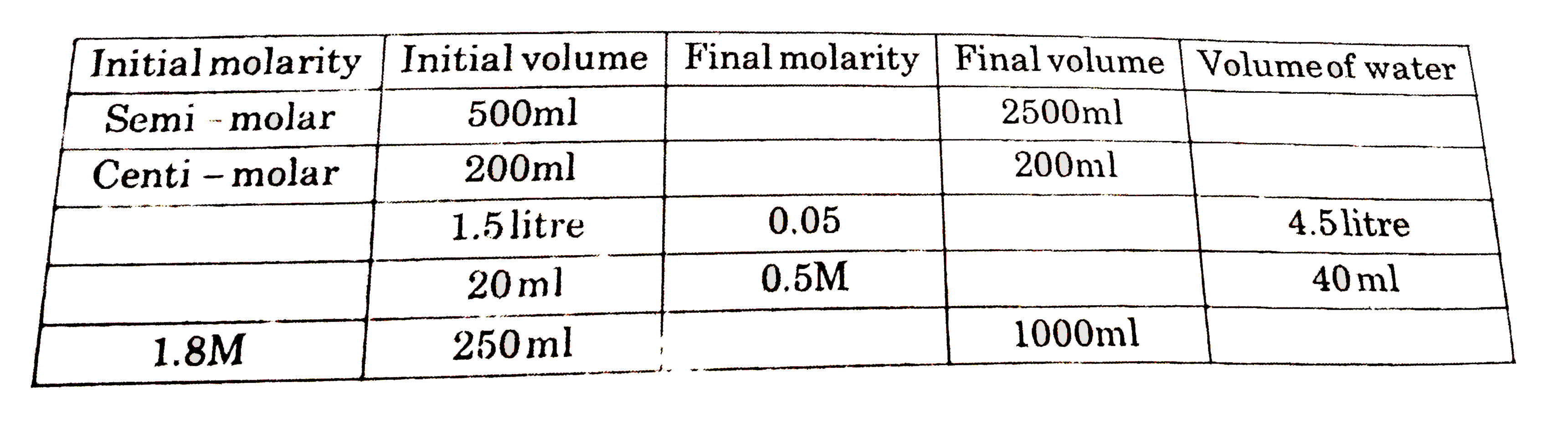
Use of dilution formula (M(1)V(1) = M(2)...

Use of dilution formula `(M_(1)V_(1) = M_(2) V_(2))`

Text Solution

Verified by Experts

The correct Answer is:

`(##ALN_NC_CHM_CT_E01_012_A01##)`
Promotional Banner

Topper's Solved these Questions

  • CONCENTRATION TERMS

    ALLEN|Exercise Exercise S - I|30 Videos
  • CONCENTRATION TERMS

    ALLEN|Exercise Exercise S - II|10 Videos
  • CONCENTRATION TERMS

    ALLEN|Exercise Previous|4 Videos
  • ACIDIC STRENGTH & BASIC STRENGTH

    ALLEN|Exercise Exercise V|16 Videos

Similar Questions

Explore conceptually related problems

A: 50 ml, decinormal HCl when mixed with 50 ml, decinormal H_(2) SO_(4) , then normality of H^(+) ion in resultant solution is 0.1 N. R: Here, MV = M_(1)V_(1) - M_(2)V_(2)

Two particles of masses m_(1) and m_(2) in projectile motion have velocities vec(v)_(1) and vec(v)_(2) , respectively , at time t = 0 . They collide at time t_(0) . Their velocities become vec(v')_(1) and vec(v')_(2) at time 2 t_(0) while still moving in air. The value of |(m_(1) vec(v')_(1) + m_(2) vec(v')_(2)) - (m_(1) vec(v)_(1) + m_(2) vec(v)_(2))|

Two solution of H_(2)SO_(4) of molarities x and y are mixed in the ratio of V_(1) mL : V_(2) mL to form a solution of molarity M_(1) . If they are mixed in the ratio of V_(2) mL : V_(1) mL , they form a solution of molarity M_(2) . Given V_(1)//V_(2) = (x)/(y) gt 1 and (M_(1))/(M_(2)) = (5)/(4) , then x : y is

The Graham's law states that ''at constant pressure and temperature the rate of diffusion or effusion of a gas is inversely proportional to the squar root of its density Rate of diffusion prop (1)/(sqrt(d)) If r_(1) and r_(2) represent the rates of diffusion of two gases and d_(1) and d_(2) are their respective densities, then r_(1)/(r_(2))=sqrt((d_(2))/(d_(1))) r_(1)/(r_(2)) =sqrt((M_(2))/(M_(1))) xx P_(1)/(P_(2)) (V_(1)xxt_(2))/(V_(2)xxt_(1)) = sqrt((d_(2))/(d_(1))) = sqrt((M_(2))/(M_(1))) V prop n (where n is no of moles) V_(1) prop n_(1) and V_(2) prop n_(2) If some moles of O_(2) diffuse in 18 sec and same moles of other gas diffuse in 45sec then what is the molecular weight of the unknown gas ? .

The Graham's law states that ''at constant pressure and temperature the rate of diffusion or effusion of a gas is inversely proportional to the squar root of its density Rate of diffusion prop (1)/(sqrt(d)) If r_(1) and r_(2) represent the rates of diffusion of two gases and d_(1) and d_(2) are their respective densities, then r_(1)/(r_(2))=sqrt((d_(2))/(d_(1))) r_(1)/(r_(2)) =sqrt((M_(2))/(M_(1))) xx P_(1)/(P_(2)) (V_(1)xxt_(2))/(V_(2)xxt_(1)) = sqrt((d_(2))/(d_(1))) = sqrt((M_(2))/(M_(1))) V prop n (where n is no of moles) V_(1) prop n_(1) and V_(2) prop n_(2) Helium and argon monoatomic gases and their atomic weights are 4 and 40 respectively Under identical conditions helium will diffuse through a semipermeable membrane .

From the above figure the values of stopping potentials for M_(1) and M_(2) for a frequency v_(3)( gt v_(02)) of the incident radiatioins are V_(1) and V_(2) respectively. Then the slope of the line is equal to

In a direct impact loss in kinetic energy is given by Delta K = (M_(1)M_(2))/(2(M_(1) + M_(2)))(V_(1) - V_(2))^(2) (1- k^(2)) with usual notations (except k) The quantity k will have dimensional formula

Figure show the variation of the stopping potential (V_(0)) with the frequency (v) of the incident radiations for two different photosensitive matererial M_(1) and M_(2) What are the values of work functions for M_(1) and M_(2) respectively
