Home
Class 12
CHEMISTRY
Reimer-Tiemann reaction introduces an al...

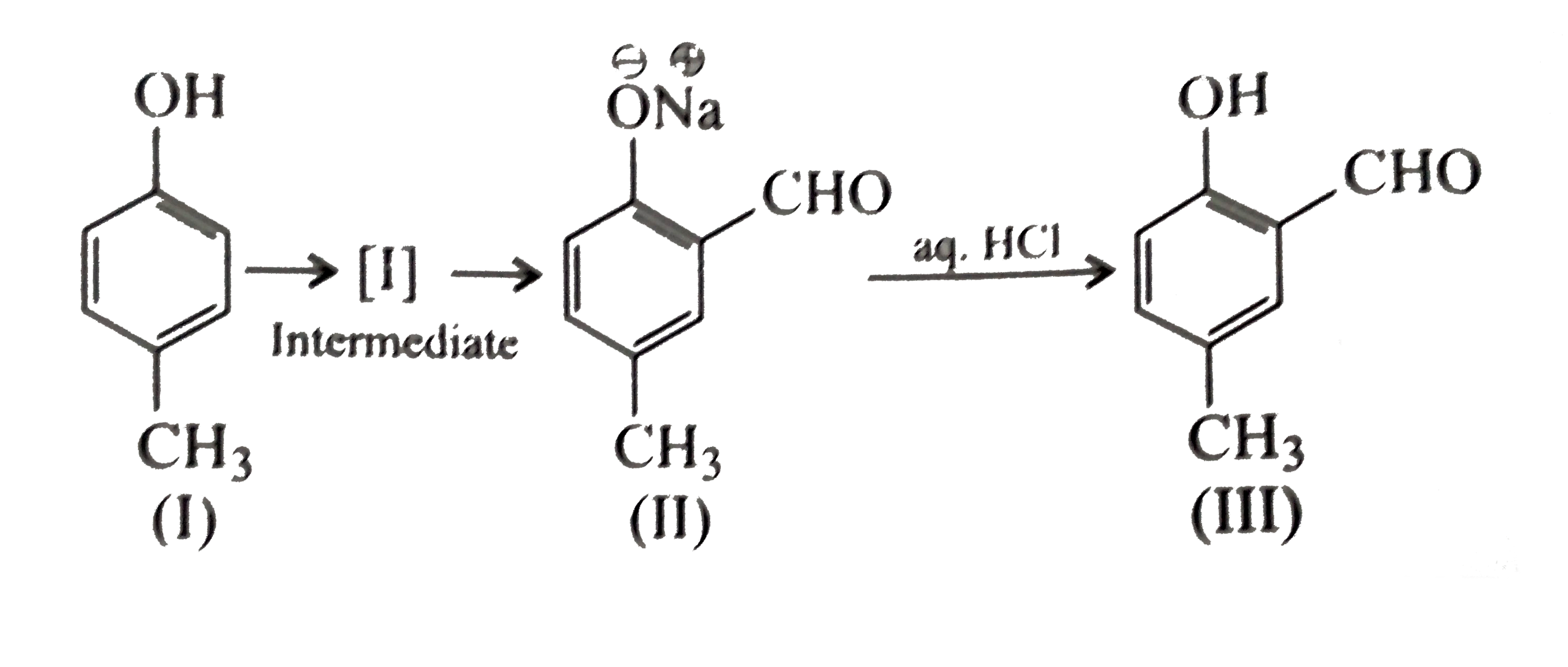
Reimer-Tiemann reaction introduces an aldehyde group on to the aromatic ring of phenol, ortho to the hydroxyl group. This reacrtion involves electrophilic aromatic subsititution. It is a general method for the synthesis of subsituted salicyladehydes as depiced below:

The electrophile in this reaction is:

A

B

C

D

Text Solution

Verified by Experts

The correct Answer is:

B
Promotional Banner

Topper's Solved these Questions

  • ALKENE, ALKANE & ALKYNE

    ALLEN|Exercise EXERCISE-5[A]|68 Videos
  • ALKENE, ALKANE & ALKYNE

    ALLEN|Exercise EXERCISE-5[B]|159 Videos
  • ALKENE, ALKANE & ALKYNE

    ALLEN|Exercise EXERCISE-4[B]|44 Videos
  • AIIMS 2019

    ALLEN|Exercise CHEMISTRY|35 Videos
  • ALKYL AND ARYL HALIDE

    ALLEN|Exercise EXERCISE-05 (B)|37 Videos

Similar Questions

Explore conceptually related problems

Reimer -Tiemann reaction introduces an aldehyde group on to the aromatic ring of phenol, ortho to the hydroxyl group. This reaction involves electrophilic aromatic substitution. This is a general method for the synthesis of substituted salicyladehydes as depicted below. The electrophile in this reaction is

Reimer-Tiemann reaction introduces an aldehyde group on to the aromatic ring of phenol, ortho to the hydroxyl group. This reacrtion involves electrophilic aromatic subsititution. It is a general method for the synthesis of subsituted salicyladehydes as depiced below: The structure of the intremediate (I) is:

Reimer-Tiemann reaction introduces an aldehyde group on to the aromatic ring of phenol, ortho to the hydroxyl group. This reacrtion involves electrophilic aromatic subsititution. It is a general method for the synthesis of subsituted salicyladehydes as depiced below: Which one of the following reagents is used in the above reaction ?

Reimer -Tiemann reaction introduces an aldehyde group on to the aromatic ring of phenol, ortho to the hydroxyl group. This reaction involves electrophilic aromatic substitution. This is a general method for the synthesis of substituted salicyladehydes as depicted below. The structure of the intermediate I is

ALLEN-ALKENE, ALKANE & ALKYNE -EXERCISE-5
  1. Reimer-Tiemann reaction introduces an aldehyde group on to the aromati...

    Text Solution

    |

  2. Reimer-Tiemann reaction introduces an aldehyde group on to the aromati...

    Text Solution

    |

  3. Reimer-Tiemann reaction introduces an aldehyde group on to the aromati...

    Text Solution

    |

  4. Assertion: Bromobenzene upon reaction with Br(2)//Fe gives 1,4-dibromo...

    Text Solution

    |

  5. Statement I: Aniline on reaction with NaNO2HCl at 0^@C followed by co...

    Text Solution

    |

  6. In the reaction the intermediate(s) is/are:

    Text Solution

    |

  7. The compound P, Q and S were separately subjected to nitration us...

    Text Solution

    |

  8. The correct acidity order of the following is

    Text Solution

    |

  9. In the reaction, the structure of the product T is:

    Text Solution

    |

  10. Among the following compounds, the most acidic is:

    Text Solution

    |

  11. Compound (A) C(8)H(9)Br. Gives a white precipitate when warmed with al...

    Text Solution

    |

  12. In the reaction shown below the major product (s) formed is/are .

    Text Solution

    |

  13. The reactivity of compound Z with different halogens under appropriat...

    Text Solution

    |

  14. Consider the reaction sequence below:

    Text Solution

    |

  15. Fluorination of an aromatic ring is easily accompolished by treating a...

    Text Solution

    |

  16. The correct statement(s) about the following reaction sequence is (are...

    Text Solution

    |

  17. Among the following reactions (s), which gives (give) tert-butyl benze...

    Text Solution

    |

  18. For the reaction C(6)H(6)+(CH(3))(2)CHCH(2)Cl overset("Anhy".AlCl(3))r...

    Text Solution

    |

  19. Complete the following reaction

    Text Solution

    |

  20. The main product of the following reaction is C(6)H(5)CH(2)(OH)CH(CH(3...

    Text Solution

    |
