Home
Class 12
CHEMISTRY
In the reaction: CH(3)-underset(CH(3))un...

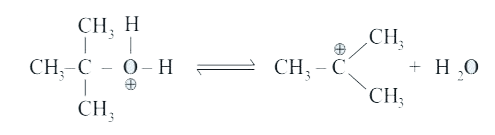
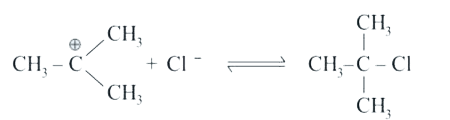
In the reaction: `CH_(3)-underset(CH_(3))underset(|)overset(CH_(3))overset(|)C-OH+HCl rarr CH_(3)-underset(CH_(3))underset(|)overset(CH_(3))overset(|)C-Cl`
the rate-determining step is:

A

`CH_(3)-underset(CH_(3))underset(|)overset(CH_(3))overset(|)C-OH+H_(3)O^(+)hArrCH_(3)-underset(CH_(3))underset(|)overset(CH_(3))overset(|)C-underset(o+)overset(H)overset(|)O-H-H_(2)O`

B

C

D

all steps take place with equal ease

Text Solution

AI Generated Solution

The correct Answer is:

To determine the rate-determining step in the reaction of the given alcohol with HCl, we can follow these steps: ### Step 1: Identify the Reactants and Products The reactant is a tertiary alcohol (specifically, 2-methyl-2-propanol, also known as tert-butanol) and the product is a tertiary alkyl chloride (tert-butyl chloride). The reaction can be represented as: \[ \text{(CH}_3)_3\text{C-OH} + \text{HCl} \rightarrow \text{(CH}_3)_3\text{C-Cl} + \text{H}_2\text{O} \] ### Step 2: Understand the Mechanism of the Reaction The reaction proceeds via a two-step mechanism: 1. Protonation of the alcohol to form a better leaving group. 2. Formation of a carbocation followed by nucleophilic attack by chloride ion. ### Step 3: Protonation of the Alcohol In the first step, the hydroxyl group (-OH) of the alcohol is protonated by HCl. This forms an oxonium ion, which is more reactive and can lead to the formation of a carbocation: \[ \text{(CH}_3)_3\text{C-OH} + \text{H}^+ \rightarrow \text{(CH}_3)_3\text{C-OH}_2^+ \] ### Step 4: Formation of Carbocation The oxonium ion formed in the previous step is unstable and loses a water molecule, resulting in the formation of a tertiary carbocation: \[ \text{(CH}_3)_3\text{C-OH}_2^+ \rightarrow \text{(CH}_3)_3\text{C}^+ + \text{H}_2\text{O} \] ### Step 5: Nucleophilic Attack In the final step, the chloride ion (Cl⁻) attacks the carbocation to form the final product, tert-butyl chloride: \[ \text{(CH}_3)_3\text{C}^+ + \text{Cl}^- \rightarrow \text{(CH}_3)_3\text{C-Cl} \] ### Step 6: Identify the Rate-Determining Step The slowest step in this mechanism is the formation of the carbocation, as it involves the breaking of a bond and the formation of a highly reactive intermediate. Therefore, the rate-determining step is: \[ \text{Formation of the carbocation} \] ### Final Answer The rate-determining step in the reaction is the formation of the carbocation from the protonated alcohol. ---

To determine the rate-determining step in the reaction of the given alcohol with HCl, we can follow these steps: ### Step 1: Identify the Reactants and Products The reactant is a tertiary alcohol (specifically, 2-methyl-2-propanol, also known as tert-butanol) and the product is a tertiary alkyl chloride (tert-butyl chloride). The reaction can be represented as: \[ \text{(CH}_3)_3\text{C-OH} + \text{HCl} \rightarrow \text{(CH}_3)_3\text{C-Cl} + \text{H}_2\text{O} \] ### Step 2: Understand the Mechanism of the Reaction The reaction proceeds via a two-step mechanism: ...
Promotional Banner

Similar Questions

Explore conceptually related problems

CH_(3)-Br+NaO-underset(CH_(3))underset(|)overset(CH_(3))overset(|)C-CH_(3)to ?

CH_(3)-underset(CH_(3))underset(|)overset(CH_(3))overset(|)C-CH=CH-CH_(3)overset(H-Cl)(to) ?

write a IUPAC name H_(3)C-underset(CH_(3))underset(|)overset(CH_(3))overset(|)C-OH

CH_(3)-underset(CH_(3))underset(|)overset(CH_(3))overset(|)(C)-CH_(2)-underset(O)underset(||)(C)-NHCH_(3)

The reaction CH_(3)-underset(CH_(3))underset(|)overset(CH_(3))overset(|)(C )-ONa+CH_(3)CH_(2)ClrarrCH_(3)-underset(CH_(3))underset(|)overset(CH_(3))overset(|)(C )-O-CH_(2)-CH_(3) is called

What are the products of the following reactions? (a) H_(3)C-underset(CH_(3))underset(|)overset(CH_(3))overset(|)C-Cl+barOCH_(3)to (b) CH_(3)-underset(CH_(3))underset(|)overset(CH_(3))overset(|)C-barO+CH_(3)-Xto

CH_(3)-underset(CH_(3))underset(|)(C)=CH-underset(CH_(3))underset(|)overset(CH_(3))overset(|)C-CH_(3)
