

Home
Class 12
PHYSICS
AB and CD are smooth, parallel rails, se...

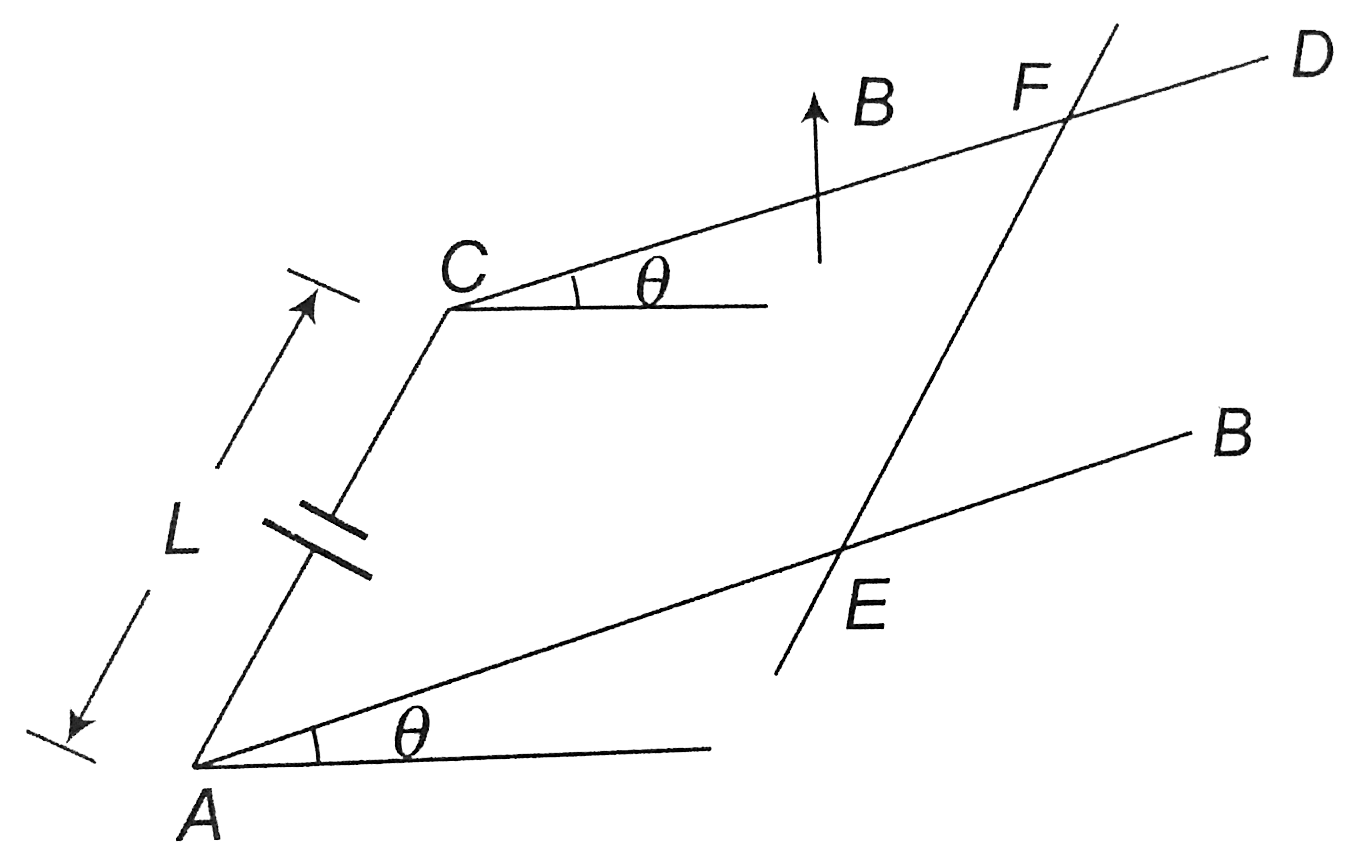
`AB` and `CD` are smooth, parallel rails, separated by a distance `L` and inclined to the horizontal at an angle `theta`. A uniform magnetic field of magnitude `B`, directed vertically upwards, exists in the region. `EF` is a conductor of mass `m`, carrying a current `i`. For `EF` to be in equilibrium

(i) `i` must flow from `E` to `F`
(ii) `B i L = m g tan theta`
(iii) `B i L = m g sin theta`
(iv) `B i L = m g`

Promotional Banner

Similar Questions

Explore conceptually related problems

A conductor ABCDE, shaped as shown, carries current I. It is placed in the x-y plane with the end A and E on the x-axis. A uniform magnetic field of magnitude B exists in the region. The force acting on it will be

A conductor ABCDE, shaped as shown, carries current I. It is placed in the x-y plane with the end A and E on the x-axis. A uniform magnetic field of magnitude B exists in the region. The force acting on it will be

The magnetic force acting on a conductor of length l carrying a current I placed in field of strength B is given as

A metal wire of mass m slides without friction on two horizontal rails spaced distance d-apart as shown in figure. The rails are situated in a uniform magnetic field B, directed vertically upwards, and a battery is sending a current I through them. Find the velocity of the wire as a function of time, assuming it to be at rest initially.

Derive an expression for the maximum force experienced by a straight conductor of length l, carrying a current I and kept in a uniform magnetic field B.

Derive an expression for the maximum force experienced by a straight conductor of length 'l', carrying current 'I' and kept in a uniform magnetic field B.

Derive an expression for the maximum force experieced by a straight conductor of length 'l', carrying current 'I' and kept in a uniform magnetic field B.