

Home
Class 11
PHYSICS
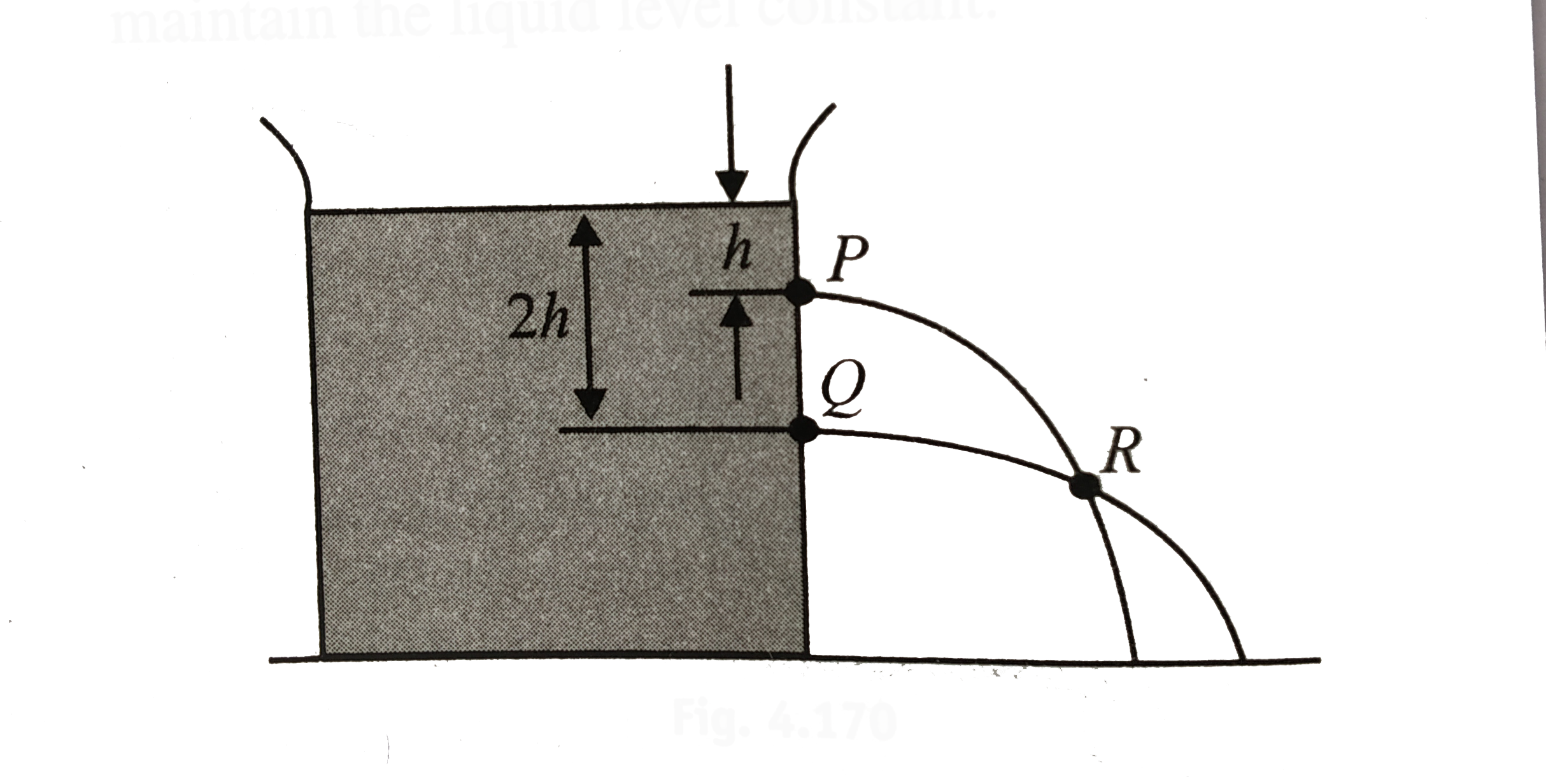
Two liquid jets coming out of the small ...

Two liquid jets coming out of the small holes at `P` and `Q` intersect at the point `R`. Find the position of and `R` if We maintain the liquid level constant.

Promotional Banner

Similar Questions

Explore conceptually related problems

Two liquid jets coming out of the small holes at P and Q intersect at the point R . Find the position of R if We maintain the liquid level constant.

The velocity of the liquid coming out of a small hole of a vessel containing two different liquids of densities 2rho and rho as shown in the figure is

The velocity of the liquid coming out of a small hole of a vessel containing two different liquids of densities 2rho and rho as shown in the figure is

The velocity of the liquid coming out of a small hole of a vessel containing two different liquids of densities 2rho and rho as shown in the figure is

figure shows two holes in a wide tank containing a liquid common. The water streams coming out of these holes strike the ground at the same point. The heigth of liquid column in the tank is

A variable plane at constant distance p form the origin meets the coordinate axes at P,Q, and R. Find the locus of the point of intersection of planes drawn through P,Q, r and parallel to the coordinate planes.

A variable plane at constant distance p form the origin meets the coordinate axes at P,Q, and R. Find the locus of the point of intersection of planes drawn through P,Q, r and parallel to the coordinate planes.

A tank with base area L^2 is filled with a liquid to height H. The tank is acceleration horizontally with acceleration a as shown in figure. If a small hole is made at the point A. then it is observed that the liquid does not come out of the tank. The magnitude of acceleration should be

A container filled with liquid up to height h is placed on a smooth horizontal surface. The container is having a small hole at the bottom. As the liquid comes out from the hole, the container moves in a backward direction with acceleration a and finally, when all the liquid is drained out, it acquires a velocity v . Neglect mass of the container. In this case