Home
Class 12
CHEMISTRY
(a) Account for the following: (i) Ozo...

(a) Account for the following:
(i) Ozone is thermodynamically unstable.
(ii) Solid `PCl_(5)` is ionic in nature.
(iii) Fluorine forms only one oxoacid HOF.
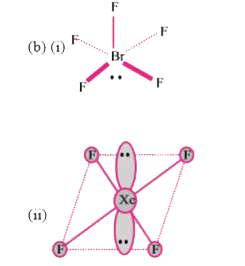
(b) Draw the structure of
(i) `BrF_(5)`
(ii) `XeF_(4)`
(i) Compare the oxidizing action of `F_(2) and Cl_(2)` by considering parameters such as bond dissociation enthalpy, electron gain enthalpy and hydration enthalpy.
(ii) Write the conditions to maximize the yield of `H_(2)SO_(4)` by contact process.
(iii) Arrange the following in the increasing order of property mentioned :
(a) `H_(3)PO_(3), H_(3)PO_(4), H_(3)PO_(2)` (Reducing character)
(b) `NH_(3), PH_(3)m AsH_(3), SbH_(3), BiH_(3)` (Base strength)

Text Solution

Verified by Experts
(a) (i) Endothermic compound/decomposition of ozone is exothermic is nature and `DeltaG` is negative/decomposition of ozone is spontaneous.
(ii) Exists as `[PCl_(4)]^(+)[PCl_(6)]^(+)`
(iii) Shows only-1 oxidation state/most electronegative element/ absence of d-orbitals
(b)(i)
Or
(i) `F_(2)` is the stronger oxidising agent than chlorine
(a) low enthalpy of dissociation of `F-F` bond
(b) less negative electron gain enthalpy of F
high hydration enthalpyof `F^(+)` ion
(ii) Low temperature, high pressure and presence of catalyst
(ii) `H_(3)PO_(4)lt H_(3)PO_(3) lt H_(3)PO_(2)`
(iii) `BiH_(3) lt SbH_(3) lt AsH_(3) lt PH_(3) lt NH_(3)`
Promotional Banner

Topper's Solved these Questions

  • PRACTICE - PAPER

    CBSE COMPLEMENTARY MATERIAL|Exercise Section : C|6 Videos
  • POLYMERS

    CBSE COMPLEMENTARY MATERIAL|Exercise LONG ANSWER TYPE QUESTIONS|5 Videos
  • PRACTICE PAPER 1

    CBSE COMPLEMENTARY MATERIAL|Exercise Questions|82 Videos

Similar Questions

Explore conceptually related problems

Considering the parameters such as bond dissociation enthalpy, electron gain enthalpy and hydration enthalpy, compare the oxidizing power of F_2 and Cl_2 .

Considering the parameters such as bond dissociation enthalpy, electron gain enthalpy and hydration enthalpy, compare the oxidising power of F_(2) and Cl_(2)

Draw the structures of (i) PCl_(5)(s) , (ii) SO_(3)^(2-)

Write the structure of the following : (i) BrF_(3) (ii) XeF_(4)

