Home
Class 11
PHYSICS
A particle is moving with uniform accele...

A particle is moving with uniform acceleration along a straight line ABC. Its velocity at A and B are 6 m/s and 9 m/s respectively if `AB:BC=5:16` then its velocity at C is

A

9.6 m/s

B

12 m/s

C

15 m/s

D

21.5 m/s

Text Solution

Verified by Experts

The correct Answer is:
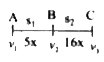
C

, `a = (v_(2)^(2))/(2s_(1)) = (v_(3)^(2) - v_(1)^(2))/(2s_(1)) = (v_(3)^(2) - v_(2)^(2))/(2s_(2))`


Promotional Banner

Similar Questions

Explore conceptually related problems

A particle is moving with uniform acceleration along a straight line "ABC" .Its velocity at A and B are 6m/s" and "9m/s respectively. If AB:BC=5:16" then its velocity at C is

A particle moves with uniform acceleration along a straight line AB . Its velocities at A and B are 2 m//s and 14 m//s respectively. M is the mid-point of AB . The particle takes t_1 seconds to go from A to M and t_2 seconds to go from M to B . Then t_2 : t_1 is.

A body is moving with constant acceleration, a= 5 m/s^2 from A to B in straight line AB. The velocity of particle at A and B are 5 m/s and 15 m/s respectively. The velocity at mid-point of AB is

A particle moving with uniform acceleration from A to B along a straight line has velcities v_(1) and v_(2) at A and B respectively. If C is the mid-point between A and B then determine the velocity of the particle at C . .

A particle goes from A to B s with uniform acceleration. Its velocity at A and B are 5 m/s and 25 m/s. Its acceleration (in m//s^(2) ) is

A particle is moving with uniform acceleration along a straight line ABC, where AB= BC. The average velocity of the particle from A to B is 10 m/s and from B to C is 15 m/s. The average velocity for the whole journey from A to C in m/s is

A particle, moving with uniform acceleration along a straight line ABC, crosses point A at t = 0 with a velocity 12 m/s. B is 40 m from A and C is 64 m from A. The particle passes B at t = 4 s. (a) At what time, will the particle be C? (b) What is its velocity at C?

A particle is moving with uniform acceleration along a straight line. The average velocity of the particle from P to Q is 8ms^(–1) and that Q to S is 12ms^(–1) . If QS = PQ, then the average velocity from P to S is

A particle moving with uniform acceleration along a straight line ABC rosses point A at t=0 with a velocity 12 m s^(-1) . is 40 m away from A and C is 64 m away from A . The particle passes B at t=4 s . a. After what time will the particle be at C ? b. What is its velocity at C ? c. What does the particle reach A again? d. Locate the point where the particle reverses its direction of motion. e. Find the distance covered by the particle in the first 15 s .