Home
Class 11
PHYSICS
The variation of potential energy (U) of...

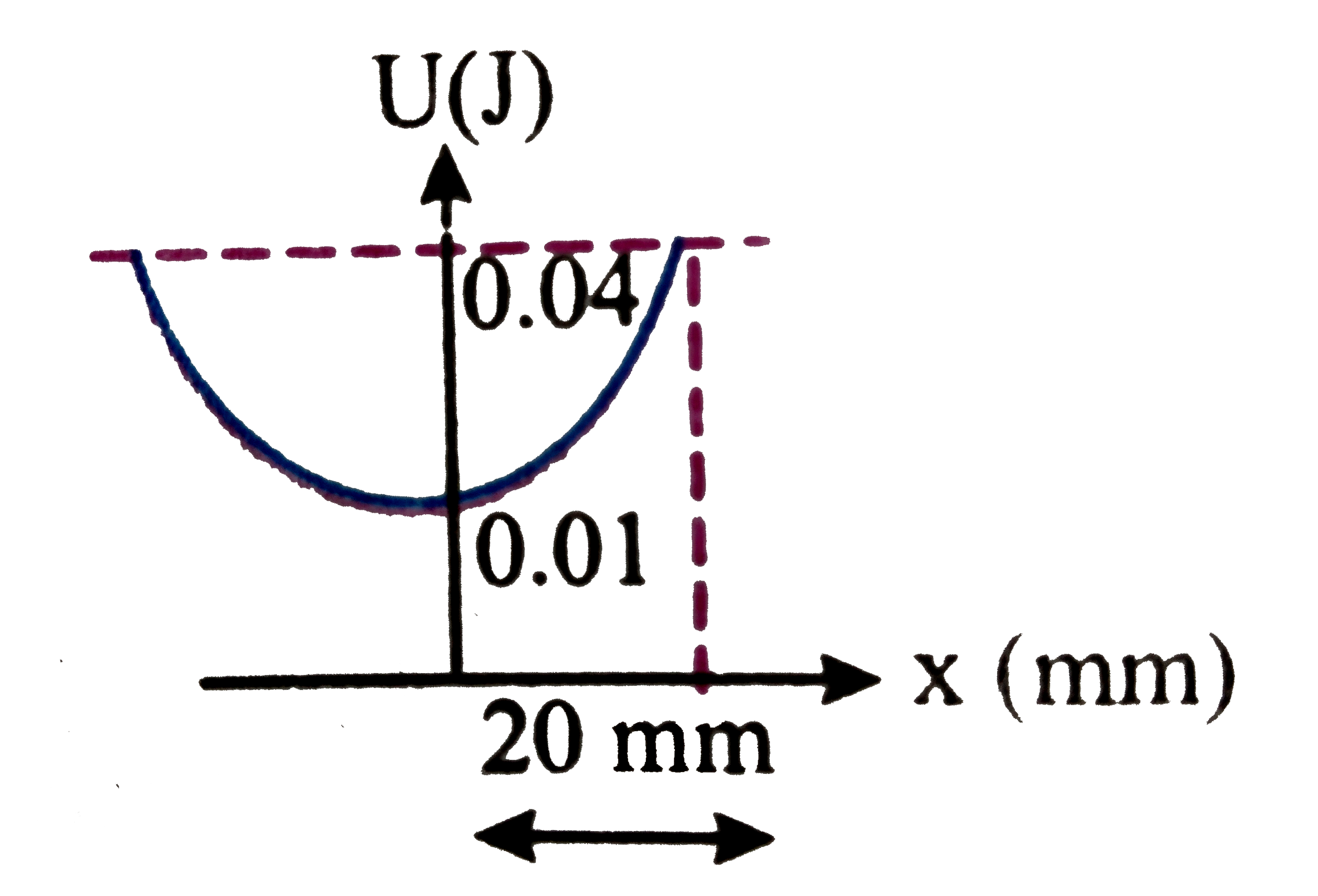
The variation of potential energy `(U)` of a simple harmonic oscillator is as shown. Then force constant of the system is `(PE` is in joules, displacement 'x' is in mm)

A

100 N/m

B

150 N/m

C

`(200)/(3)` N/m

D

300 N/m

Text Solution

Verified by Experts

The correct Answer is:

B

Pe varies from zero to maximum. It is always positive sinusoidal function
Promotional Banner

Topper's Solved these Questions

  • OSCILLATIONS

    NARAYNA|Exercise EXERCISE - III|29 Videos
  • OSCILLATIONS

    NARAYNA|Exercise EXERCISE - IV|41 Videos
  • OSCILLATIONS

    NARAYNA|Exercise EXERCISE - II (C.W)|27 Videos
  • NEWTONS LAWS OF MOTION

    NARAYNA|Exercise PASSAGE TYPE QUESTION|6 Videos
  • PHYSICAL WORLD

    NARAYNA|Exercise C.U.Q|10 Videos

Similar Questions

Explore conceptually related problems

The veriation of potential energy of harmonic escillator is as shown in figure. The spring constant is

The variation of the potential energy of harmonic oscillator is as shown in the figure. The spring constant is

The variation of potential energy U of a system is shown in figure. The force acting on the system is best represented by

The maximum potential energy of a simple harmonic oscilator is U_("max") . The the P.E. of the oscillator when it is half way to its end point is

The energy of a simple harmonic oscillator in the state of rest is 3 Joules. If its mean K.E. is 4 joules, its total energy will be :

If the total energy of a simple harmonic oscillator is E, then its potential energy, when it is halfway to its endpoint will be

Draw a graph to show the variation of PE, KE and total energy of a simple harmonic oscillator with displacement.

If the frequency of the acceleration of a simple harmonic oscillator if (f_0) then the frequency of the potential energy is

NARAYNA-OSCILLATIONS-EXERCISE - II (H.W)
  1. A particle of mass m is released from rest and follow a particle part ...

    Text Solution

    |

  2. A particle of mass m is allowed to oscillate near the minimum of a ver...

    Text Solution

    |

  3. {:("List - I","List - II"),("(a) Planets revolving around the sun","(e...

    Text Solution

    |

  4. The acceleration a of a particle undergoing S.H.M. is shown in the fig...

    Text Solution

    |

  5. Graph between velocity and displacement of a particle, executing S.H.M...

    Text Solution

    |

  6. A particle is placed at the origin and a force F=Kx is acting on it (w...

    Text Solution

    |

  7. The velocity-time graph of a particle executing SHM is as shown in the...

    Text Solution

    |

  8. The smallest time interval between maximum and minimum velocities of t...

    Text Solution

    |

  9. The acceleration-displacement graph of a particle executing SHM is as ...

    Text Solution

    |

  10. The acceleration-displacement graph of two particles P and Q exeucting...

    Text Solution

    |

  11. A simple harmonic oscillator starts from mean position at time, t = 0,...

    Text Solution

    |

  12. For a particle executing SHM, if x, v, a and F represent dispacement, ...

    Text Solution

    |

  13. A second pendulum is shifted from a plane where g = 9.8 m//s^(2) to an...

    Text Solution

    |

  14. A simple pendulum with a brass bob has a period T. The bob is now imme...

    Text Solution

    |

  15. Calculate the time period of a simple pendulum whose length is equal t...

    Text Solution

    |

  16. The l - T^(2) graph of a simple pendulum is an shown in the figure. Th...

    Text Solution

    |

  17. l - T and l-T^(2) graphs of a simple pendulum on earth are as shown in...

    Text Solution

    |

  18. For a particle executing S.H.M. the displacement x is given by x= A c...

    Text Solution

    |

  19. The variation of potential energy (U) of a simple harmonic oscillator ...

    Text Solution

    |
