Home
Class 11
PHYSICS
A and B are two points on the path of a ...

A and B are two points on the path of a particle executing SHM in a straight line, at which its velocity is zero. Starting from a certain point X `(AXltBX)` the particle crosses this pint again at successive intervals of 2 seconds and 4 seconds with a speed of `5m//s`
Q. The ratio `(AX)/(BX)` is

A

`(sqrt(2))/(sqrt(2) + 1)`

B

`(sqrt(2) - 1)/(sqrt(2) + 1)`

C

`(sqrt(3) - sqrt(2))/(sqrt(3) + sqrt(2))`

D

`(sqrt(2) + 1)/(sqrt(2) - 1)`

Text Solution

Verified by Experts

The correct Answer is:
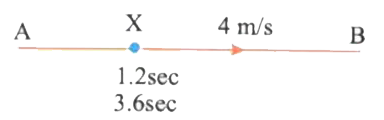
B


`T = 4.8 sec, t = (1.2)/(2) = 0.6 sec = (T)/(8)`
`x =- (A)/(sqrt(2)), (AX)/(XB) = (A-|x|)/(A+|x|)`
Promotional Banner

Topper's Solved these Questions

  • OSCILLATIONS

    NARAYNA|Exercise EXERCISE - III|29 Videos
  • NEWTONS LAWS OF MOTION

    NARAYNA|Exercise PASSAGE TYPE QUESTION|6 Videos
  • PHYSICAL WORLD

    NARAYNA|Exercise C.U.Q|10 Videos

Similar Questions

Explore conceptually related problems

A and B are two points on the path of a particle executing SHM in a straight line, at which its velocity is zero. Starting from a certain point X (AXltBX) the particle crosses this pint again at successive intervals of 2 seconds and 4 seconds with a speed of 5m//s Q. Amplitude of oscillation is

X_(1) and X_(2) are two points on the path of a particle executing SHM in a straight line, at which its velocity is zero. Starting from a certain point X(X_(1)XltX_(2)X) then particle crosses this point again at successive intervals of 2s and 4s with a speed of 5m//s . The time period of SHM is

A particle is executing SHM on a straight line. A and B are two points at which its velocity is zero. It passes through a certain point P(APltBP) at successive intervals of 0.5s and 1.5 s with a speed of 3m/s.

A particle is executing SHM in straight line starting its motion at t_(1)=0 with zero initial phase.It crosses a point during the motion at successive intervals at t_(2)=t and t_(3)=2t with a speed v. If its acceleration amplitude is (2 pi V)/(Nt) then N is equal to

(i) The acceleration (a) of a particle moving along a straight line is related to time (t) as per the differential equation (d^(2)a)/(dt^(2))=-ba. b is a positive constant. Is the particle performing SHM? If yes, what is the time period? (ii) A particle is executing SHM on a straight line. A and B are two points at which its velocity is zero. It passes through a certain point P (AP gt PB) with a speed of 3 m//s at times recorded as t = 0, 0.5 s, 2.0 s, 2.5 s, 4.0 s, 4.5 s......Determine the maximum speed of the particle and also the ratio AP//PB .

A particle moves in a straight line so that its velocity at any point is given by v^(2)=a+bx , where a,b ne 0 are constants. The acceleration is

A particle is executing SHM along a straight line. Its velocities at distances x_(1) and x_(2) from the mean position are v_(1) and v_(2) , respectively. Its time period is

The time taken by a particle performing SHM on a straight line to pass from point A to B where its velocities are same is 2 seconds .After another 2 seconds it return to B The time period of oscillation is (in seconds)

The periodic time of a particle executing a linear S.H.M. is (2pi)/(omega) . If its velocity at a dis"tan"ce b from the mean position is sqrt(3)bomega , then the path length of the particle is

NARAYNA-OSCILLATIONS-EXERCISE - IV
  1. Two particles are executing SHM in a straight line. Amplitude A and th...

    Text Solution

    |

  2. A particle is executing SHM on a straight line. A and B are two points...

    Text Solution

    |

  3. A and B are two points on the path of a particle executing SHM in a st...

    Text Solution

    |

  4. Vertical displacement of a plank with a body of mass 'm' on it is vary...

    Text Solution

    |

  5. A particle performing simple harmonic motion having time period 3 s is...

    Text Solution

    |

  6. The displacement x of a particle in motion is given in terms of time b...

    Text Solution

    |

  7. The potential energy of a particle oscillating on x-axis is given as U...

    Text Solution

    |

  8. A block A of mass m is placed on a frictionless horizontal surface. An...

    Text Solution

    |

  9. Two blocks lie on each other and connected to a spring as shown in fig...

    Text Solution

    |

  10. In the device shown in the figure, the block of mass 20 kg is displace...

    Text Solution

    |

  11. A tray of mass 12 kg is supported by two identical springs as shown in...

    Text Solution

    |

  12. A particle of mass 'm' is attached to three identical springs A,B and ...

    Text Solution

    |

  13. One end of a spring of force constant k is fixed to a vertical wall an...

    Text Solution

    |

  14. The bob of a simple pendulum is displaced from its equilibrium positio...

    Text Solution

    |

  15. A disc of mass M is attached to a horizontal massless spring of force ...

    Text Solution

    |

  16. A block of mass 'm' collides perfectly inelastically with another iden...

    Text Solution

    |

  17. Two identical particles each of mass 0.5kg are interconnected by a lig...

    Text Solution

    |

  18. The kinetic energy of SHM is 1/n time its potential energy. If the amp...

    Text Solution

    |

  19. The potential energy of a particle oscillating along x-axis is given a...

    Text Solution

    |

  20. A uniform cylinder of length (L) and mass (M) having cross sectional a...

    Text Solution

    |

