Home
Class 11
PHYSICS
A block A of mass m is placed on a frict...

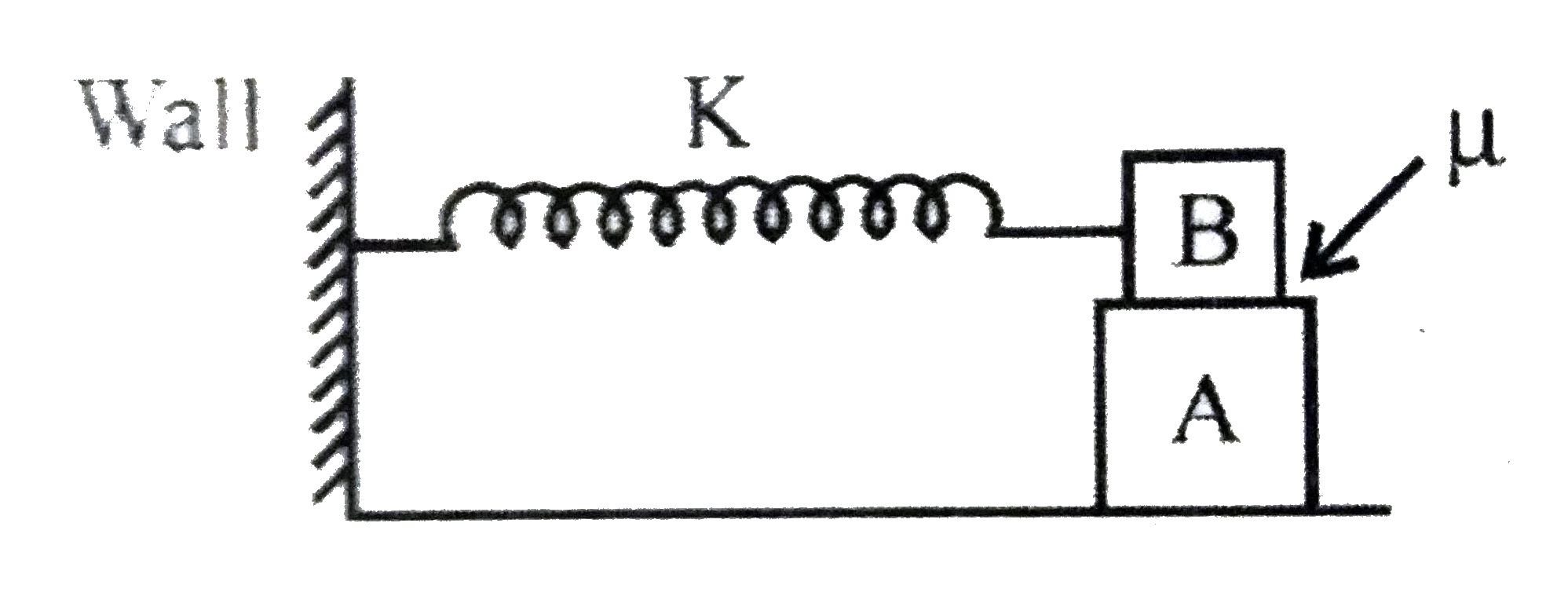
A block A of mass m is placed on a frictionless horizontal surface. Another block B of the same mass is kept on A and connected to the wall with the helpf of a spring of force constant K as shown in the figure. The coefficient of friction between the blocks A and B is `mu`. The blocks move together execting simple harmonic motion of amplitude 'a'. What is the maximum value of the fricitional force between A and B ?

A

KA

B

`(KA)/(2)`

C

zero

D

`mu_(s)` mg

Text Solution

Verified by Experts

The correct Answer is:

B

`kx - f = ma, f = ma`
`kx = 2r, kA = 2 f_(max)`
`rArr f_(max) = (kA)/(2)`
Promotional Banner

Topper's Solved these Questions

  • OSCILLATIONS

    NARAYNA|Exercise EXERCISE - III|29 Videos
  • NEWTONS LAWS OF MOTION

    NARAYNA|Exercise PASSAGE TYPE QUESTION|6 Videos
  • PHYSICAL WORLD

    NARAYNA|Exercise C.U.Q|10 Videos

Similar Questions

Explore conceptually related problems

A long block A is at rest on a smooth horizontal surface. A small block B whose mass is half of mass of A is placed on A at one end and is given an initial velocity u as shown in figure. The coefficient of friction between the blocks is mu .

Two block of masses m1 and m2 are connected with a massless unstretched spring and placed over a plank moving with an acceleration 'a' as shown in figure. The coefficient of friction between the blocks and platform is mu

A block of mass m is moving with a speed v on a horizontal rought surface and collides with a horizontal monted spring of spring constant k as shown in the figure .The coefficient of friction between the block and the floor is mu The maximum cobnpression of the spring is

A block of mass m =1 kg placed on top of another block of mass M = 5 kg is attached to a horizontal spring of force constant K = 20 N/m as shown in figure. The coefficient of friction between the blocks is µ where as the lower block slides on a frictionless surface. The amplitude of oscillation is 0.4 m. What is the minimum value of µ such that the upper block does not slip over the lower block ?

A block of mass m is placed on a rough horizontal surface. If minimum force to pull the block is (mg)/(2) then coefficient of friction is :

A block P of mass m is placed on a smooth horizontal surface. A block Q of the same mass is placed over the block P and the coefficient of static friction between them is mu . A spring of spring constant K is attached to block Q. The blocks are displaced together to a distance A and released. The upper block oscillates without slipping over the lower block. The maximum frictional force between the block is:

A block A of mass m_(1) is placed on a horizontal frictionless table. It is connected to one end of a light spring of force constant k whose other end is fixed to a wall. A small block B of mass m_(2) is placed on block A. The coefficient of static friction between the blocks is mu . The system is displaced slightly from its equilibrium position and released. What is the maximum amplitude of the resulting simple harmonic motion of the system so that the upper block does not slip over the lower block ?

A block of mass m_1 resting on a frictionless horizontal surface is connected to a spring of spring constant k that is anchored in a near by wall. A block of mass m_2 is placed on the top of the first block. The coefficient of static friction between the two blocks is mu Assuming that the two blocks move together as a unit, find the period of oscillation of the system and also find maximum oscillation amplitude that permits the two bodies to move as a unit.

There block A B ,and C of equal mass m are placed one over the other on a frictionless surface (table) as shown in figure The coefficient of friction between any blocks A ,B and C is mu The maximum value of mass of block D so that the blocks A,B and C move without slipping over each other is

A spring, placed horizontally on a rough surface is compressed by a block of mass m, placed on the same surface so as to store maximum energy in the spring. If the coefficient of friction between the block and the surface is mu , the potential energy stored in the spring is

NARAYNA-OSCILLATIONS-EXERCISE - IV
  1. The displacement x of a particle in motion is given in terms of time b...

    Text Solution

    |

  2. The potential energy of a particle oscillating on x-axis is given as U...

    Text Solution

    |

  3. A block A of mass m is placed on a frictionless horizontal surface. An...

    Text Solution

    |

  4. Two blocks lie on each other and connected to a spring as shown in fig...

    Text Solution

    |

  5. In the device shown in the figure, the block of mass 20 kg is displace...

    Text Solution

    |

  6. A tray of mass 12 kg is supported by two identical springs as shown in...

    Text Solution

    |

  7. A particle of mass 'm' is attached to three identical springs A,B and ...

    Text Solution

    |

  8. One end of a spring of force constant k is fixed to a vertical wall an...

    Text Solution

    |

  9. The bob of a simple pendulum is displaced from its equilibrium positio...

    Text Solution

    |

  10. A disc of mass M is attached to a horizontal massless spring of force ...

    Text Solution

    |

  11. A block of mass 'm' collides perfectly inelastically with another iden...

    Text Solution

    |

  12. Two identical particles each of mass 0.5kg are interconnected by a lig...

    Text Solution

    |

  13. The kinetic energy of SHM is 1/n time its potential energy. If the amp...

    Text Solution

    |

  14. The potential energy of a particle oscillating along x-axis is given a...

    Text Solution

    |

  15. A uniform cylinder of length (L) and mass (M) having cross sectional a...

    Text Solution

    |

  16. Time period of a simple pendulum of length L is T(1) and time period o...

    Text Solution

    |

  17. A rod with rectangular cross section oscillates about a horizontal axi...

    Text Solution

    |

  18. In an experiment with bar pendulum having four holes, the same time pe...

    Text Solution

    |

  19. A sphere of radius r is kept on a concave mirror of radius of curation...

    Text Solution

    |

  20. A disc of radius R and mass M is pivoted at the rim and it set for sma...

    Text Solution

    |
