Home
Class 12
CHEMISTRY
Two moles of a perfect gas undergo the f...

Two moles of a perfect gas undergo the following processes:
a. A reversible isobaric expansion from `(1.0 atm, 20.0L)` to `(1.0 atm, 40.0L)`.
b. A reversible isochroic change of state from `(1.0 atm, 40.0L)` to `(0.5 atm, 40.0 L)`
c. A reversible isothermal expansion from `(0.5 atm, 40.0 L) to(1.0 atm, 20.0 L)`.
i. Sketch with lables each of the processes on the same `P -V` diagram.
ii. Calculate the total work `(w)` and the total heat change `(q)` involved in the above process.
iii. What will be the values of `DeltaH` for the overall process?

Text Solution

Verified by Experts
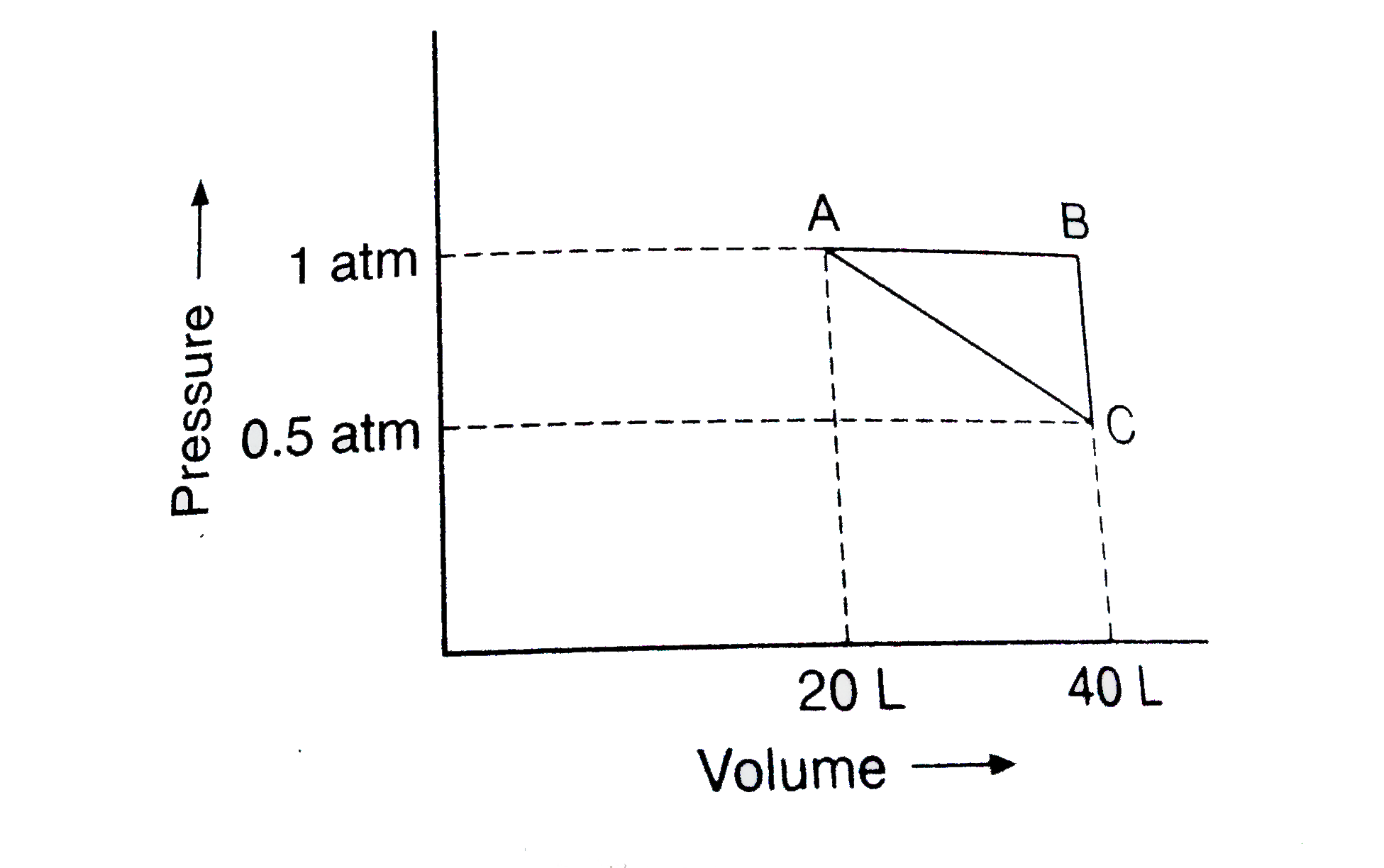
`AB to`Isobaric process
BC`to` Isochoric process
`CA to` Isothermal compression

Total work `=w_(AB)+w_(BC)+w_(CA)` ltbr. `=-PxxDeltaV+0+2.303nRT" log "((V_(2))/(V_(1)))`
`=-1xx20xx101.3+0+2.303xx2xx8.314xxT" log "((40)/(20))` . . .(i)
`PV=nRT` (At A)
`1xx20=2xx0.082xxT`
`T=(20)/(2xx0.0821)=121.8K`
From eq. (i)
Total work=`-2026+2.303xx2xx8.314xx121.8" log "2`
`=-622.06J`
`w=q=-622.06J`
In cyclic process, `DeltaU=0,DeltaH=0 and DeltaS=0`.
Promotional Banner

Topper's Solved these Questions

  • Chemical Thermodynamics and Thermochemistry

    OP TANDON|Exercise Practice problems|81 Videos
  • Chemical Thermodynamics and Thermochemistry

    OP TANDON|Exercise Objective Question Level-A|177 Videos
  • Chemical Thermodynamics and Thermochemistry

    OP TANDON|Exercise Illustrations of Objective Questions|58 Videos
  • CHEMICAL KINETICS

    OP TANDON|Exercise LINKED COMPRESHENSION TYPE QUESTIONS ( SECTION-VI)|4 Videos
  • CLASSIFICATION AND NOMENCLATURE OF ORGANIC COMPOUNDS

    OP TANDON|Exercise INTEGER|2 Videos

Similar Questions

Explore conceptually related problems

Two moles of a perfect gas undergo the following processes: a. A reversible isobaric expansion from (1.0 atm, 20.0L) to (1.0 atm, 40.0L) . b. A reversible isochroic change of state from (1.0 atm, 40.0L) to (0.5 atm, 40.0 L) c. A reversible isothermal expansion from (0.5 atm, 40.0 L) to(1.0 atm, 20.0 L) . i. Sketch with lables each of the processes on the same P -V diagram. ii. Calculate the total work (w) and teh total heat change (q) involved in the above process. iii. What will be the values of DeltaG and DeltaH for the overall process?

Two moles of a perfect gas undergo the following processes: (a) a reversible isobaric expansion from (1.0 atm , 20.0 L) to (1.0 atm, 40.0 L) (b) a reversible isochroic change of state from (1.0 atm , 40.0L) to (0.5 atm , 40.0 L) (c) a reversible isothermal compression from (0.5 atm,40.0 L ) to (1.0atm, 20.0L) Calculate the magnitude of work (W) done in L.atm

Two moles of a perfect gas undergo the following process: (a) A reversible isobaric expansion from ( 1.0 atm, 20.0 litre) to ( 1.0 atm, 40.0 litre). (b) A reversible isochoric change of state from ( 1.0 atm, 40.0 litre) to ( 1.0 atm, 40.0 litre). (b) A reversible isochoric change of state from ( 1.0 atm, 40.0 litre) to ( 0.5 atm, 40.0 litre). (c) A reversible isothermal compression from ( 0.5 atm, 40.0 litre) to ( 1.0 atm, 20.0 litre). (i) Sketch with labels each of the process on the same P-V diagram. (ii) Calculate the total work (W) and the total heat change (q) involved in the above process. (iii) What will be the value of DeltaU, DeltaH and DeltaS for the overall process?

Two moles of an ideal gas undergo the following process : (a) a reversible isobaric expansion from ( P atm, V L) to ( P atm , 2V L) . (b) a reversible isochoric change of state from ( P atm , 2V,L) to (P//2 atm, 2V L) (c ) a reversible isothermal compression from (P//2 atm, 2V L) to (P atm, V L) . Sketch with labels each of the processes on the same P-V diagram.

Maximum heat absorbed during isothermal expansion of an ideal gas from (10 atm, 1 L) to (1 atm, 10 L) is :

One mole of an ideal gas undergoes a change of state (2.0) atm, 3.0 L) to (2.0 atm, 7.0 L) with a change in internal energy (DeltaU) = 30 L-atm. The change in enthalpy (DeltaH) of the process in L-atm :

OP TANDON-Chemical Thermodynamics and Thermochemistry-Miscellaneous Numerical Examples
  1. The standared heat of formation listed for gaseous NH(3) is -11.0kcal ...

    Text Solution

    |

  2. The heat of combusion of glycogen is about 476 kJ mol^(-1) of carbon. ...

    Text Solution

    |

  3. At 25^(@)C, the following heat of formations are given: {:("Compound...

    Text Solution

    |

  4. The 'heat of total cracking' of hydrocarbons DeltaH(TC) is defined as ...

    Text Solution

    |

  5. A constant pressure calorimeter consists of an insulated beaker of mas...

    Text Solution

    |

  6. C(2)H(4) +CI(2) rarr C(2)H(4)CI(2) DeltaH =- 270.6 kJ mol^(-1)K^(-1)...

    Text Solution

    |

  7. Find bond enthalpy of S-S bond from the following data: C(2)H(5)-S-C...

    Text Solution

    |

  8. A natural gas may be assumed to be a mixture of methane and ethane onl...

    Text Solution

    |

  9. From the data at 25^(@)C: Fe(2)O(3)(s) +3C(("graphite")) rarr 2Fe(s)...

    Text Solution

    |

  10. Calculate DeltaH at 85^(@)C for the reaction: Fe(2)O(3)(s) +3H(2)(g)...

    Text Solution

    |

  11. The standard heats of formation at 298K for C Cl(4)(g),H(2)O(g),CO(2)(...

    Text Solution

    |

  12. Calculateq, W, DeltaU and DeltaH for the isothermal reversible expansi...

    Text Solution

    |

  13. A sample of argon gas at 1atm pressure and 27^(@)C expands reversibly ...

    Text Solution

    |

  14. Show that the reaction CO(g) +(1//2)O(2)(g) rarr CO(2)(g) at 300K ...

    Text Solution

    |

  15. Diborane is a potential rocket fuel which undergoes combustion accordi...

    Text Solution

    |

  16. An insulated vessel contains 1mole of a liquid, molar volume 100mL at ...

    Text Solution

    |

  17. In the reaction equilibrium N(2)O(4) hArr 2NO(2)(g) When 5 mol of ...

    Text Solution

    |

  18. When 1pentyne (A) is treated with 4N alcoholic KOH at 175^(@)C, it is ...

    Text Solution

    |

  19. Two moles of a perfect gas undergo the following processes: a. A rev...

    Text Solution

    |

  20. The surface of copper gets tarnished by the formation of copper oxide....

    Text Solution

    |

