Home
Class 12
CHEMISTRY
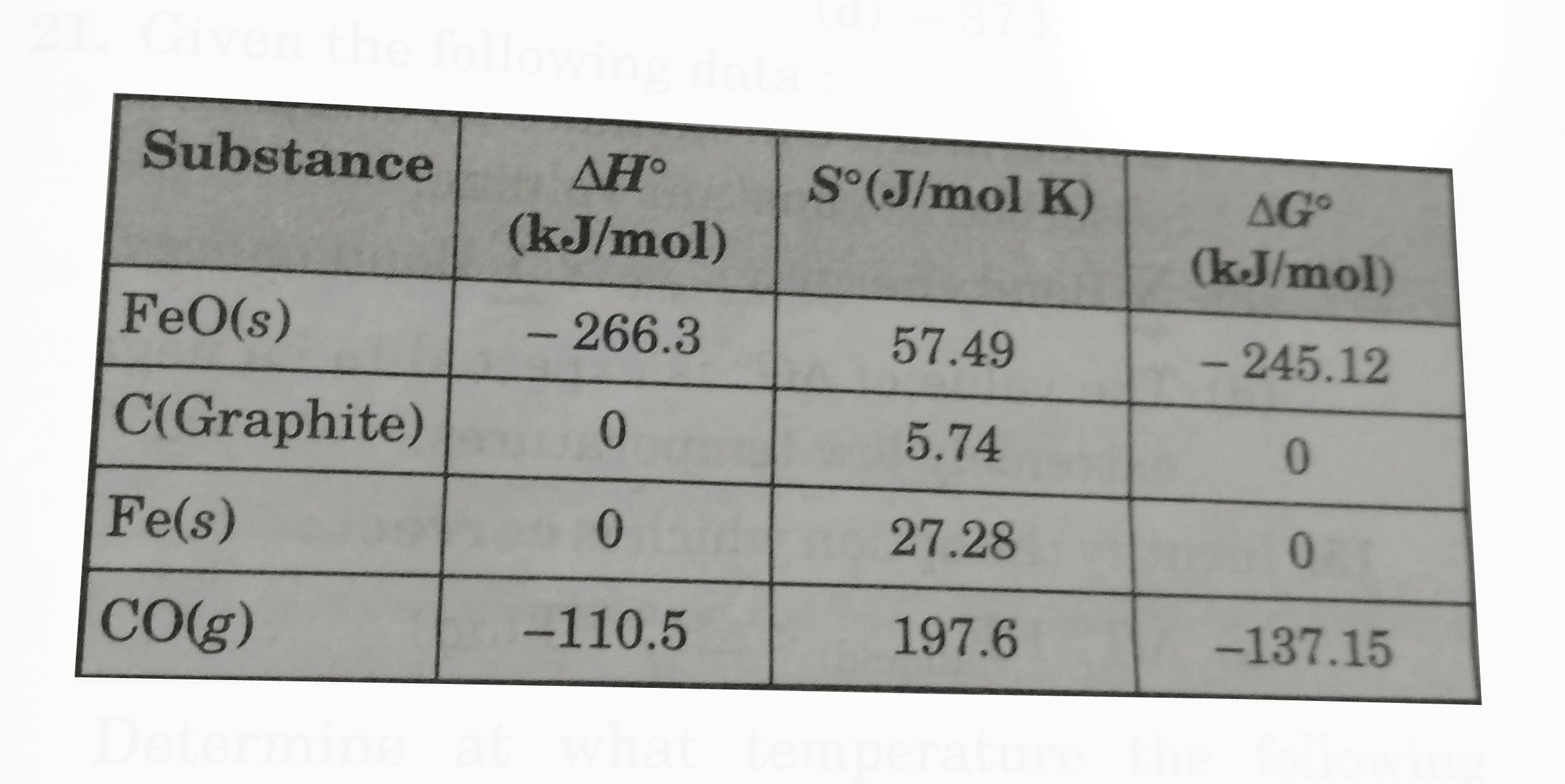
Given the following data : Determin...

Given the following data :

Determine at what temperature the following reaction is spontanous?
`FeO(s)+C_("graphite")toFe(s)+CO(g)`

A

298 K

B

668 K

C

966K

D

`DeltaG^(@)` is +ve, hence the reaction will never be spontaneous.

Text Solution

Verified by Experts

The correct Answer is:

C

`DeltaH_("reaction")=sum{DeltaH_(f" "Fe(s))^(@)+DeltaH_(f" "CO" "(g))^(@)}-{DeltaH_(f" "FeO(s))^(@)+DeltaH_(f" "C("graphite"))^(@)}`
`=(0-110.5)-(-266.3+0)=155.8kJ" "mol^(-1)`
`DeltaS_("reaction")=sum[S_(Fe(s))^(@)+S_(Co(g))^(@)]-[S_(FeO(s))^(@)+S_(C("graphite"))^(@)]`
`=(27.28+197.6)-(57.49+5.74)`
`=161.65JK^(-1)" "mol^(-1)`
For spontaneous reaction, `T gt (DeltaH)/(DeltaS),T gt (155.8xx1000)/(161.65)`
`thereforeT gt 966K`
Promotional Banner

Topper's Solved these Questions

  • Chemical Thermodynamics and Thermochemistry

    OP TANDON|Exercise Objective Question Level B Set II|8 Videos
  • Chemical Thermodynamics and Thermochemistry

    OP TANDON|Exercise Assertion Reason Type Question|29 Videos
  • Chemical Thermodynamics and Thermochemistry

    OP TANDON|Exercise Set 2|18 Videos
  • CHEMICAL KINETICS

    OP TANDON|Exercise LINKED COMPRESHENSION TYPE QUESTIONS ( SECTION-VI)|4 Videos
  • CLASSIFICATION AND NOMENCLATURE OF ORGANIC COMPOUNDS

    OP TANDON|Exercise INTEGER|2 Videos

Similar Questions

Explore conceptually related problems

Given the following data {:("Substance",DeltaH^(@)(KJ//mol),S^(@)(J//mol K),DeltaG^(@)(kJ//mol),),(FeO(s),-266.3,57.49,-245.12,),(C("Graphite"),0,5.74,0,),(Fe(s),0,5.74,0,),(CO(g),-110.5,197.6,-137.15,):} Determine at what temperature the following reaction is spontaneous? FeO(s)+C("Graphite")rarrFe(s)+CO(g)

Given the following data: {:("Substance", DeltaH^(@)"(KJ//mol)", S^(@)"(J//mol K)", DeltaG^(@)"(KJ//mol)"),(FeO(s),-266.3,57.49,-245.12),(C("Graphite"), 0, 5.74, 0),(Fe(s),0,27.28,0),(CO(g),-110.5,197.6,-137.15):} Determine at what temperature the following reaction is spontaneous? " "FeO(S) + C("Graphite") rarr Fe(s) + CO(g)

In which of the following cases, the reaction is spontaneous at all temperatures

Which of the following is//are the rate determining step (s) of the given reaction ? .

At 1250 K 2FeO(s)to2Fe(s)+O_(2)(g) , DeltaG=+320kJmol^(-1) of O_(2) 2C(s)+O_(2)(g)to2CO(g) , DeltaG=-430 kJ mol^(-1) of O_(2) The following coupled reaction is spontaneous because 2FeO(s)+2C(s)to2Fe(s)+2CO(g)

Calculate the temperature above which the reaction of lead oxide to lead in the following reaction become spontaneous. PbO(s) + C(s) rarr Pb(s) + CO(g) Given Delta H = 108.4 kJ mol^(-1), Delta S = 190 JK^(-1) mol^(-1)

Calculate the temperature above which the reduction of lead oxide to lead in the following reaction become spontaneous. PbO(s) + C(s) rightarrow Pb(s) + CO(g) Given Delta H = 118.4 kJ mol^(-1), Delta S = 200 JK^(-1) mol^(-1) .

Which of the following statements is (are) correct about the following reaction ? 2Pbo(s) + C(s) to 2Pb(s) + CO_(2) (g)

OP TANDON-Chemical Thermodynamics and Thermochemistry-Objective Question Level B
  1. For the process NH(3)(g) +HCI(g) rarr NH(4)CI(s)

    Text Solution

    |

  2. A gas is allowed to expand reversibly under adiabatic conditions. What...

    Text Solution

    |

  3. Given the following data : Determine at what temperature the foll...

    Text Solution

    |

  4. Which of the following equations has/have enthalpy changes equal to De...

    Text Solution

    |

  5. The enthalpy change of which reaction corresponds to DeltaH(f)^(@) ...

    Text Solution

    |

  6. Enthalpy is equal to

    Text Solution

    |

  7. When a bomb calorimeter is sued to determine the heat of reaction, whi...

    Text Solution

    |

  8. For the reaction shown , which which is closest to the value o fDelta...

    Text Solution

    |

  9. An ice cube at 0.00^(@)C is placed is 200g of distilled water at 25^(@...

    Text Solution

    |

  10. Which reaction occurs with the greatest increase in entropy?

    Text Solution

    |

  11. The table given below lists the bond dissociation energy (E("diss")) f...

    Text Solution

    |

  12. An ideal gas is taken around the cycle ABCA as shown in P-V diagram. T...

    Text Solution

    |

  13. One gram mole of graphite and diamond were burnt to form CO(2) gas: ...

    Text Solution

    |

  14. Which among the following is not an exact differential?

    Text Solution

    |

  15. A gas expands adiabatically at constant pressure such that: T prop(1...

    Text Solution

    |

  16. 2Zn+O(2)to2ZnO," "DeltaG^(@)=-606J . . . (i) 2Zn+2Sto2ZnS," "D...

    Text Solution

    |

  17. The efficiency of the reversible cycle shown in the given figure is

    Text Solution

    |

  18. IN Haber's process of manufacturing of ammonia : N(2)(g)+3H(2)(g)to2...

    Text Solution

    |

  19. Consider the following statements: I. Change in enthalpy is always s...

    Text Solution

    |

  20. In C(2)H(4) energies of formation of (C=C) and (C-C) are -145 kJ/mol a...

    Text Solution

    |
